The white-eyed duck [1] , or the white-eyed black [2] ( lat. Aythya nyroca ) is a bird of the duck family. The dive got its name for the color of the eyes - the iris of the eyes in the drakes is yellowish-white (from afar it seems white).
| White-eyed dive |
 |
| Scientific classification |
|---|
| No rank : | Bilateral symmetrical |
|
| International Scientific Name |
|---|
Aythya nyroca
( Gueldenstadt , 1770 ) |
| Area |
|---|
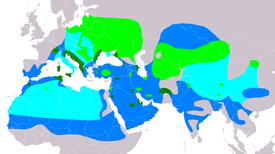 Only nests All year round Migration routes Migration areas |
| Security status |
|---|
Close to VulnerabilityIUCN 3.1 Near Threatened : 22680373 |
|
The Red Book of Russia
the population is declining |
|---|
|
Content
The white-eyed duck is a medium-sized duck weighing from 0.4 to 0.65 kg. The color of adult birds is uniformly brown. In the mating attire, the male has a white belly and chin, brown-red sides, the upper side of the body, as well as brown collars at the base of the neck. There is a white mirror on the wing. The female is paler, and the iris of her eye is brown.
Inhabits reed lakes with open spaces of water. Keeps in pairs or small groups. It flies well and quickly, takes off from the water easier than other blacks. It feeds on aquatic plants, as well as mollusks, aquatic insects and small fish. Often fed at night. It rarely comes ashore.
Voice
The voice of a drake is a soft, hoarse sound, and females are a crackling quack.
Reproduction
Egg
Aythya nyroca -
Toulouse Museum Breeds in separate pairs. A nest is arranged near the water itself, often on heaps of vegetable debris. In clutch 7 - 11 yellowish-white eggs. Elliptical eggs with a size of 52.3 x 38.2 mm [3] . Their mass averages 43 g. Clutch occurs at intervals of one egg per day. Only the female incubates. The incubation period is from 23 to 27 days. Two weeks later, the chicks get on the wing.