Irreducible performance algebraic structure Is a nonzero representation that does not have its own subview closed by .



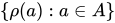
Any finite-dimensional on a Hermitian vector space [1] is the direct sum of irreducible representations. Since irreducible representations are always indecomposable (that is, cannot be further decomposed into the direct sum of representations), these terms are often confused. However, in the general case, there are many reducible but indecomposable representations, such as the two-dimensional representation of real numbers, acting by means of upper triangular unipentent matrices.

Content
History
The representation theory of groups was generalized by Richard Brower in the 1940s, giving a , in which matrix operations act on a vector space over a field with an arbitrary characteristic , and not a vector space over a field of real numbers or over a field of complex numbers . A structure similar to the irreducible representation in the resulting theory is a simple module .
Overview
Let be will be a representation, i.e. a homomorphism groups where is the vector space above the field . If we choose a basis for , can be considered a function (homomorphism) from a group to a set of invertible matrices, and in this context, a representation is called a matrix representation . However, everything is greatly simplified if we consider the space without basis.
Linear subspace called -invariant if for all and all . narrowing on -invariant subspace known as subview . They say that performance irreducible if it has only trivial subviews (all representations can form a subview with trivial -invariant subviews, for example, with the whole vector space and {0} ). If there exists a proper nontrivial invariant subspace They say the view is reducible .
Group designations and terminology
Elements of a group can be represented by matrices , although the term “represented” has a specific and precise meaning in this context. A group view is a mapping from the elements of a group to a complete linear group of matrices. Let a , b , c ... denote elements of the group G with a group product that is not reflected by any symbol, that is, ab is the group product of a and b , which is also an element of the group G. Let representations be denoted by the letter D. The representation of a is written as
By definition of group representations, the representation of a group product is translated into the multiplication of the representation matrices :
If e is a neutral element of the group (so that ), then D ( e ) is the identity matrix , since we must have
and the same for the other elements of the group. The last two statements correspond to the requirement that D be a group homomorphism .
Decomposable and indecomposable representations
The representation is decomposable if a similar matrix P can be found for the similarity transformation [2] :
- ,
which diagonalizes any matrix in the presentation into diagonal blocks - each of the blocks is a group representation independently of each other. It is said that the representations D ( a ) and D ′ ( a ) are equivalent [3] . A representation can be decomposed into a direct sum of k matrices :
- ,
so that D ( a ) is decomposable and usually labels on decomposition matrices are written in brackets, like D ( n ) ( a ) for n = 1, 2, ..., k , although some authors write numerical labels without brackets.
The dimension D ( a ) is equal to the sum of the dimensions of the blocks:
If this is not possible, that is , then the representation is indecomposable [2] [4] .
Examples of irreducible representations
Trivial Presentation
All groups have a one-dimensional irreducible trivial representation. More generally, any one-dimensional representation is irreducible due to the absence of its own nontrivial subspaces.
Irreducible Integrated Representations
Irreducible complex representations of a finite group G can be described using results from character theory . In particular, all such representations are decomposable into a direct sum of irreducible representations and the number of irreducible representations of the group equal to the number of conjugacy classes [5] .
- Irreducible complex representations exactly defined by the mappings where is an th root of unity .
- Let be will be -dimensional integrated representation with basis . Then decomposes as a direct sum of irreducible representations
- and the orthogonal subspace is given by the formula:
- The first irreducible representation is one-dimensional and isomorphic to the trivial representation . Second is dimensional and known as standard representation [5] .
- Let be - Group. group is a free complex vector space with basis with group action denoted by All irreducible representations appear in decomposition as a direct sum of irreducible representations.
Applications in Theoretical Physics and Chemistry
In quantum mechanics and quantum chemistry, each set of degenerate eigenstates of a Hamiltonian operator constitutes a vector space V to represent the symmetry group of the Hamiltonian, a “multiplet” that is best studied through reduction to irreducible parts. The notation of irreducible representations therefore allows us to assign labels to states and to predict how they upon perturbation or go into another state in V. Thus, in quantum mechanics, the irreducible representations of the symmetry group of the system partially or completely determine the labels for the energy levels of the system, which allows us to determine the selection rules [6] .
Lee Groups
Lorentz Group
The irreducible representations D ( K ) and D ( J ) , where J is a generator of rotations and K is a generator of boosts , can be used to construct the of the Lorentz group , since they are related to quantum mechanics . This allows us to use them to derive [7] .
See also
Associative Algebra
- Simple module
- Indecomposable module
Lee Groups
- Representation of Lie Algebra
Notes
- ↑ Definition A finite-dimensional vector space over a field C equipped with a positive definite Hermitian form is called a Hermitian space ( Nikitin 2010 ), ( Timofeeva 2017 )
- ↑ 1 2 Wigner, 1959 , p. 73.
- ↑ Tung, 1985 , p. 32.
- ↑ Tung, 1985 , p. 33.
- ↑ 1 2 Serre, 1977 .
- ↑ A Dictionary of Chemistry, Answers.com . Oxford Dictionary of Chemistry.
- ↑ Jaroszewicz, Kurzepa, 1992 , p. 226-267.
Literature
- N.D. Nikitin. ALGEBRA AND THEORY OF NUMBERS. - Penza, 2010.
- N.V. Timofeeva. Linear algebra. Modern algebra. Part 2. - Yaroslavl: Yaroslavl State University, 2017 .-- P. 52. - ISBN 978-5-8397-1118-1 .
- Wigner EP Group theory and its application to the quantum mechanics of atomic spectra. - Academic press, 1959. - (Pure and applied physics).
- Tung WK Group Theory in Physics . - World Scientific, 1985. - ISBN 978-997-1966-560 .
- Jean-Pierre Serre. Linear Representations of Finite Groups. - Springer-Verlag, 1977 .-- ISBN 978-0387901909 .
- Tung WK Group Theory in Physics . - World Scientific, 1985. - S. 32. - ISBN 978-997-1966-560 .
- T. Jaroszewicz, PS Kurzepa. Geometry of spacetime propagation of spinning particles // Annals of Physics. - 1992. - T. 216 , no. 2 . - S. 226–267 . - DOI : 10.1016 / 0003-4916 (92) 90176-M . - .
Books
- H. Weyl . The theory of groups and quantum mechanics . - Courier Dover Publications, 1950 .-- S. 203. - ISBN 978048660269.
- Boardman AD, O'Conner DE, Young PA Symmetry and its applications in science. - McGraw Hill, 1973. - ISBN 978-0-07-084011-9 .
- Heine V. Group theory in quantum mechanics: an introduction to its present usage . - Dover, 2007 .-- ISBN 978-0-07-084011-9 .
- Heine V. Group Theory in Quantum Mechanics: An Introduction to Its Present Usage . - Courier Dover Publications, 1993 .-- ISBN 978-048-6675-855 .
- Abers E. Quantum Mechanics. - Addison Wesley, 2004 .-- S. 425. - ISBN 978-0-13-146100-0 .
- Martin BR, Shaw G. Particle Physics. - 3rd. - Manchester Physics Series, John Wiley & Sons. - S. 3. - ISBN 978-0-470-03294-7 .
- Weinberg S. The Quantum Theory of Fields. - Cambridge University Press, 1995. - T. 1. - S. 230–231. - ISBN 978-0-521-55001-7 .
- Weinberg S. The Quantum Theory of Fields. - Cambridge University Press, 1996. - T. 2. - ISBN 978-0-521-55002-4 .
- Weinberg S. The Quantum Theory of Fields. - Cambridge university press, 2000. - T. 3. - ISBN 978-0-521-66000-6 .
- Penrose R. The Road to Reality. - Vintage books, 2007. - ISBN 978-0-679-77631-4 .
- Atkins PW Molecular Quantum Mechanics (Parts 1 and 2): An introduction to quantum chemistry. - Oxford University Press, 1970. - T. 1. - S. 125–126. - ISBN 978-0-19-855129-4 .
Articles
- Bargmann V., Wigner EP Group theoretical discussion of relativistic wave equations // Proc. Natl. Acad. Sci. USA - 1948. - T. 34 , no. 5 . - S. 211–23 . - DOI : 10.1073 / pnas . 34.5.211 . - . - PMID 16578292 .
- Wigner E. On Unitary Representations Of The Inhomogeneous Lorentz Group // Annals of Mathematics. - 1937. - T. 40 , No. 1 . - S. 149 . - DOI : 10.2307 / 1968551 . - .
Further Reading
- Artin, Michael Noncommutative Rings (1999).
Links
- Commission on Mathematical and Theoretical Crystallography, Summer Schools on Mathematical Crystallography .
- Some notes on group theory (2012).
- Representation Theory (2005).
- Some Notes on Young Tableaux as useful for irreps of su (n) . (inaccessible link)
- Irreducible Representation (IR) Symmetry Labels (2008).
- Representations of Lorentz Group (2008).
- Representations of Lorentz and Poincaré groups (2007).
- Quantum Mechanics for Mathematicians: Representations of the Lorentz Group (2015). see chapter 40
- Representations of the Symmetry Group of Spacetime (2009).
- Lie Algebra for the Poincaré, and Lorentz, Groups . Archived on June 17, 2012.
- Bekaert, Xavier & Boulanger, Niclas (2006), "The unitary representations of the Poincaré group in any spacetime dimension", arΧiv : hep-th / 0611263