Clever Geek Handbook
📜 ⬆️ ⬇️

Sordes

Sordes [2] ( lat. Sordes ) is a genus of small pterosaurs from the family Rhamphorhynchidae , the fossil remains of which were found in the Karabastau suite , Kazakhstan . Inhabited in the upper Jurassic period ( Oxford - Kimmeridge centuries).

† Sordes
Sordes pilosus skeleton.JPG
Skeleton of Sordes from the Paleontological Museum. Yu. A. Orlova
Scientific classification
Domain:Eukaryotes
Kingdom:Animals
Kingdom :Eumetazoi
No rank :Bilateral symmetrical
No rank :Secondary
Type of:Chordate
Subtype :Vertebrates
Infratype :Maxillary
Overclass :Tetrapods
Grade:Reptiles
Subclass :Diapsids
Infraclass :Archosauromorphs
No rank :Archosauriformes
No rank :Archosaurs
Treasure :† Ornithodirs
Treasure :† Pterosaurromorphs ( Pterosauromorpha Padian, 1997 )
Squad:† Pterosaurs
Treasure :† Novialoidea
Family:† Rhamphorhynchidae
Subfamily :† Scaphognathinae
Gender:† Sordes
International scientific name

Sordes Sharov , 1971

The only view [1]
† Sordes pilosus Sharov, 1971
Geochronology
161.2-150.8 Ma
million yearsPeriodEraAeon
2,588Even
KaF
but
n
e
R
about
s
about
th
23.03Neogene
66.0Paleogen
145.5a piece of chalkM
e
s
about
s
about
th
199.6Yura
251Triassic
299PermianP
but
l
e
about
s
about
th
359.2Carbon
416Devonian
443.7Silur
488.3Ordovician
542Cambrian
4570Precambrian
◄
Nowadays
◄
Cretaceous-Paleogene extinction
◄
Triassic extinction
◄
Mass Permian Extinction
◄
Devonian extinction
◄
Ordovician-Silurian extinction
◄
Cambrian explosion

Title

The genus was named in 1971 by Alexander Grigorievich Sharov [3] . The only species is Sordes pilosus . The genus name means “evil spirits” in Latin , and the species name means “hairy”. Despite the grammatical word sordes being feminine, the species name was not corrected for pilosa .
Description

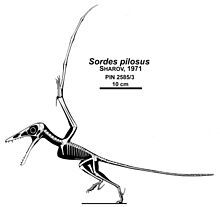
Reconstruction of the skeleton of S. pilosus , holotype PIN 2585/3

Sordes had a wingspan of 0.63 meters. The wings were relatively short. According to Sharov and Anvin, sordes had leathery membranes extending from the wings to the legs, and the same membranes between the legs. The neck is short. The tail is long, more than twice as long as the body, with an elongated lobe at the tip.

Skull and Teeth

Sordes had a thin, not round head with moderately long pointed jaws. Unlike many pterosaurs, he did not have a crest. The teeth in the front of the jaw were large, adapted to capture prey. In the depths of the mouth, the teeth were smaller and more numerous, adapted to crush the solid parts of food. Two different types of teeth indicate a specialization for catching prey, which was difficult not only to catch, but also to eat. Sordes probably hunted invertebrates with a solid exoskeleton or slippery amphibians that needed to be nibbled before being swallowed [4] .

Hairline

 
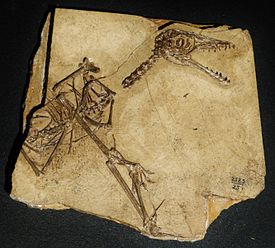
Holotype Sample

Fossil samples contain the remains of soft tissues, such as leathery membranes and hair filaments. The presence of hair indicates the warm-bloodedness of the animal, as well as the greater streamlining of the body during flight. The hair strands were of two types: long on the far side of the wings and short near the body. In the 1990s, David Anvin claimed that both types were essentially not hairs, but reinforced fibers on leathery membranes. He later emphasized that the “hair” was indeed present on the body of the Sordes, as later findings clearly indicated this.

Opening

The genus is based on the holotype PIN 2585/3, an almost complete damaged skeleton on a stone slab. It was found in the 1960s in the foothills of Karatau in Kazakhstan .

Sharov attributed to the Sordes family the paratype , or the second sample, PIN 2470/1 - again, a fairly complete skeleton on the plate. By 2003, six more specimens were discovered.

Classification

Sordes was assigned to the Rhamphorhynchidae family. These were one of the earliest pterosaurs that developed in the Late Triassic and survived to the end of the Jurassic period . According to Anvin, sordes, within the family Rhamphorhynchidae belonged to the subfamily Scaphognathinae . Other researchers, such as Alexander Kellner, after conducting a cladistic analysis, classify sordes as more basal (primitive) pterosaurs.
See also

  • Pterosaur list
  • Phylogeny of pterosaurs

Notes

  1. ↑ † Sordes information on the Fossilworks website. (Retrieved March 14, 2016)
  2. ↑ Averyanov A.O. Fossil vertebrates of Russia and neighboring countries. Fossil reptiles and birds. Part 2 / Kurochkin E.N. , Lopatin A.V. - M .: GEOS, 2012. - T. 2. - S. 337. - 419 (154 fig., 26 phototables.) P. - ISBN 978-5-89118-594-4 .
  3. ↑ Sharov, A.G. 1971 New flying reptiles from the Mesozoic of Kazakhstan and Kyrgyzstan. Proceedings Pal. inst. Moscow .
  4. ↑ Sordes (neopr.) . Prehistoric Wildlife . Date of treatment January 31, 2015.

Links

  • Artistic reconstruction of a Sordes pilosus at the Fossilsmith Studios
  • A fossil of a Sordes at paleo.ru
  • Article and picture of Sordes
Source - https://ru.wikipedia.org/w/index.php?title=Sordes&oldid=100321025


More articles:

  • Toguzov, Gazak Ilasovich
  • Baron Palmer
  • Goli (Slonim District)
  • Novoaleksandrovka (Chanovsky district)
  • Bikes (Slonim District)
  • Evdokimov-Vogak, Rostislav Borisovich
  • Averino (Voronezh region)
  • Foodsharing.de
  • Men's European Water Polo Championship 1989
  • Colombia Futsal Team

All articles

Clever Geek | 2019