Cave nightlight [1] ( lat. Myotis velifer ) is a species of North American bats of the genus nightlight ( Myotis ) of the family smooth-billed bats ( Vespertilionidae ).
| Cave night |
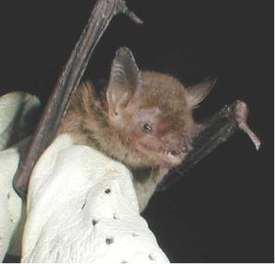
In the Sonora area ( USA ). |
| Scientific classification |
|---|
| No rank : | Bilateral symmetrical |
| Superfamily : | Vespertilionoidea |
|
| International scientific name |
|---|
Myotis velifer ( Allen , 1890) |
| Area |
|---|

|
| Security status |
|---|
Least ConcernedIUCN 3.1 Least Concern : 14208 |
|
Body length on average 99.5 mm, body weight about 12 g. It differs morphologically from fringed nightlight ( Myotis thysanodes ) with a more pronounced sagittal crest . The color of the fur varies from light brown to black-brown.
The species is common in countries: Belize, El Salvador, Guatemala, Honduras, Mexico, USA (Arizona, California, Kansas, Nevada, New Mexico, Oklahoma, Texas). It occurs from the lowlands to 3300 m above sea level. This species is commonly found in evergreen pine or oak forests and in coastal areas near a desert shrub. Colonies number from 50 to 15,000 individuals.
This species of bats leaves the shelter shortly after sunset and flies directly to the water to drink before feeding. As a rule, it eats just above vegetation, with fast, direct flight. Foods include bugs, flying ants and butterflies. Some northern populations remain wintering, others migrate.