Refraction of sound - the phenomenon of changing the direction of propagation of sound.
Occurs when sound passes from one medium to another. In this case, the sound , generally speaking, is refracted, that is, it changes the direction of its initial propagation. A necessary condition for refraction is the difference in sound propagation velocities in both media. The law of refraction of sound is the same as for light:
- ,
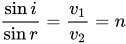
that is, that the ratio of the sines of the angles of incidence and refraction, equal to the ratio of the propagation velocities in the first and second media, is therefore a constant value. It is called the refractive index. The first experiments on the refraction of sound were made by Sondhauss (Sondhauss, 1852). If you build biconvex lentils from elastic membranes (bubble, collodion or rubber) attached to the hoop and fill it with carbon dioxide, it will collect sound (for example from a pocket watch) at one point (focus), just like glass lentils collect light rays. You can arrange acoustic lentils even differently (N. Gezehus, 1890). If you fill a hemispherical thin metal mesh (fine mesh is always on sale) with fluff, cotton or some shavings, covering it with a flat mesh, then such a flat-convex lentil will also collect sound due to the fact that the speed of sound propagation in it will be slowed down compared to the speed sound in free air. Therefore, having placed a sound source (pocket watch or whistle) on one side of the lentil, we will be able to find the focus position on the other side either directly with the ear or with a sensitive flame. Knowing the distance of the sound source and the focus of the acoustic center of the lentils, we can calculate the refractive index, and therefore the speed of sound in the lentils. Hajech (1857) investigated the refraction of sound in different gases and in water through an acoustic prism. A pipe was inserted into the wall separating the two rooms, the ends of which were covered by membranes, which made up a certain angle between themselves. The tube was filled with the test gas or liquid and the direction in which the sound passing through the tube was heard best was determined. Experiments on the refraction of sound were also carried out by Neyrenef (1894), Perrault and Dussault (1895), etc.
Literature
- N.P. Sluginov. "Acoustics".
- O. D. Hvolson. "The course of physics." 2nd volume
- Refraction of sound // Brockhaus and Efron Encyclopedic Dictionary : in 86 volumes (82 volumes and 4 additional). - SPb. , 1890-1907.