Zuni is an American unguided air-to-ground missile.
| Zuni | |
|---|---|
 Launch from the A-4F | |
| Type of | unguided tactical missile |
| Status | in service |
| Developer |  |
| Years of development | 1951-1957 |
| Adoption | 1957 |
| Manufacturer | |
| Years of production | 1957 |
| Units produced | > 225 |
| Unit cost | 150 USD (1957) [1] |
| Years of operation | 1957 - present |
| Main operators | US Armed Forces |
| Key Specifications | |
Range - 8 km Speed - 2600 km / h (720 m / s) | |
| ↓ All specifications | |
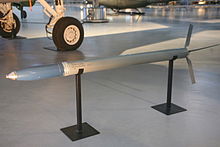

It was developed in the 1950s by Douglas and Sperry corporations together with the engineers of the China Lake Arms Test Station , and in 1957 it was adopted by the US Navy and Air Force . Missiles were armed with carrier-based F-89 , F-4 fighters, as well as all types of attack aircraft. Intended to destroy small-sized ground and surface targets (tanks, small ships, art. Batteries). It can be equipped with various types of warheads . The cumulative fragmentation warhead pierces armor about 500 mm thick.
The maximum range of an aimed shot is 8 km. The stabilization of the rocket in flight is provided by rotation. For use with missiles, the LAU-10 launcher is proposed, it has four tubular guides in which the missiles are placed.
Widely used during the Vietnam War .
The modified missile is in service today.
Content
Incidents
A fire caused by self-launching a rocket that occurred on July 29, 1967 at about 10:50 local time in the Gulf of Tonkin on board the Forrestol aircraft carrier.
According to the official conclusion, the fire began after the spontaneous launch of the Zuni unguided rocket under the influence of an accidental surge in the circuits of one of the F-4 Phantom aircraft that were on deck. The plane was preparing to strike at Vietnam during the US participation in the Vietnam War (1965-1973).
The incident killed 134 and injured 161 people. Material damage amounted to $ 75 million ($ 509 million in current prices), not counting the cost of burned aircraft [2] [3] .
TTX
| External Images | |
|---|---|
| NAR samples at the WIS aeroballistic laboratory (1957) | |
- Projectile caliber: 127 mm
- Projectile length: 2790 mm
- Projectile weight: 46.3-61.6 kg, depending on the warhead and engine type (25.6 / 31.0 / 36.0 kg)
- The mass of the warhead: 20.7-25.6 kg, depending on the destination.
- Type of warhead: high-explosive, high-explosive, armor-piercing, lighting, smoke, dipole reflectors, practical
- The highest velocity of the projectile: 725 m / s
- Firing Range: 8000-9000 m
- The number of guides of the launcher: 1-4
Notes
- ↑ Jet Propulsion News . // Journal of Jet Propulsion . - 1957. - Vol. 27 - No. 5 - P. 556.
- ↑ Stewart, Henry P. LCDR USN . The Impact of the USS Forrestal's 1967 Fire on United States Navy Shipboard Damage Control ( journal ) : journal. - Army Command and General Staff College, Fort Leavenworth, KS, 2004. - Vol. Master's Thesis, Master of Military Art & Science, Military History .
- ↑ US Navy. Damage control museum. USS Forrestal (CVA 59) Archived on October 6, 2009. .
Literature
- NOTS Converts Ideas Into Missiles . // Aviation Week , June 3, 1957, v. 66, no. 22, p. 148-153.