
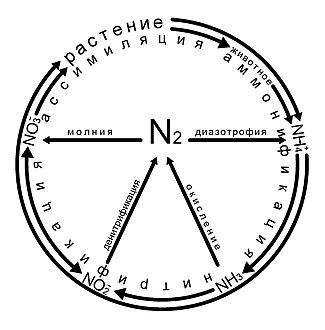
The nitrogen cycle is the biogeochemical cycle of nitrogen . Most of it is due to the action of living beings. Soil microorganisms play a very important role in the cycle, providing nitrogen exchange of the soil - the nitrogen cycle in the soil, which is present there in the form of a simple substance (gas - N 2 ) and ions: nitrites (NO 2 -), nitrates (NO 3 -) and ammonium (NH 4 +). The concentrations of these ions reflect the state of soil communities, since the state of biota (plants, microflora), the state of the atmosphere , and leaching of various substances from the soil affect these indicators. They are able to reduce the concentration of nitrogen-containing substances that are harmful to other living organisms. They can convert ammonia toxic to living things into less toxic nitrates and biologically inert atmospheric nitrogen. Thus, the microflora of the soil helps maintain the stability of its chemical indicators.
Content
The role of soil microorganisms in the nitrogen cycle
Nitrogen Fixation
Nitrogen reserves in nature are very large. The total content of this element in organisms is more than 25 billion tons, a large amount of nitrogen is also found in the soil . In air, nitrogen is present as N 2 gas. However, nitrogen gas, whose content in the atmosphere reaches 78% by volume, eukaryotes cannot assimilate by themselves. A unique ability to convert N 2 to nitrogen-containing compounds is possessed by some bacteria, which are called nitrogen-fixing, or nitrogen-fixing. Nitrogen fixation is possible by many bacteria and cyanobacteria . They live either in soil, or in symbiosis with plants, or with several species of animals.
For example, the legume family (Fabaceae) contains such bacteria on its roots . A typical representative of free-living nitrogen-fixing microorganisms is Azotobacter , a gram-negative bacterium that binds air nitrogen. Nitrogen fixation products are ammonia ( NH 3 ), nitrites .
Nitrification
Nitrogen in the form of ammonia and ammonium compounds obtained in the processes of biogenic nitrogen fixation is rapidly oxidized to nitrates and nitrites. This process is called nitrification, it is carried out by nitrifying bacteria. However, there is no bacterium that directly converts ammonia to nitrate. Two groups of bacteria always participate in its oxidation: some oxidize ammonia to form nitrite, while others oxidize nitrite to nitrate. The most famous types of nitrifying bacteria are Nitrosomonas and Nitrobacter.
Nitrosomonas oxidizes ammonia:
- NH 3 + 1½ O 2 = (NO 2 -) + 2H + + H 2 O
Nitrobacter oxidize nitrite:
- (NO 2 -) + ½ O 2 = NO 3 -
Ammonia oxidizing bacteria provide a substrate for nitrite oxidizing bacteria. Since high concentrations of ammonia have a toxic effect on Nitrobacter, Nitrosomonas, using ammonia and forming acid, thereby improves the living conditions for Nitrobacter.
Nitrificators are gram-negative bacteria belonging to the Nitrobacteracea family. They do not need reduced carbon compounds for normal growth and reproduction, they are able to reduce CO 2 to organic compounds using the oxidation energy of mineral nitrogen compounds: ammonia and nitrites. That is, nitrifying agents are bacteria that are able to feed exclusively on inorganic compounds and carry out the process of chemosynthesis, the synthesis of organic compounds from minerals. Chemosynthesis is a way of assimilation of inorganic carbon by living creatures, an alternative to photosynthesis .
Plants use nitrates to form various organic substances. Animals consume vegetable proteins, amino acids, and other nitrogen-containing substances with food. Thus, plants make organic nitrogen available to other consumer organisms.
All living organisms supply nitrogen to the environment. On the one hand, all of them emit products of nitrogen metabolism during the course of their life: ammonia, urea and uric acid. The last two compounds decompose in the soil to form ammonia (which when dissolved in water gives ammonium ions).
Ammonification
Uric acid secreted by birds and reptiles is also rapidly mineralized by special groups of microorganisms with the formation of NH 3 and CO 2 .
On the other hand, nitrogen, included in the composition of living beings, undergoes ammonification after their death (decomposition of nitrogen-containing complex compounds with the release of ammonia and ammonium ions (NH 4 + )) and nitrification.
Denitrification
The nitrification products - NO 3 - and (NO 2 -) are subsequently denitrified. This process is entirely due to the activity of denitrifying bacteria, which have the ability to reduce nitrate through nitrite to gaseous nitrous oxide (N 2 O) and nitrogen (N 2 ). These gases freely enter the atmosphere.
- 10 [H] + 2 H + + 2NO 3 - = N 2 + 6 H 2 O
In the absence of oxygen, nitrate serves as the ultimate hydrogen acceptor.
The ability to receive energy by using nitrate as the ultimate hydrogen acceptor to form a nitrogen molecule is widespread in bacteria.
Temporary nitrogen loss in limited soil areas is undoubtedly associated with the activity of denitrifying bacteria.
Thus, the nitrogen cycle is impossible without the participation of soil microflora.
Assimilation
Assimilable nitrogen compounds can accumulate in soil in an inorganic form (nitrate) or can be incorporated into a living organism as organic nitrogen . Assimilation and mineralization determines the absorption of nitrogen compounds from the soil, their combination into plant biomolecules and conversion to inorganic nitrogen after the death of plants, respectively. Assimilation is the conversion of inorganic nitrogen (such as nitrate) to the organic form of nitrogen, such as amino acids . With the help of enzymes, nitrate is first converted to nitrite ( nitrate reductase ), then to ammonia ( nitrite reductase ). Ammonia is a part of amino acids.
Factors affecting the nitrogen cycle in anthropogenic biocenoses
In the absence of human activity, the processes of nitrogen binding and nitrification are almost completely balanced by the opposite denitrification reactions. Part of the nitrogen enters the atmosphere from the mantle with volcanic eruptions, part is firmly fixed in soils and clay minerals, in addition, nitrogen is constantly leaking from the upper atmosphere to the interplanetary space. But at present, many factors caused by man influence the nitrogen cycle.
Firstly, it is acid rain , a phenomenon in which the pH of rainfall and snow decreases due to air pollution by acid oxides (for example, nitrogen oxides). The chemistry of this phenomenon is as follows. To burn fossil fuels, air or a mixture of fuel and air is supplied to internal combustion engines and boilers. Almost 4/5 of the air consists of nitrogen gas and 1/5 of oxygen . At high temperatures created inside the plants, the reaction of nitrogen with oxygen inevitably occurs and nitric oxide is formed:
- N 2 + O 2 = 2NO - Q
This reaction is endothermic and in vivo occurs during lightning discharges, and also accompanies other similar magnetic phenomena in the atmosphere. Nowadays, a person as a result of his activities greatly increases the accumulation of nitric oxide (II) on the planet.
Nitric oxide (II) is easily oxidized to nitric oxide (IV) under normal conditions:
- 2NO + O 2 = 2NO 2
Next, nitric oxide reacts with atmospheric water to form acids:
- 2NO 2 + H 2 O = HNO 3 + HNO 2
nitric and nitrous acids are formed . In droplets of atmospheric water, these acids dissociate with the formation, respectively, of nitrate and nitrite ions, and the ions fall into the soil with acid rain.
The second group of anthropogenic factors affecting the nitrogen exchange of soils is technological emissions. Nitrogen oxides are one of the most common air pollutants. A steady increase in the production of ammonia, sulfuric and nitric acid is directly associated with an increase in the volume of exhaust gases, and therefore with an increase in the amount of nitrogen oxides emitted into the atmosphere. The third group of factors is soil fertilization with nitrites, nitrates ( nitrate ) and organic fertilizers.
And finally, an increased level of biological pollution negatively affects the nitrogen exchange of soils. Its possible causes: wastewater discharge, non-compliance with sanitary standards (dog walking, uncontrolled landfills of organic waste, poor functioning of sewer systems, etc.). As a result, the soil is contaminated with ammonia, ammonium salts, urea , indole, mercaptans and other decomposition products of organics. An additional amount of ammonia is formed in the soil, which is then processed by bacteria into nitrates.
The relevance of the study of the nitrogen cycle in anthropogenic biocenoses
Between the lithosphere , hydrosphere , atmosphere and living organisms of the Earth, an exchange of chemical elements constantly occurs. This process has a cyclical nature: moving from one sphere to another, the elements again return to their original state.
Anthropogenic biocenoses are special natural communities formed under the direct influence of a person who himself can create new landscapes and seriously change the ecological balance. In addition, human activity has a huge impact on the cycle of elements. It has become especially noticeable in the last century, because there have been serious changes in the natural cycles due to the addition or removal of chemicals present in them as a result of human-induced effects.
Nitrogen is an element necessary for the existence of animals and plants, it is a part of proteins , amino acids , nucleic acids , chlorophyll , gems, etc. In this regard, a significant amount of bound nitrogen is found in living organisms, “dead organics” and dispersed matter of the seas and oceans.
It is very important to study and control the nitrogen cycle, especially in anthropogenic biocenoses, because a small malfunction in any part of the cycle can lead to serious consequences: severe chemical pollution of soils, overgrowing of water bodies and pollution by their decomposition products of dead organics (ammonia, amines , etc.). ), a high content of soluble nitrogen compounds in drinking water.
To study the features of the nitrogen cycle, you can use a comprehensive technique to study the content of nitrite ions (NO 2 -), nitrates (NO 3 -) and ammonium (NH 4 +) in the soil and its microbiological parameters.
See also
- Nitrogen
- Category: Nitrogen Compounds ;
- Nitrogen oxides ;
- Ammonia
- Nitric acid ;
- Nitrates .
- Microbiological soil analysis .
Literature
- Biological Encyclopedic Dictionary / chapters. ed. M.S. Gilyarov. - M.: Soviet Encyclopedia, 1986.- 831 p.
- Odum Yu. Ecology: In 2 volumes / trans. from English - M.:. Mir, 1986. - T. 1. - S. 205-209.
- Hoult J. A Brief Identifier of Bergi Bacteria. M.: Mir, 1980, 496 p.
- Shilov I.A. Ecology. - M.: Higher School, 1997. - S. 50-51.
- Schlegel G. General Microbiology. M .: Mir, 1987, 567 p.