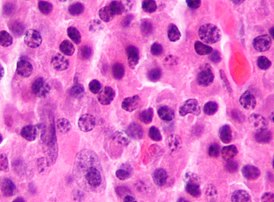
Hemoblastosis ( lat. Haemoblastosis ; other Greek. Αἷμα “blood” + βλαστός germ, germ + -osis) - tumor (neoplastic) diseases of the blood-forming and lymphatic tissue.
| Hemoblastosis | |
|---|---|
 | |
| ICD-10 | C 81. - C 96. |
| ICD-9 | 200 - 208 |
| ICD-O | 9590-9999 |
| Mesh | D019337 |
Hemoblastoses are divided into systemic diseases - leukemia , as well as regional - lymphomas .
The differences between leukemia and lymphomas are not only in the presence or absence of systemic lesions. In the terminal stage, lymphomas give extensive metastases, including to the bone marrow. But with leukemia, the bone marrow is affected primarily, and with lymphomas, it is secondary as a result of metastasis. With leukemia, tumor cells, as a rule, are found in the blood, therefore, the term used to refer to leukemia, proposed by R. Virchow - “ leukemia ” is used in the literature.
Epidemiology
Tumors of the hematopoietic and lymphoid tissue are among the five most common human tumors. Among the tumors of children of the first 5 years of life, they account for 30% of cases.
Etiology
Factors contributing to the occurrence of hemoblastoses.
- A variety of mutagenic factors of exogenous and endogenous origin .
- Heredity . Its role is confirmed by the frequent development of leukemia in people with hereditary diseases with spontaneous chromosome breaks (Down, Bloom disease, Fanconi anemia), with non-divergence of sex chromosomes (Klinefelter, Turner disease), as well as the existence of “leukemia families”. Often, leukemia develops in patients with hereditary immunity defects ( ataxia-telangiectasia , or Louis-Bar syndrome, Wiskott-Aldridge syndrome, Braton’s disease).
- Ionizing radiation . Its role is proved by observations of patients with leukemia and lymphomas after a certain time after the atomic bombing of Japan, accidents at nuclear power plants, and nuclear tests. Cases of diseases are described in people who received radiotherapy, as well as in radiologists. Known cytogenetic marker of radiation damage - ring-shaped chromosome. Reliably established the relationship between radiation damage and the development of acute and chronic myelogenous leukemia, acute erythromyeloid leukemia and acute lymphoblastic leukemia in children.
- Chemical carcinogens . Their role is proved by experimental data, observations of patients who worked in harmful enterprises using benzene , as well as patients who received cytostatic therapy for other oncological diseases. The use of cytostatic drugs such as melphalan , azathioprine , leukeran , myelosan , and the antibiotic chloramphenicol may lead to acute and chronic myelogenous leukemia , acute myelomonoblastic leukemia, and erythromyelosis .
- Viruses . The participation of two viruses has been proven in the development of human hemoblastoses: Epstein-Barr virus ( African Burkitt lymphoma ) and T-lymphocytic human leukemia virus of the first type ( T-cell lymphoma and cell leukemia). There is experimental evidence indicating a direct carcinogenic effect of viruses on hematopoietic cells through viral oncogenes. However, in most situations, the introduction of viruses into the cell causes only immortalization (immortality) of the latter, against which additional rearrangements of the genome arise, leading to malignant transformation ( multistage carcinogenesis ).
Pathogenesis
The whole set of etiological factors, acting on stem and half-stem hematopoietic cells, lead to the same results - malignant transformation.
For example, with Burkitt’s lymphoma, reciprocal translocation occurs between chromosomes 8 and 14q32. The c-myc cell oncogen from chromosome 8 moves to chromosome 14 and enters the zone of action of genes that regulate the synthesis of immunoglobulin heavy chains. The described changes are also combined with the N-ras point mutation .
In chronic myelogenous leukemia, the Philadelphia chromosome is often formed as a result of reciprocal translocation between chromosomes 9 and 22. A new c-abl-bcr hybrid gene is formed, the protein product of which has tyrosine kinase activity. Oncogenes usually integrate into chromosome breaks. So, with B-lymphocytic lymphomas and leukemia, breaks occur in chromosome 14 at locus 32q, where the genes of the immunoglobulin heavy chains are localized. With T-lymphocytic leukemia and lymphomas - at the 11q locus of the T-lymphocyte receptor α-chain gene.
Morphogenesis
The development of hemoblastoses begins with the malignancy of one stem or half-stem cell, giving a pool of tumor cells. This means that all hemoblastoses are of monoclonal origin. The monoclonal origin is confirmed by experimental and clinical data on the detection in all tumor cells of the same patient of a clonal label - chromosomal or isoenzyme. For example, in all tumor cells in chronic myelogenous leukemia, the Philadelphia chromosome is present.
Stem cells make up approximately 0.01-0.001% of the whole population of bone marrow cells. Growth and differentiation of stem and semi-stem progenitor cells are driven by growth factors and stromal microenvironment. This is confirmed by experiments with cell cultures, where the growth and differentiation of cells occurs only in the presence of growth factors or stromal cells.
Numerous studies on the morphology and cellular kinetics of hemoblastoses (primarily leukemia) have shown that not only malignancy occurs at the level of stem and semi-stem progenitor cells, but also a differentiation block develops in the pool of tumor cells.
Literature
- Brief Medical Encyclopedia - Petrovsky BV, 1984
- Pathological anatomy. Lecture course. Ed. V.V.Serova, M.A. Paltseva. - M .: Medicine, 1998
See also
- Leukemia
- Lymphomas
- Tumor