Takifugu [1] , or fugu [1] ( lat. Takifugu ) is a genus of fluffy fish of the family of puffer - bellied detachment. The genus includes 26 species.
| Takifugu |
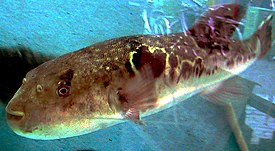
Brown puffer |
| Scientific classification |
|---|
| No rank : | Bilateral symmetrical |
| Subfamily : | Tetraodontinae |
|
| International scientific name |
|---|
Takifugu Abe , 1949 |
| Synonyms |
|---|
|
|
For most, the habitat is the salt water of the northwestern Pacific Ocean , but several species are found in the fresh waters of Asian rivers belonging to the Indo-Pacific region. The diet of representatives of the genus consists mainly of algae , mollusks , invertebrates and, less commonly, crustaceans . A distinctive feature of this genus is the protective mechanism of fish, which in case of danger inflate their bodies several times relative to their normal size, in addition, some fish organs are toxic. These remedies allow fish to actively explore the environment without much fear of being attacked.
Fish is highly toxic, but despite this, or perhaps because of this, it is considered a delicacy in Japan . Fish contains lethal amounts of tetrodotoxin poison in the internal organs, especially in the liver and ovary, to a lesser extent in the skin and testis [2] . Based on this, only specially licensed cooks can cook and sell puffer [2] , and the consumption of the liver and ovaries of fish is prohibited. However, it should be noted that annually fatal cases of poisoning are recorded when eating fish of the family [2] .
The mechanism of action of the poison is as follows: it paralyzes the muscles , while the victim remains fully conscious and eventually dies of suffocation . There is currently no antidote to the poison, and the standard medical approach is to try to maintain the respiratory and circulatory systems until the effects of the poison subside.
Takifugu fish are prominent in Japanese art and culture .
License to cook
puffer .
Japan -
2013 .
Most of the described species of the genus live in the northwestern part of the Pacific Ocean, several live in freshwater rivers in China . All members of the genus are omnivorous, have strong teeth, which can be relatively large if there is no abrasive feed in the fish diet. In case of danger, fish can bite.
Not all representatives of the genus have been studied in detail, the largest amount of information has been collected about the species Takifugu rubripes (Brown puffer), due to commercial use and breeding of the species. About brown puffer, it is known that the spawning period occurs from March to May, fish attaches eggs to rocky slopes at a depth of about 20 meters. Throughout life, the fish can change color from darker to lighter depending on the habitat. Brown puffer is a model organism in biological research [3] .
Most species of the genus do not experience population threats, with the exception of 2 species: Takifugu chinensis [4] and Takifugu plagiocellatus [5] , the first of which is on the verge of extinction.
Having a pear-shaped body shape, representatives of the genus are not fast swimmers, because they use their pectoral fins for maneuvering, while the fish can swim in the opposite direction and change direction much faster than most fish species. For the reasons described above, they are rarely found in open water, preferring to stay closer to the seabed, where they can explore complex environments such as oyster, grassy meadows and rocky reefs. Nevertheless, these fish are very curious and active, and in some cases even aggressive against representatives of their own genus, as well as against other fish.
In case of danger, the fish inflates itself, filling its extremely elastic stomach with water (or air, when it is outside the water), in these situations the fish is almost spherical. The process of filling with water is fixed by a special valve in the lower part of the mouth of the fish. The extremely elastic stomach expands. Depending on the type, the puffer can achieve an almost perfect spherical shape.
Despite the ability to inflate, the main protection of the fish of the species is the neurotoxin contained in the internal organs, mainly in the ovary and liver, to a lesser extent in the intestines and skin; only a small amount is found in muscles and blood [6] . This makes the puffer a lethal food for most predators, as well as for humans [6] . The toxin is called tetrodotoxin (C 13 H 21 N 3 O 10 ) [7] . Studies have shown that fish are not able to produce neurotoxin, but only accumulates it in their body. Initially, tetrodotoxin is produced by marine bacteria of the genus Pseudomonas , which are then eaten by a variety of living organisms. Thus, fish acquires toxicity with food (fish grown in an artificial environment and not consuming Pseudomonas bacteria are completely non-toxic [8] ): special mechanisms involving transport proteins capture tetrodotoxin in the fish’s liver and transport it to the skin with blood flow and other organs. It is worth noting that, unlike freshwater poisonous representatives of the family of pufferfish , in which the maximum concentration of neurotoxin is observed in the skin, tetrodotoxin accumulates in puffer mainly in the ovaries and liver [9] . The degree of toxicity of fish varies depending on the species.
The genus includes 26 species [10] :
- Takifugu alboplumbeus (Richardson, 1845)
- Takifugu basilevskianus (Basilewsky, 1855)
- Takifugu bimaculatus (Richardson, 1845)
- Takifugu chinensis (Abe, 1949)
- Takifugu chrysops (Hilgendorf, 1879)
- Takifugu coronoidus Ni & Li, 1992
- Takifugu exascurus (Jordan & Snyder, 1901)
- Takifugu flavidus (Li, Wang & Wang, 1975)
- Takifugu niphobles (Jordan & Snyder, 1901)
- Lattice Takifugu ( Takifugu oblongus ) [1] (Bloch, 1786)
- Takifugu obscurus (Abe, 1949)
- Takifugu ocellatus (Linnaeus, 1758)
- Takifugu orbimaculatus Kuang, Li & Liang, 1984
- Takifugu pardalis (Temminck & Schlegel, 1850)
- Takifugu plagiocellatus Li, 2002
- Takifugu poecilonotus (Temminck & Schlegel, 1850)
- Takifugu porphyreus (Temminck & Schlegel, 1850)
- Takifugu pseudommus (Chu, 1935)
- Takifugu radiatus (Abe, 1947)
- Takifugu reticularis (Tian, Cheng & Wang, 1975)
- Brown Puffer [11] ( Takifugu rubripes ) (Temminck & Schlegel, 1850)
- Takifugu snyderi (Abe, 1988)
- Takifugu stictonotus (Temminck & Schlegel, 1850)
- Takifugu variomaculatus Li & Kuang, 2002
- Takifugu vermicularis (Temminck & Schlegel, 1850)
- Takifugu xanthopterus (Temminck & Schlegel, 1850)
- ↑ 1 2 3 Reshetnikov Yu.S. , Kotlyar A.N. , Russ T. S. , Shatunovsky M.I. Fish. Latin, Russian, English, German, French. / edited by Acad. V. E. Sokolova . - M .: Rus. Yaz., 1989 .-- S. 416. - 12 500 copies. - ISBN 5-200-00237-0 .
- ↑ 1 2 3 Le fugu, un mets à haut risque
- ↑ Yves Van de Peer. Tetraodon genome confirms Takifugu findings: most fish are ancient polyploids (Eng.) // Genome Biology: journal. - 2004. - Vol. 5 , no. 250 . - P. 250 . - DOI : 10.1186 / gb-2004-5-12-250 . - PMID 15575976 .
- ↑ Takifugu chinensis (English) . The IUCN Red List of Threatened Species .
- ↑ Takifugu plagiocellatus (English) . The IUCN Red List of Threatened Species .
- ↑ 1 2 Tetraodon genome confirms Takifugu findings: most fish are ancient polyploids
- ↑ DESTRUCTION OF SPORES AND VEGETATIVE CELLS TETRODOTOXIN PRODUCING BACTERIA BACILLUS SP. 1839
- ↑ Toxicity of pufferfish (neopr.) . article on Aquavitro.org.
- ↑ Toxicity of pufferfish (neopr.) . article on Aquavitro.org.
- ↑ Fish Identification
- ↑ Animal life. Volume 4. Lancelet. Cyclostomes. Cartilaginous fish. Bone fish / ed. T. S. Rassa, ch. ed. V. E. Sokolov. - 2nd ed. - M.: Education, 1983 .-- S. 384, 506. - 575 p.
- The genus Takifugu (English) in the World Register of Marine Species .
