Ross 614 (GJ 234) is a double star in the constellation Unicorn . Located at a distance of 13.47 light years from the sun .
| Ross 614 AB | |||
|---|---|---|---|
| Star | |||
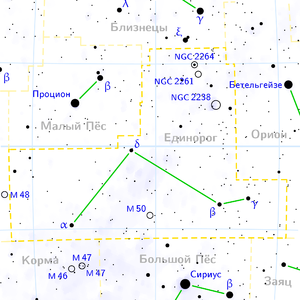 Location of Ross 614 in the constellation Unicorn | |||
| Observational data ( Age J2000) | |||
| Right ascension | |||
| Declination | |||
| Distance | 13.47 ± 0.16 St. years (4.13 ± 0.05 pc ) | ||
| Visible magnitude ( V ) | 11.15 | ||
| Constellation | Unicorn | ||
| Astrometry | |||
| Radial velocity ( R v ) | +18.2 km / s | ||
| Own movement (μ) | RA: 694.73 mas per year Dec: -618.62 mas per year | ||
| Parallax (π) | 244.34 ± 2.01 mas | ||
| Absolute magnitude (V) | 13.09 | ||
| Specifications | |||
| Spectral class | M4.5V / M8V | ||
| Color Index ( B - V ) | 1.72 | ||
| Color Index ( U - B ) | 1.19 | ||
| Variability | |||
| physical characteristics | |||
| Weight | |||
| |||
| Database Information | |||
| SIMBAD | data | ||
| ARICNS | data | ||
| Sources: [1] [2] | |||
Content
Discovery History
Frank Ross ( Yerkes Observatory , Chicago) discovered the main star of the system in 1927 . In 1936, the Dutch-American astronomer Dirk Rail discovered the dual nature of the system, observing it at the McCormick Observatory ( University of Virginia ).
Features
The system consists of two red dwarfs of small mass - Ross 614 A and Ross 614 B. The spectral class of components is M4.5V and M8V, respectively. The masses of the components are 0.2228 ± 0.0055 and 0.1107 ± 0.0028 solar masses, respectively [3] . The orbital period calculated by George Gatewood Based on old observations and data from the Hipparch telescope, it is about 16.6 years, and the main half-axis is only 0.932 "or 1.04-1.1" (the average distance between components varies from 2.4 a.u. to 5.3 A. e.) [4] . The Ross 614 AB system is one of the closest to the Sun. The approximate distance to the system is about 13.4 light years , which puts Ross 614 AB in 29th place in the list of nearby star systems. The absolute magnitude Ross 614 A is 13.09 m , Ross 614 B is 16.17 m . The main star of the Ross 614 A system (aka Gliese 234 A) is a flashing star of the UV Ceti type.
Surroundings
The closest stars to Ross 614 AB are: Leiten's Star (3.9 St.), Procyon AB (4.6 St.), Sirius AB (5.5 St.), 40 Eridanus ABC (9.1 St. years), DX Cancer (9.1 light years) and Epsilon Eridana (9.4 light years).
In the literature
Ivan Efremov , “ The Andromeda Nebula ”. Veda Kong gives a lecture on the history of the Earth for the inhabitants of the planet Ross 614.
See also
- List of nearby stars
Notes
- ↑ SIMBAD . - Ross 614 AB in the SIMBAD database . Date of treatment July 10, 2011.
- ↑ ARICNS . - Ross 614 AB in the ARICNS database. Date of treatment July 10, 2011.
- ↑ An Astrometric Study of the Low-Mass Binary Star Ross 614
- ↑ Davey, BLK; Cocke, WJ; Bates, RHT; McCarthy, DW, Jr .; Christou, JC; Cobb, ML [T Infrared speckle observations of the binary Ross 614 AB - Combined shift-and-add and zero-and-add analysis]