The Red Banner Northwest Border District (abbreviated as KSZPO ) is the military-administrative operational association ( border district ) of the border troops of the KGB of the USSR and the Border Service of the FSB of Russia .
| Red Banner Northwest border district KSZPO | |
|---|---|
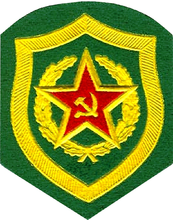 Patch of frontier troops of the KGB of the USSR | |
| Years of existence | April 1, 1918 [1] August 1, 1998 [2] |
| A country |  the USSR the USSR  Russia Russia |
| Subordination | Commander of the PV KGB of the USSR |
| Included in | KGB of the USSR USSR Armed Forces (until 21.03.1989) |
| Type of | border district |
| Includes | management , connections , parts , institutions |
| Function | border protection of the USSR |
| Number | Union |
| Dislocation | In different years: Arkhangelsk region , Murmansk region , Leningrad region Lithuanian SSR , Latvian SSR , Estonian SSR , Kaliningrad region |
| Colors | green [3] |
| Participation in | Soviet-Finnish War World War II [4] |
| Marks of Excellence |  |
This association, in different historical periods under various names, carried out the task of protecting the northwestern and northern borders of the USSR and Russia from the Kaliningrad region to the Arkhangelsk region of the RSFSR .
In view of the fact that the association during the course of numerous reforms was divided into separate compounds , and then re-united into a single formation, the article discusses the general history of all compounds that were part of it.
Formation History
Precursors of Formation in the Russian Empire
On August 5, 1827, the Customs Border Guard was established. In 1835, she was renamed the Border Guard.
By the second half of the 19th century, the Russian Empire in its northwestern and northern extremities included Finland and the former Baltic principalities that were part of the Vilna and Coven provinces . [5] .
By the decree of Alexander III of October 15, 1893, on the basis of the border guard of the customs duties department of the Ministry of Finance, a separate border guard corps was formed, which organizationally streamlined border protection. As part of the corps, 2 districts were formed whose tasks included protecting the northwestern and northern borders of the Russian Empire along the coast of the Baltic and Barents Seas .
Since the Principality of Finland had greater autonomy than, for example, the Kingdom of Poland (also part of the Russian Empire), the border of this principality was organized with other subjects of the empire ( Olonets , St. Petersburg and Arkhangelsk provinces ).
The task of these districts was to protect the coast of the Barents Sea, the White and Baltic Seas, the river and land borders with East Prussia and Finland .
With the outbreak of World War I, all border brigades on the northwestern borders were reassigned to the War Ministry , additionally deployed to wartime states, and partially participated in hostilities [5] .
The interwar period
In January 1918, the People's Commissariat for Military Affairs set the management of the Separate Border Corps the task of drawing up a project to organize the protection of the borders of the Soviet Republic. According to the presented project, it was planned to create 9 border districts, which required the allocation of 35 thousand people and 10 488 horses. But in connection with the abolition of the Separate Border Corps, the project was not completed.
Following the results of the Brest Peace , concluded on March 3, 1918, Finland and the provinces formed on the site of the former Baltic principalities were torn away from Soviet Russia .
To organize border protection, on March 30, 1918, the General Directorate of Border Guard (GUPO) was formed as part of the People’s Commissariat for Finance. On April 1, 1918, the creation of the Petrograd District Border Guard began under the leadership of the GUPO. As part of the Petrograd District Border Guard until May 16, 1918 the following territorial units were created [1] :
- Belomorsky district - 2 subareas for 12 border outposts
- Olonets district - 3 subareas for 10 outposts
- Finland District - 3 Subareas for 52 outposts
- Petrogradsky district - 2 subareas for 6 outposts
- Peipsi district - 3 subareas for 6 outposts
On March 29, 1918, by the decision of the Military Council of the RSFSR , the Western section of the curtain units was created, which was a unit for protecting the border from the invasion of German troops [7] , which, according to military historians, should be considered as an association that performed the functions of border troops [8] .
On May 28, 1918, a Decree on the creation of the border guard of the Soviet Republic was signed [1]
On July 1, 1918, the RSFSR Border Guard was transferred from the People’s Commissariat for Finance to the People’s Commissariat of Trade and Industry.
On February 1, 1919, by order of the Revolutionary Military Council, the border guard was transformed into border troops. Border districts were renamed as border divisions, districts into border infantry regiments, subareas into battalions, and distances into companies. In total, three border divisions were formed, each of which had five regiments and five cavalry divisions.
Due to the difficult situation on the fronts of the Civil War , on July 18, 1919, the Labor and Defense Council included the border troops in the army.
January 19, 1921 by a decision of the Council of Labor and Defense, border troops were withdrawn from the army.
Under the leadership of the Cheka’s chairman F.E. Dzerzhinsky, by June 1921, 15 border brigades had been formed, with a total number of 36,000 people, which amounted to less than half of the adopted border guard staff [5] .
In 1937–38, the Directorate of Border Troops was created at the districts of the NKVD [9] .
The indicated formations for this historical period were involved in the protection of the maritime and land borders with Estonia, Latvia and Finland.
Soviet-Finnish War (1939-1940)
By the end of autumn 1939, the leadership of the USSR faced the need to resolve the issue of ensuring the security of Leningrad as soon as possible. The second largest and most populated Soviet city, which was the largest and almost the only naval base on the Baltic Sea, was potentially threatened by its proximity to the state border.
After the hostilities unleashed by the Soviet side, which took place from November 30, 1939 to March 12, 1940, the Armed Forces of the USSR managed to significantly push the state border north from Leningrad and west from Murmansk .
Active participation in hostilities, along with units of the Red Army , took border troops of all three border districts (Murmansk, Leningrad and Karelian). By order of the NKVD of the USSR dated 12.12.1939 No. 001478 from the districts, 7 border regiments were formed, each of 1,500 people.
The main task of the frontier regiments was to ensure the security of the rear of the advancing armies from Finnish sabotage groups. According to the results of hostilities, by decree of the Presidium of the Supreme Soviet of the USSR of April 26, 1940, 4 formations were awarded the Order of the Red Banner :
- 4th border regiment of the Karelian district
- 5th Border Regiment of the Leningrad District
- 6th border regiment of the Leningrad district
- 73rd Rebol Frontier Detachment
By the same decree, 13 border guards of the Karelian district were awarded the title Hero of the Soviet Union [11] .
March 1940 - June 1941
In connection with the transfer of the state border of the USSR to new frontiers deep into the former territory of Finland, from January to March 1940 new border detachments were formed, and the Karelian okrug was renamed the Karelian-Finnish okrug. Also, there was a relocation of some former units to the northwest.
As part of the Office of the Border Troops of the Murmansk District, the following were created (names with geographic reference were found in official documents of that time) [11] :
- 100th Ozerkovsky border detachment - n. Ozerko village (from January 21, 1940 to March 17, 1940 - the 27th border detachment)
- 101st Kuoloyarvinsky border detachment - n. v. Kuoloyärvi
As part of the Office of the Border Troops of the Leningrad District, the following were created:
- 102nd Alisenvaara Border Detachment named after S. M. Kirov - n. Alisenvaara
- 103rd Alakurttin border detachment - n. n. Rempetti
With the accession of the Baltic states to the USSR , on July 26, 1940, the Baltic border district was created. With its creation, a vast section of the Baltic Sea coast west to East Prussia was taken under guard by the border troops.
World War II
Initial Stage
On June 22, 1941, the NKVD border troops guarding the western border of the USSR were the first to take the blow from the invasion of the Wehrmacht land forces. This mainly affected the formations of the Ukrainian, Belarusian and Baltic districts.
Unlike the indicated districts, on the first day of the war, only Luftwaffe and the Finnish Air Force raided in the zone of responsibility of the Murmansk, Karelian-Finnish and Leningrad districts. Soviet border guards visually observed on the Finnish side the arrival and accumulation of enemy forces, the implementation of engineering field work and the evacuation of civilians from the border strip, which indicated that the enemy was preparing for the invasion.
The invasion of Finnish and German ground forces on the territory of the USSR in the north-western and northern directions was recorded only at 8.40 in the morning of June 29, 1941 (a week after the outbreak of war). The enemy attacked the border posts of the 5th and 102nd detachments with several battalions. To the north, also on July 29, enemy ground units attacked the outposts of the Restikent border detachment of the Murmansk District. On July 30, the enemy broke through the border defense in the area of Enso, in the area of responsibility of the Karelian-Finnish okrug, by forces of two infantry divisions [4] [12] .
Due to the fact that the small units of border guards on the western border were almost completely destroyed in border battles and it was physically impossible to conduct loss statistics, among the irretrievable losses over 90% are missing. On April 1, 1942, 3,684 people were considered dead and injured in the border troops, 35,298 were missing, 136 were captured, 8240 were wounded and frostbite, and 956 were retired for various reasons. The largest losses were in the border units of the Belarusian, Ukrainian and Baltic districts [12] .
In turn, on the northern border and the north-western border, the enemy did not create a significant predominance in manpower and technology as on the western border. Therefore, the intensity of the battles was not so heavy. This is evidenced by the loss of the Murmansk District in the period from June 22 to August 20, 1941: 253 were killed and died from wounds, 571 people were injured [4] .
This alignment of forces is explained by the fact that the territories north of Leningrad represented an inaccessible terrain on which enemy advance was possible only in 8 directions on a relatively wide front of 1,500 kilometers: Olonetskoye, Petrozavodskoye, Medvezhyegorskoye, Rebolskoye, Ukhtinskoye, Loukhskoye, Kandalakshskoye, Murmanskoye [14 ] .
Reforming Frontier Forces
With the further retreat of Soviet troops to the east, the Belarusian, Ukrainian, Moldavian and Baltic districts actually ceased to exist. Emergency measures were required to reorganize the remnants of the NKVD border troops in the western direction. Also required was the reorganization of the formations of the Crimean okrug in the south, and the Leningrad, Karelian-Finnish and Murmansk okrugs in the north and north-west, in the area of responsibility of which military operations on land have not yet begun.
By order of Lieutenant General I.I. Maslennikov, Deputy People's Commissar of Internal Affairs of the USSR for Border and Internal Troops, dated June 26, 1941, the remnants of the surviving units of the border detachments were withdrawn to the rear of the Red Army and reorganized into the NKVD border regiments with the preservation of the serial number. He was tasked with protecting the rear of the army, which they carried out together with the internal troops of the NKVD. By this order, the remnants of the border troops of the former border districts in the western direction, were transferred to the operational subordination to the rear protection chiefs of the following fronts [4] :
- troops of the Moldavian district - protection of the rear of the Southern Front .
- troops of the Ukrainian district - protection of the rear of the South-Western Front
- the troops of the Crimean district - protection of the rear of the Separate Primorsky Army of the Southern Front .
- troops of the Belorussian district - protection of the rear of the Western Front . Parts of the border troops of the Belorussian Border District, deployed in the territory of the Lithuanian SSR, were transferred to the rear guard department of the North-Western Front .
- troops of the Baltic region - protection of the rear of the North-Western Front and the Northern Front .
- the troops of the Leningrad, Karelian and Murmansk districts transferred to the rear protection of the Northern Front .
On August 23, 1941, based on the directive of the General Headquarters, the Supreme High Command was divided into the Leningrad and Karelian fronts .
On September 30, 1941, the Directorate of Frontier Forces of the Karelian-Finnish District was reorganized into the Directorate of Frontier Guard of the Karelian Front.
On June 26, 1942, the Directorate of Border Troops of the Murmansk District was transformed into the Operational Group of the Directorate of the NKVD Troops for the Protection of the Rear of the Karelian Front.
The final decision on the complete withdrawal of all formations of the NKVD border and convoy service from the army was decided by the Supreme Command Headquarters on December 15, 1941. Also, fighter battalions to combat saboteurs were formed from border guards withdrawn to the rear. Border formations carried out tasks to protect the rear of the army and to combat saboteurs until the end of hostilities [12] .
Parts of the Office of the Border Troops of the Leningrad District, together with the troops of the Leningrad Front, went over to the defense of Leningrad . Formations of the Baltic region located on the eastern flank of the district were also reassigned to the Leningrad Front: the 99th separate border guard detachment and the division of border vessels deployed on the Hanko Peninsula , and the 6th Rakvere and 8th Haapsalu border detachments withdrawn from the territory of the Estonian SSR.
Parts of the Karelian and Murmansk districts, together with parts of the Karelian Front, launched the Strategic Defensive Operation in the Arctic and Karelia , the successful completion of which eventually forced the advancing enemy to switch to a long-term defense of the occupied lines for 2 years and 10 months.
In fact, the border guards on the northern and northwestern borders, in addition to the tasks directly assigned to them to protect the rear of the army, were involved in positional battles with the enemy and raids behind enemy lines [4] .
Border
As the Red Army liberated the occupied Soviet territories, by mid-1944 the front in many sectors moved to the west to the line of the pre-war state border of the USSR.
GKO Decree No. 5584ss of April 8, 1944, the NKVD troops were ordered to restore protection of the western border. For this purpose, the NKVD border regiments, which carried out tasks to protect the rear of the active Red Army, were sent to the formation of the pre-existing Directorates of Border Troops of the NKVD okrugs.
40% of the rank and file of the NKVD rear guard troops were transferred to the border troops, which allowed the formation of 11 Border Troops Directorates (UPV) of the NKVD districts consisting of 34 border detachments.
On June 10, 1944, the Vyborg-Petrozavodsk offensive operation began . In the course of the ensuing hostilities, the Soviet troops were able to significantly push back the Finns. On August 25, 1944, the Finns formally requested a truce from the USSR.
On September 5, hostilities on the Karelian front were stopped and the Finns completely liberated occupied Soviet territory.
At the beginning of September 1944, Soviet border guards reached the state border of the USSR with Finland and began to guard it.
On September 21, 1944, the Directorate of the Border Troops of the NKVD of the Murmansk, Karelian-Finnish and Leningrad Districts was restored.
On November 22, 1944, the Baltic Region was created on the basis of the Latvian and Estonian districts [15] .
Post-war period
With the end of the war, the territory of East Prussia , which became the Kaliningrad region of the RSFSR, partly ceded to the USSR. Её граница с Польшей вошла в зону ответственности Белорусского пограничного округа [16] .
Также по условиям международных переговоров Финляндия потеряла выход к Северному Ледовитому океану, а СССР получил небольшой участок сухопутной границы с Норвегией.
17 октября 1949 года пограничные войска были переподчинены от МВД СССР в состав МГБ СССР .
5 марта 1953 года МГБ был упразднён и пограничные войска снова оказались в составе МВД.
2 июня 1953 года Карело-Финский округ и Мурманский округа объединили в Северный округ с управлением в Петрозаводске.
В 1953 году по приказом МВД СССР №00320 Управление пограничных войск МВД Литовского округа было преобразовано в Управление пограничных войск Прибалтийского пограничного округа. Данным приказом управление пограничных войск по всем прибалтийским республикам стало единым.
19 февраля 1954 Прибалтийский пограничный округ был упразднён. Его войска и зона ответственности отошли Ленинградскому пограничному округу.
В июне 1955 года Прибалтийский округ был заново создан выделением из состава Ленинградского округа.
10 марта 1956 года Прибалтийский округ был переименован в Западный округ с управлением в Риге .
2 апреля 1957 года пограничные войска переданы в подчинение КГБ СССР .
28 июня 1957 года Западный округ был обратно переименован в Прибалтийский округ. Также в зону ответственности Прибалтийского военного округа была включена граница Калининградской области и граница Литовской ССР с Польшей, которая в довоенное время входила в зону ответственности Белорусского пограничного округа.
22 января 1960 года Прибалтийский округ был расформирован с передачей войск и зоны ответственности в состав Ленинградского округа.
13 сентября 1963 года слиянием Ленинградского и Северного пограничных округов был создан Северо-Западный пограничный округ чья зона ответственности включала сухопутную и морскую границу СССР от Калининградской области до Архангельской области.
27 мая 1968 года Северо-Западный пограничный округ был награждён орденом Красного Знамени .
23 октября 1975 года из состава Северо-Западного пограничного округа был выделен Прибалтийский пограничный округ , в чью зону ответственности вошли Латвийская ССР, Эстонская ССР, Литовская ССР и Калининградская область.
В итоге последнего разделения Северо-Западный пограничный округ получил в зону ответственности побережье Балтийского моря в пределах Ленинградской области, сухопутную границу с Финляндией и Норвегией, побережье Баренцова и Белого морей в пределах Мурманской и Архангельской областей.
В таком виде пограничный округ просуществовал до распада СССР [15] .
Округ в Российской Федерации
Распад СССР не оказал особого влияния на дальнейшее существование Северо-Западного пограничного округа, поскольку он полностью дислоцировался на территории бывшей РСФСР .
Ввиду необходимости рационализации управления пограничными войсками в условиях изменившейся мировой обстановки и внутреннего устройства России, требовалась реструктуризация прежней системы пограничных округов. Указом Президента России от 1 августа 1998 года Северо-западный пограничный округ был переименован в Северо-Западное региональное управление ФПС России [2] .
В последующем данная организация была переименована в Региональное пограничное управление ФСБ РФ по Северо-Западному Федеральному округу . Данная организация имела большую зону ответственности в отличие от КСЗПО, поскольку к бывшей советской границе по побережью Балтийского моря в пределах Ленинградской области добавились участки сухопутной и морской границ Калининградской и Псковской областей с прибалтийскими государствами и Польшей. Указанное региональное управление было упразднено 1 апреля 2010 года.
На данный момент управление пограничной службы в зоне ответственности бывшего КСЗПО разделено по отдельным субъектам (областям) и осуществляется Пограничными управлениями ФСБ [17] .
Состав округа
Расположение отрядов
Состав Северо-Западного пограничного округа перед распадом СССР. Отряды указаны по расположению вдоль границы с востока на запад и с севера на юг [15] [18] :
- Управление округа — Ленинград
- District commandant's office (military unit 2448) - Leningrad
- 4th Arkhangelsk border detachment (military unit 9794)
- 82nd Murmansk Red Banner Frontier Detachment (military unit 2173)
- 100th Nickel Border Order of the Red Star Detachment (military unit 2200)
- 101st Alakurttin border detachment (military unit 2201)
- 72nd Kalevala Border Order of the Red Star Detachment (military unit 2143)
- 73rd Rebolsky Frontier Red Banner Detachment (military unit 2146)
- 80th Suoyarva Red Banner Frontier Detachment (military unit 2150)
- 1st Sortavala border Red Banner detachment (military unit 2121)
- 102nd Vyborg Red Banner Frontier Detachment named after S. M. Kirov (military unit 2139)
- 5th Leningrad border detachment named after Yu. V. Andropov (military unit 9816) - Sosnovy Bor
- 107th separate three times orders of the Red Star and Alexander Nevsky communications battalion (military unit 2209) - Sestroretsk
- 4th interdistrict school of sergeant staff (military unit 2416) - Sortavala
- 14th Separate Aviation Regiment (military unit 2397) - Petrozavodsk
- 1st Separate Red Banner Brigade of Border Patrol Ships (military unit 2289) - Kuvshinskaya Salma
- 2nd separate brigade of border guard ships (military unit 2241) - Vysotsk
- Separate checkpoint "Vyborg"
- Separate checkpoint "Leningrad"
- District Military Hospital (military unit 2517) - Petrozavodsk
- District Military Hospital (military unit 2518) - Sestroretsk
- 51st separate civil engineering company (military unit 3339) - Petrozavodsk
District Commanders
The list of district commanders (military commanders) is given for the period from September 13, 1963 to 1991 [15] :
- Ionov, Petr Ivanovich - March 1963 - December 1968
- Secretarev, Konstantin Fedorovich - December 26, 1968 – November 6 –6, 1975
- Victorov, Alexander G. - November 1975 - 1992
Heroes of the Soviet Union
Soviet-Finnish War (1939-1940)
Military personnel of the border troops of the NKVD of the Karelian district, awarded the title Hero of the Soviet Union for participating in the Soviet-Finnish War (1939-1940) (all awarded with one decree of the Presidium of the Supreme Council of the USSR of April 26, 1940 [11] ):
- Zagarinsky Alexander Grigorievich . Site " Heroes of the country ". - machine gunner of the 4th border regiment.
- Zinoviev Ivan Dmitrievich . Site " Heroes of the country ". - company commander of the 4th border regiment.
- Kiselev Semyon Sergeevich . Site " Heroes of the country ". - Military Commissioner of the 5th Border Regiment.
- Kobzun Ivan Mikhailovich . Site " Heroes of the country ". - commander of a machine-gun platoon of the 5th border regiment.
- Korenchuk Theodosius Pavlovich . Site " Heroes of the country ". - Deputy political instructor of a sapper platoon of the 4th border regiment of the NKVD of the Karelian district.
- Kuzyakin Gavriil Vasilievich . Site " Heroes of the country ". - shooter of the 2nd company of the 5th border regiment of the NKVD of the Karelian district.
- Luzhetsky Andrey Gavrilovich . Site " Heroes of the country ". - commander of a machine gun company of the 5th border regiment.
- Petrenko Dmitry Filippovich . Site " Heroes of the country ". - commander of a machine-gun platoon of the 4th company of the 4th border regiment. The title is assigned posthumously.
- Grigory Petrov Petrovich . Site " Heroes of the country ". - company commander of the 4th border regiment. The title is assigned posthumously.
- Pushanin Ivan Ivanovich . Site " Heroes of the country ". - Political officer of the 3rd company of the 4th border regiment. The title is assigned posthumously.
- Rakus Dmitry Ivanovich . Site " Heroes of the country ". - commander of a mortar platoon of the 4th border regiment of the NKVD of the Karelian district. The title is assigned posthumously.
- Samsonov Vladimir Andreevich . Site " Heroes of the country ". - shooter of the 3rd company of the 4th border regiment.
- Spekov Alexander Vasilievich . Site " Heroes of the country ". - telephone operator of a platoon of communications of the 2nd border regiment. The title is assigned posthumously.
World War II
The military personnel of the border troops of the NKVD of the Karelian-Finnish district, awarded the title Hero of the Soviet Union for participating in the Great Patriotic War [19] :
- Kaimanov Nikita Fadeevich . Site " Heroes of the country ". - Head of the combat training department of the headquarters of the 80th border detachment of the Karelian-Finnish district. The title was awarded on August 26, 1941.
See also
- Border troops of the KGB of the USSR
- Border District
Notes
- ↑ 1 2 3 “Creation of the first districts of the border guard of the Soviet Republic. 1918-1923. "V. V. Tereshchenko. Leading Researcher, CPM, Federal Security Service of the Russian Federation
- ↑ 1 2 Report on the results of verification of the use of federal budget funds allocated for the maintenance of the North-West Regional Directorate of the Federal Border Service of the Russian Federation
- ↑ Moscow magazine. V.N. Kulikov. "The history of the green cap." Topic: Russian Border Guard: history and modernity.
- ↑ 1 2 3 4 5 6 7 Border troops. Collection of materials and documents. 1941-1945. - M .: "Science", 1975. - S. 154-179, 186-248, 369-385, 443-455. - 708 p.
- ↑ 1 2 3 Guarding the borders of the Fatherland. The history of the border service .. - M .: "Border", 1998. - S. 221-222, 270, 277-309. - 607 p. - ISBN 5-86436-078-3.
- ↑ Website of the Separate Border Guard Corps
- ↑ A. P. Gritskevich “The Western Front of the RSFSR 1918-1920. The struggle between Russia and Poland for Belarus ”- Minsk: Harvest, 2010. ISBN 978–985–16–6650–4
- ↑ Border troops. Collection of materials and documents. 1918-1928. - M .: "Science", 1973. - S. 393-488. - 928 s.
- ↑ 1 2 Border troops. Collection of materials and documents. 1929-1938. - M .: "Science", 1972. - S. 41-67. - 776 p.
- ↑ 1 2 "Border districts on the eve of World War II." V.V. Tereshchenko. Leading Researcher, CPM, Federal Security Service of the Russian Federation
- ↑ 1 2 3 4 5 Border troops. Collection of materials and documents. 1939-1941. - M .: "Science", 1970. - S. 39-224. - 815 s.
- ↑ 1 2 3 4 5 Guarding the borders of the Fatherland. Russian border troops in wars and armed conflicts of the 20th century. - M .: “Border”, 2000. - S. 226-240, 252-273, 353-374. - 504 s. - ISBN 5-86436-294--8.
- ↑ 82nd Separate Restriction Frontier Detachment
- ↑ Creation of the Karelian Front (inaccessible link) . Date of treatment February 25, 2016. Archived September 30, 2009.
- ↑ 1 2 3 4 “Border troops”. History of domestic special services and law enforcement agencies. Historical site of Valentin Mzareulov
- ↑ Border troops. Collection of materials and documents. 1945-1950. - M .: "Science", 1974. - S. 246-458. - 760 s.
- ↑ Official site of the Border Service of the FSB of the Russian Federation
- ↑ Border troops of the KGB of the USSR in districts at the end of the 80s.
- ↑ Website "Heroes of the Country"
Literature
- E. D. Soloviev, A.I. Chugunov. Western border // Border troops. Collection of materials and documents. 1918-1928. - Moscow: "Science", 1973. - P. 545-571. - 928 p. - 25,000 copies.
- P.A. Ivanchishin, A.I. Chugunov. Western border // Border troops. Collection of materials and documents. 1929-1939. - Moscow: "Science", 1972. - P. 41-67. - 776 p. - 20,000 copies.
- E.V. Tsybulsky, A.I. Chugunov, A.I. Yuht. Western border // Border troops. Collection of materials and documents. 1939-1941. - Moscow: "Science", 1970. - P. 39-225. - 815 p. - 20,000 copies.
- A.I. Chugunov, T.F. Karyaeva, E.V. Sakharova. Western border // Border troops. Collection of materials and documents. 1941-1945. - Moscow: Nauka, 1975. - P. 154-179, 186-248, 369-385, 443-455. - 708 p. - 5,000 copies.
- E. D. Soloviev, A.I. Chugunov. Western border // Border troops. Collection of materials and documents. May 1945-1950. - Moscow: "Science", 1975. - P. 168-208. - 760 p. - 25,000 copies.
- IN AND. Boyarsky, V.I. Burduzhuk, V.I. Boriskin, A.S. Velidov. Guarding the borders of the Fatherland. The history of the border service .. - Moscow: "Border", 1998. - P. 225, 277-309, 410-412, 468-469, 539-566. - 607 p. - 5,000 copies. - ISBN 5-86436-078-3.
- IN AND. Boyarsky, V.I. Burduzhuk, Yu.I. Zavatsky, E.P. Egorov. Guarding the borders of the Fatherland. Russian border troops in wars and armed conflicts of the 20th century. - Moscow: “Border”, 2000. - 504 p. - 5,000 copies. - ISBN 5-86436-294--8.