
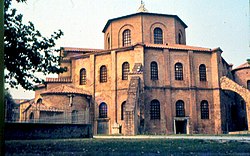
The Rahanin Exarch , or the Italian Exarch, [1] is a Byzantine province on the Apennine Peninsula (northeastern Italy) with its center in the city of Ravenna . Known since 584 as an outpost against the onslaught of barbarians , created by the Byzantine emperor Mauritius . It was conquered by the Lombards in 751 . After the conquests of Pepin the Short ( 754 , 756 ), the lands of the Ravenna Exarchate were transferred to the Franks . Then Pepin the Short " presented " them together with the Roman region to the Roman Pope , which marked the beginning of the Papal State .
Content
Introduction
Ravenna became the capital of the Western Roman Empire in 402 under Emperor Honorius thanks to the beautiful port with access to the Adriatic and an ideal (from the point of view of defense) location in the middle of impassable swamps. The city remained the capital of the empire until its fall in 476 , when it became the capital of Odoakr , and then (under Theodoric ) and the capital of the kingdom of the Ostrogoths . It remained the capital of the Kingdom of the Ostrogoths , but in 540 during the Byzantine-Gothic War of 535–554 Ravenna was taken by the military leader of the Eastern Roman Empire, Belisarius . During the Byzantine rule, Ravenna was the seat of the Byzantine governor. At the same time, the administrative structure in Italy followed (with some changes) the old system established by Emperor Diocletian and preserved by Odoacer and Ostrogoths .
Langobard invasion and Byzantium reaction
In 568, the Lombards , led by their king Alboin , together with other Germanic tribes, invaded northern Italy, which suffered during the Byzantine-Gothic wars . Local Roman troops were weak. Having seized a number of cities, in 569 the Lombards took Milan . After a three-year siege in 572, Pavia fell, which the Lombards made their capital. In subsequent years, they took Tuscany . Under the leadership of Faroald and Zotto, the Lombards infiltrated into Central and Southern Italy, where they founded the duchy of Spoleto and Benevento . After the murder of Alboin in 573, the Lombards broke up into several separate duchies ("The Board of the Dukes ").
Emperor Justin II tried to take advantage of this, and in 576 he sent his son-in-law, Vaduarius, to Italy. However, he was defeated and died in battle, and the ongoing crisis in the Balkans and the East meant that another attempt by the Empire to recover lost lands was impossible. Because of the invasions of the Lombards, the Roman possessions were split into several separate areas, and in 580 the emperor Tiberius II reorganized them into five provinces, which were now called in Greek dioceses : Annonaria in northern Italy around Ravenna, Calabria , Campania , Emilia and Liguria , and Urbicaria around Rome ( Urbs ). Thus, by the end of the 6th century, the new organization of power was incorporated into a solid model. Ravenna, ruled by the Exarch (the post was established by the emperor Mauritius in 584 ), who had civil and military power, in addition to his church office, was limited to the city, port and adjacent lands north to the Po , for which was the land of the Duke of Venice , nominally an imperial official, and in the south to the river Marecchia , beyond which was the Adriatic Pentagrad ( Pentapol ), also under the authority of the duke (nominally representing the Byzantine emperor).
Exarchate
The exarchate was divided into a group of duchies (the Duchy of Rome, the Duchy of Venice, the Duchy of Calabria, Lucania, Spoleto, etc.), most of which were coastal cities on the Italian Peninsula since the Lombards subdued the inland areas.
The civil and military head of these imperial domains, the Exarch, was the representative of the Emperor of Constantinople in Ravenna. The adjoining lands stretched from the border with Venice in the north to the Pentapolis (Pentapolis) in Rimini , the border of the “five cities” in Marki along the Adriatic coast; and even reached cities not on the coast, such as Forli for example. This whole area lies on the eastern slope of the Apennines ; she was under the direct control of the exarch and constituted the Exarchate in the literal sense. The adjoining lands were ruled by the dukes and the magistri militium more or less dependent on him. From the point of view of Constantinople, the Exarchate consisted of Italian provinces.
The exarchate was not the only Byzantine province in Italy. Byzantine Sicily had its own government, while Corsica and Sardinia , while remaining Byzantine , belonged to the African Exarchate .
The Lombards placed their capital in Pavia and controlled the vast valley of the Po River. The Lombards wedged across the territory of Italy to the south and founded the duchies in Spoleto and Benevento ; they controlled the interior of the country, while the Byzantine rulers more or less controlled the coast.
Piedmont , Lombardy , the inner territories of Venice , Tuscany and the inner regions of Naples belonged to the Lombards, and gradually the representative of the Empire in Italy lost all real power, although nominally he controlled such areas as Liguria (finally left to the Lombards in 640), or Naples and Calabria (captured Lombard duke of Benevento). In Rome, the real master was the Pope.
Finally, around the year 740, the Exarchate included Istria , Venice (with the exception of the Venetian lagoon itself, which gradually became self-defending city-state, the predecessor of the future Republic of Venice), Ferrara , Ravenna (exarchate in the narrow sense), with Pentapolis, and Perugia .
These fragments of the province of Italy, in the form Justinian conquered them, were also all lost in favor of the Lombards, who finally captured Ravenna about 750 years, and also because of a split with the Pope, who finally settled off from the Empire as a result of the imperative dispute.
Ravenna Exarchs
| Years of government | Exarch |
|---|---|
| 553 - 568 | Narses (as prefect) |
| 569 - 574 | Longin |
| 574 - 577 | Baduarius |
| 584 - 585 | Decius (as Exarch) |
| 585 - 589 | Emerald |
| 589 - 598 | Novel |
| 598 - 603 | Callinicus |
| 603 - 611 | Smaragd (repeat) |
| 611 - 616 | John I Lemigios |
| 616 - 619 | Eleftheria |
| 619 - 625 | Gregory I |
| 625 - 643 | Isaac |
| 643 - 645 | Theodore I Calliope |
| 645 - 649 | Plato |
| 649 - 652 | Olympic |
| 653 - 666 | Theodore I Calliope (repeat) |
| 666 - 678 | Gregory II |
| 678 - 687 | Theodore II |
| 687 - 702 | John II Platin |
| 702 - 710 | Theophylact |
| 710 - 711 | John III Rizokop |
| 711 - 713 | Entihy |
| 713 - 726 | Scholastic |
| 726 - 727 | Paul |
| 728 - 752 | Evtikhiy |
See also
- African Exarchate
Notes
- ↑ In Italian historical periodicals.
Literature
- Borodin O. D. Ravenna Exarchate. Byzantines in Italy. - SPb. : Aletheia, 2001. - ISBN 5-89329-440-8 .