Mycocepurus castrator (lat.) - a species of ants of the genus Mycocepurus from the tribe of mushrooms Attini , which has no workers. The social parasite of other ants and the first inquilin in the lower fungus.
| Mycocepurus castrator |
| Scientific classification |
|---|
| {{{{{{{{{{{{{{{{{{{{{{{{{{{{{{{{{{{{{{{{{{{| 1}} | 1}} | 1}} | 1}} | 1}} | 1}} | 1}} | 1}} | 1}} | 1}} | 1}} | 1}} | 1}} | 1}} | 1 }} | 1}} | 1}} | 1}} | 1}} | 1}} | 4}} : | Animals |
| No rank : | Bilateral symmetrical |
| Subtype : | Tracheo-breathing |
| Infraclass : | Winged insects |
| Treasure : | Fully Transformed Insects |
| View: | Mycocepurus castrator |
|
| International scientific name |
|---|
Mycocepurus castrator
Rabeling & Bacci, 2010 |
|
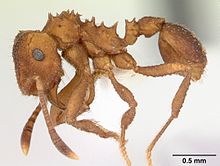
The working ant of the host species is
Mycocepurus goeldii , on which the
Mycocepurus castrator parasitizes.
Content
South America : Brazil , Sao Paulo , Rio Claro [1] .
Small ants (body length less than 2 mm , head length 0.63). Workers are absent. The antennae of males and females are 11-segmented. Females are reddish brown, males are dark brown. The mandibular palps are 3-segmented, the lower labial palps are composed of 2 segments. Mandibles reduced, saber, without teeth on the chewing edge. The body is smooth and shiny with a hexagonal micro-sculpture of a surface resembling a honeycomb. The tendril scapus is extremely long (its length is 0.8 mm) and it is bent backward and exceeds its head by half its length. Antennal grooves and frontal ridges absent on the upper surface of the head. Ocelli developed, slightly rising above the parietal part of the head. The first tergite of the abdomen with a concave surface. Posterothorax with propodeal spines. The stalk between the breast and the abdomen consists of two segments: the petiolus and postpetiolus (the latter is clearly separated from the abdomen). Petiolus with a short stalk in front and a nodule pointed at the top. Postpetiol is three times wider than its length. The sting is developed, pupae are naked (without cocoon) [1] [2] .
Social parasites in the nests of fungus ants Mycocepurus goeldii . M. castrator is a polygynous species and in one colony of host ants there can be up to two hundred females and males of a parasite ant. The sex ratio for the species is strongly shifted relative to females with a ratio of about 11 to 1. This species is tolerant to the host, and wingless inquiline females are found in the same nesting chambers as the uterus of the host species M. goeldii . However, inquiline inhibits the reproduction of the host, preventing the production of their sexual castes (females and males). The host nests, which are inhabited by parasitic ants, include about a thousand workers and one uterus of M. goeldii , consist of 5-8 chambers and are located at a depth of 5 to 190 cm . Workers of M. goeldii feed females of M. castrator using trophallaxis . These two species also take care of each other, while M. castrator females often creep onto the back of workers and M. goeldii females. Workers of the host species sometimes attack and kill females of Inquivlin. The marital process in Inquiline occurs intranidally. Females and males do not leave the anthill and do not participate in mating flight, like most ants. During mating, females and males apparently mate randomly, with mating lasting from 18 to 27 seconds on average. Young winged females begin to lose their wings three hours after mating, after which they get together and are engaged in social care, grooming. Males do not live long and begin to die twelve hours after mating [1] [2] .
During the study of Mycocepurus castrator (a parasite species ), it was found that in the colonies of the Mycocepurus goeldii fungus ants (host species) infected with it, there was no production of their sexual individuals (females and males), although nesting colonies of M. goeldii grew females and males. Instead, females and males of only parasites are raised. Thus, the authors suggest that the parasitic ants' inquilinism inhibits and completely stops the production of the genital castes of the hosts, leaving their females only laying eggs of sterile working castes. This is, in essence, “social castration”, hence the specific name “castrator” [1] .
The species was first described in 2010 by American worldmecologist Christian Rabeling ; Section of Integrative Biology, University of Texas at Austin , Texas , USA ) and Brazilian entomologist Maurício Bacci ; Center for the Study of Social Insects, Sao-Paulo State University , Rio Clara , Brazil ). M. castrator during evolution evolved directly from M. goeldii , that is, from its owner. Such relationships are not uncommon among social parasites, as recognized by the Emery rule . Less common are cases such as M. castrator , where the two species diverge without geographical isolation, that is, sympatrically. In 2014, Christian Rabeling et al. (2014) analyzed the discrepancy between mitochondrial and nuclear DNA , finding that nuclear alleles are more similar than mitochondrial alleles. This forced them to exclude the possibility of recent crossbreeding and conclude that sympatric speciation occurred. It is believed that these two species evolutionarily diverged about 37,000 years ago during the Late Pleistocene [1] [2] .
- Kempf W. A review of the ant genus Mycocepurus Forel, 1893 (Hymenoptera: Formicidae) (Eng.) // Studia Entomologica: Journal. - 1963. - Vol. 6. - P. 417-432.
- Mackay, WP; Maes, J.-M .; Fernández, Patricia Rojas; Luna, G. The ants of North and Central America: the genus Mycocepurus (Hymenoptera: Formicidae) (Eng.) // Journal of Insect Science (Tucson): Journal. - 2004. - Vol. 4, no. 27 . - P. 1-7.
