Calligrammatids [1] ( lat. Kalligrammatidae ) is a family of extinct insects from the order of retinopterans (Neuroptera). Representatives of the family lived on Earth during the time period from the middle Jurassic period to the beginning of the middle Cretaceous period in the territory of modern Europe , Asia and South America .
| † Calligrammatids | |||||||||||||||||||||||||||||||||||||||||
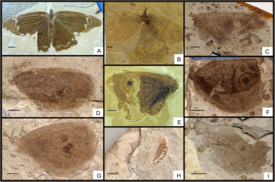 Species diversity of calligrammatis | |||||||||||||||||||||||||||||||||||||||||
| Scientific classification | |||||||||||||||||||||||||||||||||||||||||
|---|---|---|---|---|---|---|---|---|---|---|---|---|---|---|---|---|---|---|---|---|---|---|---|---|---|---|---|---|---|---|---|---|---|---|---|---|---|---|---|---|---|
| |||||||||||||||||||||||||||||||||||||||||
| International Scientific Name | |||||||||||||||||||||||||||||||||||||||||
Kalligrammatidae Handlirsch, 1906 | |||||||||||||||||||||||||||||||||||||||||
| Geochronology 161.2-112.6 Ma
◄ Nowadays◄ Cretaceous-Paleogene extinction◄ Triassic extinction◄ Perm mass extinction◄ Devonian extinction◄ Ordovician-Silurian extinction◄ Cambrian explosion | |||||||||||||||||||||||||||||||||||||||||
The similarity of a number of features of the morphology and ecology of calligrammatids with lepidoptera (butterflies) led to the fact that in English they are sometimes called “butterflies of the Jurassic period” (butterflies of the Jurassic) [2] , although they belong to a completely different order of insects.
Spread
Representatives of the family are known by fossil remains from sediments of Western Europe, the British Isles , Central Asia and China . Most of the described species (31 species) are known from the Jurassic and Cretaceous fossils found in China. Eight species are known from Kazakhstan , two types of fossils were found in Russia . One species is described from Mongolia . Four species have been described from the territory of Germany , and another from the UK [2] . Only one genus, including two species, was described from the territory of Brazil [3] . The genus Kalligrammula was widely distributed in Europe and Asia up to the middle of the Cretaceous, which confirms the version that the nature of the flora in these territories could be fairly uniform.
The most ancient members of the family are described by the fossils of the Callovian tier of the Haifanggou and Daohugou formations in China [4] [5] . The species inhabited in the Jurassic period are known from Asia and Europe. Species from the Cretaceous period are less common, their finds are known from Eurasia. The most recent finds of the family are found in Cretaceous Burmese amber [6] .
Morphology
Because of the lifestyle similar to butterflies, calligrammatids acquired many common features with them [7] .
All species are known for fossil compression prints, which are preserved in the layers of soft sedimentary rock. Many species are known only from the prints of the front of the torso or wings, some from the completely preserved prints. Antennae, usually no longer than the front wings, of simple structure, filiform.
There is a variation of the oral apparatus, which is usually represented by a long proboscis from 8 to 20 mm, but some basal species have more clearly arranged jaws. On the sides of the proboscis were long densely pubescent maxillary palpi, like in modern butterflies from the Nymphalidae family . Inside the proboscis of one of the fossils were found the remains of the sweetish liquid of an ancient plant. However, on the bodies of most of the specimens studied, paleoentomologists could not find pollen. The only exception was the Kazakhstani representative of the genus Meioneurites - pollen grains of conifers Cheirolepidaceae were found on its maxillary palpi. Perhaps the special ribbed scales covering the palpi were intended to carry pollen [7] .
The length of the front wing is usually more than 50 mm, an average of 70-90 mm. The wings are large, ovate or triangular in shape, often with an oculate spot located in their center and numerous closely spaced branching veins [2] . The system of parallel veins occupies almost the entire wing. A significant part of it is formed by veins MP [8] . Also for the venation of the wings of representatives of the family are characterized by numerous transverse veins [8] .
Most species also have distinctly developed scales on their wings, similar to those of modern lepidoptera (butterflies). Two types of scales are distinguished: with a broad base, tapering towards the tip, and narrower, having a spatulate shape [7] . The Makarkinia kerneri species has the largest wing length among the well-known representatives of the retina-wing squad, which reached 100–160 mm [3] , therefore, the wingspan of this species was over 32 cm. It comes from sediments of the Brazilian Santana formation about 110 Ma. Its closely related species Makarkinia adamsi had a wingspan of up to 160 mm. Like the butterflies, the wings of the family members were covered with scales, but their location was different - they had large scales with 3–8 longitudinal ribs on the main veins of the wing, and smaller scales on the other sections. While the butterflies scales on the veins, as a rule, are absent. On the wings of many calligraphies, like many modern daytime butterflies, there were eye spots. According to the results of spectroscopy, their pattern was formed by a cluster of melanin pigment, like in butterflies [7] .
Species of at least one genus, Oregramma , possess an elongated egg-shaped spear.
Paleobiology
It is believed that large body size and large wings made members of the family bad flyers [2] . Colored patterns on the wings of many species indicate that they were diurnal, like modern butterflies. Ocular spots on the wings of many species, for example the genus Sophogramma [2] , served to scare off potential predators. The structure of the oral apparatus suggests that members of the family were probably pollinators and fed on pollen and sap of conifers [2] [3] [9] from the family Bennettitales and Cheirolepidiaceae [4] [9] . Eating pollen is unique to the retinae, as most modern species are predators. Among modern retinopterans, only representatives of the Nemopteridae group feed on pollen.
Probably, calligrammatids injected their eggs into vegetable shoots with their long ovipositories, and their hatched larvae gnawed in them the passages. The proof of this theory can serve prints Bennettitovyh plants, eaten from the inside of the moves [7] .
In the middle of the Cretaceous period, the first flowering plants appeared, which supplanted the gymnosperms with which the members of the family were associated, which probably caused their extinction [7] .
Classification
- Kalligrammatinae
- Angarogramma
- Kalligramma
- Kalligrammina
- Limnogramma
- Sinokalligramma
- Kalligramma
- Kallihemerobiinae
- Affinigramma
- Apochrysogramma
- Huiyingogramma
- Kalligrammula
- Kallihemerobius
- Lithogramma
- Stelligramma
- Apochrysogramma
- Meioneurinae
- Meioneurites
- Oregrammatinae
- Abrigramma
- Itthigramma
- Oregramma
- Itthigramma
- Sophogrammatinae
- Protokalligramma
- Sophogramma
- Childbirth incertae sedis
- Makarkinia
- Palparites
- Angarogramma
Phylogeny
The estimated phylogeny of the family [2] :
| Kalligrammatidae |
| ||||||||||||||||||||||||||||||||||||||||||||||||||||||||||||||||||||||||||||||||||||||||||
See also
- Makarkinia adamsi
Notes
- ↑ Panfilov D.V. Calligrammatids (Neuroptera, Kalligrammatidae) from the Karatau Jurassic Deposits // Jurassic Insects Karatau. - M .: Science, 1968. - P. 166-174.
- ↑ 1 2 3 4 5 6 7 Yang, Q .; Wang, Y .; Labandeira, CC; Shih, C .; Ren, D. Mesozoic lacewings from China provide phylogenetic insight into the Kalligrammatidae (Neuroptera) (Eng.) // BioMed Central : journal. - 2014. - Vol. 14 - P. 126 . - DOI : 10.1186 / 1471-2148-14-126 .
- ↑ 1 2 3 Bechly, G .; Makarkin, VN A new gigantic lacewing species (Insecta: Neuroptera) from the Lower Cretaceous of Brazil confirms the occurrence of the Kalligrammatidae in the Americas (Eng.) // Cretaceous Research: journal. - 2016. - Vol. in press . - DOI : 10.1016 / j.cretres.2015.10.014 .
- ↑ 1 2 Liu, Q .; Khramov, AV; Zhang, H .; Jarzembowski, EA Two new species of Kalligrammula Handlirsch, 1919 (Insecta, Neuroptera, Kalligrammatidae) from the Jurassic of China and Kazakhstan (Eng.) // Journal of Paleontology : journal. - Paleontological Society , 2015. - Vol. 89 P. 405-410 . - DOI : 10.1017 / jpa.2015.25 .
- ↑ † Kalligammatidae (English) information on the Fossilworks website. (Checked February 1, 2016)
- ↑ Qing Liu, Xiumei Lu, Qingqing Zhang, Jun Chen, Xiaoting Zheng. High niche diversity in Mesozoic pollinating lacewings (English) // Nature Communications. - 2018-09-17. - Vol. 9 , iss. 1 . - ISSN 2041-1723 . - DOI : 10.1038 / s41467-018-06120-5 .
- ↑ 1 2 3 4 5 6 Labandeira, CC; Yang, Q .; Santiago-Blay, JA; Hotton, CL; Monteiro, A .; Wang, Y.-J .; Goreva, Y .; Shih, CK; Siljeström, S .; Rose, TR; Dilcher, DL; Ren, D. The evolutionary convergence of mid-Mesozoic lacewings and Cenozoic butterflies (Eng.) // Proceedings of the Royal Society B: Biological Sciences: journal. - 2016. - Vol. 283 , no. 1824 . - DOI : 10.1098 / rspb.2015,2893 .
- ↑ 1 2 B. B. Rodendorf, A. P. Rasnitsyn (ed.). The historical development of the class of insects. Proceedings of the Paleontological Institute, vol. 178. - M .: Nauka, 1980. 256 p.
- 2 1 2 Labandeira, CC The long-proboscid insects ( CCA ) : Annals of the Missouri Botanical Garden: journal. - 2010. - Vol. 97 , no. 4 - P. 469-513 .