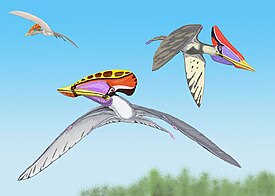
The genus was named and described by and Diogen de Almeida Campos in 1988 [2] .
Typical species is Tupuxuara longicristatus . The generic name is taken from the mythology Tupi and means the evil spirit, and its specific name is translated from the Latin language as "long crest".

Rebuilt Skull
T. deliradamusThe holotype MN 6591-V was found in the Cretaceous sediments of in Brazil . It consists of an incomplete skull and fragments of wing bones. Mature T. longicristatus specimens had a large, wide crest, which stretched from the beak. Later a large amount of fossil material was found, showing significant differences in morphology . Some researchers attribute this to intraspecific diversity caused by age or field differences. However, others suggest that several species of Tupuxuara existed. In 2006, David Martill and from the University of Portsmouth described an adolescent individual with an underdeveloped crest, which supports the assumption of the crest as an indicator of age maturity.
In 1994, Kellner and Campos gave the name to the second species - Tupuxuara leonardii . The specific name is given in honor of Giuseppe Leonardi [3] . The holotype is MN 6592-V, a partial skull with a more rounded crest. To T. leonardii other material of a similar sense was attributed: the largest skulls, 130 centimeters long, indicating an animal's wingspan of 5.5 meters.
In 2009, Mark Paul Whitton described a third species - Tupuxuara deliradamus , the holotype of which is SMNK PAL 6410, the skull. The other skull, KPMNH DL 84, is a paratype . The specific name is made up of Latin words Lat. delirus - “crazy” and adamas - “invincible” or “diamond”. This species has a characteristic diamond-shaped through hole in the skull and low eye sockets. The name is given in honor of the song " Shine On You Crazy Diamond " by the British group Pink Floyd , one of the favorite groups of Whitton [4] .
It was suggested that Tupuxuara fed on fish that it caught on the coast of modern South America . Another hypothesis states that she ate fruit. Comparison of eye rings with similar bone formations in modern birds and reptiles indicates the daily life of the genus.
Kellner ranked Tupuxuara to the family of taperides within the treasures of the azhdarchoid . However, according to some data from the analysis, the genus is closer to the azhdarchids (a group that includes the giant quetzalcoatl ) than to the Tapejera and its relatives. The cladogram presented below reflects the data of the analysis conducted by Felipe Pinheiro and his colleagues in 2011 [5] :
| Azhdarchoidea |
| Azhdarchidae |
| | Tapejaridae | | Thalassodrominae |
| Thalassodromeus sethi |
|
|
| Tupuxuara deliradamus |
|
| Tupuxuara leonardii |
|
|
|
|
|
|
| Chaoyangopterinae |
|
| Tapejarinae |
|
|
|
|
|
|
|
Classification
According to the Paleobiology Database website, as of December 2018, 3 extinct species are included in the genus [1] :
- Tupuxuara deliradamus Witton, 2009
- Tupuxuara leonardii Kellner & Campos, 1994
- Tupuxuara longicristatus Kellner & Campos, 1988 typus [ syn. Tepuxuara longicristatus (Kellner & Campos, 1988) , orth. var. ]