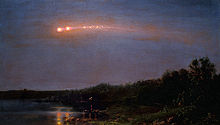
A touched (flying) meteor is a meteoroid flying through the earth's atmosphere and then continuing its movement in space. Sometimes its fragments can fall to the Earth in the form of meteorites if the meteoroid began to fall apart or exploded in dense layers of the atmosphere . Due to the fact that the friction of the Earth’s atmosphere reduces the mass and speed of the meteor , when the object leaves it, the orbit of the object will be changed [1] [2] [3] . The most famous examples are the Big Car of 1860 and the Big Daytime Car of 1972 [4] .
Known Touching Meteors
Since the affected meteors are a very rare occurrence, as of 2008 only 4 cases were correctly recorded and described [5] , although much more individual observations are known.
1860 Big Car
On July 20, 1860, in the evening in the sky over the USA, eyewitnesses saw the asteroid decay. It is believed that it was he who was captured in his works by the American artist Frederick Edwin Church (see the heading of the article) and the poet Walt Whitman (poem Year of the Meteors [6] ). 150 years later, in 2010, it was established that this meteor was touched [1] , that is, this is the first recorded observation of such an object.
The Great Procession of 1913 Meteors

On February 9, 1913, a stream of bright fireballs was observed over North America, slowly crossing the sky one after another in several groups. Based on their speed and direction of movement, a hypothesis was put forward that they are the remains of a small natural satellite of the Earth - an asteroid or a group of meteoroids, which were in Earth orbit for some time and, due to its change, plunged into the atmosphere. [7] .
1972 Big Daytime Car
The most famous passage of a meteor through the atmosphere occurred on August 10, 1972. At 14:29 pm local time (20:29 UTC), the asteroid US19720810 passed at a speed of 15 km / s in the sky over the United States and Canada , breaking 57 kilometers. Its size is estimated from 3 to 14 meters, and after departure from the earth's atmosphere, it could decrease by a third or even half. The car was so bright that it could easily be seen in the daytime sky, for which it got its name. [4] [3]
1990 Meteor
On October 13, 1990, asteroid EN131090 , having a mass of 44 kg, flew over Czechoslovakia and Poland at a speed of 41.74 km / s [8] . This event is interesting in that, thanks to several observation points, one can name the exact height of the span (about 100 km), the brightness of the asteroid (-6 sound magnitude ), its exact weight, coordinates and even the parameters of the orbit before and after entering the atmosphere [9] .
2006 Meteor
March 29, 2006 in the sky over Japan, a meteor at a speed of 18.8 km / s passed 71.4 kilometers in the Earth’s atmosphere .
2007 Meteor
On August 7, 2007, asteroid EN070807 passed through the Earth's atmosphere in the sky over Europe. It belongs to a rare group of small bodies of the solar system - atons [5] .
2012 Meteor
On June 10, 2012, a meteor that touched 510 km was seen over Spain . It was the dimmest touched meteor in the history of observations, as well as the first to be associated with the meteor shower (Daytime ζ-Perseids) [10] .
2014 Christmas Meteor
On December 24, 2014, a slowly flying Christmas Meteor was spotted. SPMN241214 covered about 1200 km over northern Africa , Spain and Portugal [11] .
Notes
- ↑ 1 2 Texas State astronomers solve Walt Whitman meteor mystery: University News Service: Texas State University . Date of treatment October 19, 2013 .. Txstate.edu (2010-05-28). Retrieved on 2013-10-19.
- ↑ Images of Harper's Weekly front page story
- ↑ 1 2 Daylight Fireball of August 10, 1972 (January 20, 2005). Date of treatment February 3, 2017. Archived January 20, 2005.
- ↑ 1 2 Astronet> The big daytime car of 1972, which touched the Earth . www.astronet.ru. Date of treatment February 18, 2016.
- ↑ 1 2 Spurný, P. Spurný; J. Borovička; Z. Ceplecha; L. Shrbený. Precise Multi-instrument Data on 45 Fireballs Recorded over Central Europe in the Period 2006-2008 // Asteroids, Comets, Meteors: journal. - Czech Republic: Astronomical Institute of the Academy of Sciences, Fričova 298, CZ-251 65 Ondřejov Observatory, 2008.
- ↑ ... Nor the strange huge meteor procession, dazzling and clear, shooting over our heads, // (A moment, a moment long, it sail'd its balls of unearthly light over our heads, // Then departed, dropt in the night, and was gone;) Full text on Best-Poems.Net
- ↑ John A. O'Keefe. A Probable Natural Satellite: The Meteor Procession of February 9 1913 // Journal of the Royal Astronomical Society of Canada. - 1959-04-01. - T. 53 . - S. 59 . - ISSN 0035-872X .
- ↑ Borovicka, J. & Ceplecha, Z. SAO / NASA Astrophysics Data System (ADS) . SAO / NASA Astrophysics Data System (ADS) . SAO / NASA Astrophysics Data System (ADS).
- ↑ Pavel Spurný. Recent fireballs photographed in central Europe (English) // Planetary and Space Science . - Elsevier , 1994-02-01. - Vol. 42 , iss. 2 . - P. 157-162 . - DOI : 10.1016 / 0032-0633 (94) 90027-2 .
- ↑ José M. Madiedo, Francisco Espartero, Alberto J. Castro-Tirado, Sensi Pastor, José A. de los Reyes. An Earth-grazing fireball from the Daytime ζ-Perseid shower observed over Spain on 2012 June 10 // Monthly Notices of the Royal Astronomical Society . - Oxford University Press , 2016-07-21. - Vol. 460 , iss. 1 . - P. 917-922 . - ISSN 0035-8711 . - DOI : 10.1093 / mnras / stw1020 .
- ↑ PRELIMINARY SPECTROSCOPIC AND DYNAMICAL ANALYSIS OF AN EARTH-GRAZER FIREBALL OBSERVED ON DECEMBER 24, 2014 . 47th Lunar and Planetary Science Conference (2016).