Kallaste ( Est. Kallaste ), until 1923, Red Mountains [1] - a city in the extreme east of Estonia in the county of Tartu , on the shores of Lake Peipsi . The population lives by fishing. Kallaste is a separate urban municipality and is not part of any parish. Most of the population is Russian . Estonians make up about 15%.
| City | |||||
| Kallaste | |||||
|---|---|---|---|---|---|
| Kallaste | |||||
 | |||||
| A country |  Estonia Estonia | ||||
| Status | city municipality | ||||
| County | Tartumaa | ||||
| Burgomaster | Maye Nisu | ||||
| History and Geography | |||||
| Based | XVIII century | ||||
| Former names | Red mountains [1] | ||||
| City with | 1938 | ||||
| Square | 1.93 km² | ||||
| Timezone | UTC + 2 , in summer UTC + 3 | ||||
| Population | |||||
| Population | 920 [2] people ( 2012 ) | ||||
| Density | 606.3 people / km² | ||||
| Digital identifiers | |||||
| Telephone code | +372 74 | ||||
| Car code | T | ||||
| kallaste.ee (est.) | |||||


Content
Title
The name of the city comes from the Estonian word kallas ( coast ). In Russian, the settlement was formerly called "Red Mountain", "Red Mountains" or "Red Posad", which is associated with red sandstone , characteristic of the area.
History
The resettlement of the Vodi and Russian tribes to the lands occupied by the town took place in the XIII-XV centuries and at the end of the XVI and especially at the beginning of the XVII century, among the many people living on the coast there were many Russians, whose descendants mostly settled down. The new wave of immigrants was made by the Old Believers from Novgorod who fled from the church reform of Patriarch Nikon, who laid the foundation for the modern fishing village, founded in the XVIII century on the lands of Kokor Manor. [3]
Until 1918, it was part of the Livonia province of the Russian Empire . In 1921 it became a village, in 1938 - a city. In 1950-1959 was the center of the Kallaste district .
Nature
The city has the longest exposure of Estonian Devonian sandstone. Its dimensions: length 930 m, maximum height 8 m (according to measurements of 2001). There are also a number of caves and soil fractures.
Population
| 1897 | 1922 | 1934 | 1939 | 1940 | 1941 | 1959 | 1970 | 1979 | 1989 | 2000 | 2010 | 2012 |
|---|---|---|---|---|---|---|---|---|---|---|---|---|
| 1354 | 1627 | 1605 | 1570 | 1616 | 1091 | 1668 | 1604 | 1431 | 1328 | 1195 | 1115 | 920 |
National composition ( 2000 ): Russians - 72.91%, Estonians - 21.14%.
Confessional composition ( 2000 ): Orthodox Christians - 17.55%, Lutherans - 7.10%, other faiths (mainly Old Believers) - 36.21%, non-believers, atheists, etc. - 39.15%.
Gallery
Peipsi Lake
Coast
Devon outcrop
Peipsi Lake
Outcrop
On the shores of Lake Peipsi
View of Kallaste
Kallaste (main street)
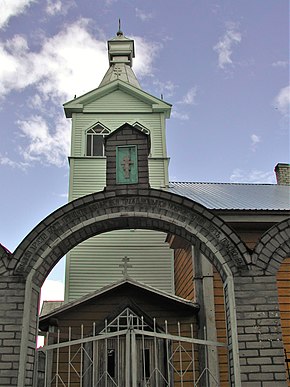
Orthodox Church
Building in Kallast
Bus station
Monument to Soviet soldiers
Orthodox cemetery
Notes
Links
- Russian site about the city of Kallaste
- Kallaste. A bit of history
- Republic of Estonia, Kallaste ( inaccessible link) (inaccessible link from 03/17/2016 [1250 days])
- Old Believer community of Kallaste