Echinopla melanarctos (lat.) - a species of ants of the genus Echinopla from the subfamily formicina (Formicinae, Camponotini ). They are found in Southeast Asia ( Indonesia , Malaysia , Singapore ) [1] .
| Echinopla melanarctos |
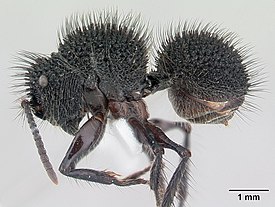
Ant Echinopla melanarctos |
| Scientific classification |
|---|
| No rank : | Bilateral symmetrical |
| Subtype : | Tracheo-breathing |
| Infraclass : | Winged insects |
| Treasure : | Fully Transformed Insects |
| View: | Echinopla melanarctos |
|
| International scientific name |
|---|
Echinopla melanarctos Smith, 1857 |
|
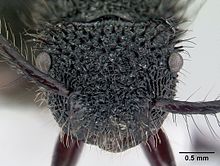
Ant
Echinopla melanarctos , head

Ant
Echinopla melanarctos ,
aerial view
Content
Medium-sized black ants (palps lighter). The length of the workers is from 6.5 to 8.2 mm, the length of the females is from 8.8 to 9.7 mm. The width of the head of workers from 2.05 to 2.44 mm, the width of the head of females from 2.41 to 2.70 mm. It is distinguished by long stiff dark hairs (on the head they are placed on small protrusions), which makes these ants look like small hedgehogs (hence the first part of the generic name, other Greek. Ἐχῖνος - “hedgehog”). The integument is dense. The posterior thorax is round without propodeal teeth, however, the petiol carries several spines from above. Antennae in females and workers are 12-segmented (in males, antennae consist of 13 segments). Stinging workers with 5 teeth. The mandibular palps are 6-segmented, the lower labial palps are composed of 4 segments. Shins of middle and hind legs with one apical spur. The stalk between the breast and the abdomen consists of one segment ( petiol ). The species was first described in 1857, and its validity was confirmed during a generic revision in 2015 by the Austrian myrmecologists Herbert Zettel and Alice Laciny (Zoological Department, Natural History Museum, Vienna , Austria ). Type species of the genus Echinopla [1] [2] [3] .
