Ozovnik ( lat.Ophioglossum ) - a genus of ferns of the family Ozhovnikovye ( Ophioglossaceae ). It includes about 35 species [2] , distributed around the world, mainly in tropical and subtropical habitats [3] , four species are found on the territory of Russia [4] . The name Ophioglossum is literally translated from Greek as “snake language” [3] .
| Widow |
|---|
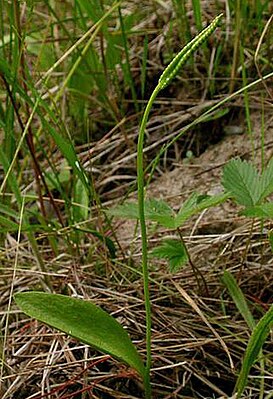
Ophioglossum pusillum Raf. |
|
| The Department: | Fern-shaped |
| Order: | The widows ( Ophioglossales Link , 1833 ) |
|
|
Ophioglossum L. , 1753 |
|
- Cheiroglossa C.Presl
- Ophioderma ( Blume ) Endl.
- Rhizoglossum C.Presl
|
|
Ophioglossum vulgatum L. [1] - Common Odin |
|
The believers got their name due to the fact that their sporophyll and sexual escape resemble the language of a snake . Small herbaceous plants a little over 10 cm tall, with short, non-branching rhizomes. The leaves are small, few, sometimes single, in most cases not dissected, with mesh venation, almost sessile or on the stalk. The sexual shoot departs from the base of the leaf and ends with a sporophyll, sporangia are arranged in two rows and deeply buried in the sporophyll tissue [3] .
Sexual escape is often absent and the plant consists entirely of leaves. The widows may not germinate for several years and live under a layer of soil, eating due to symbiosis with mushrooms .
Representatives of the genus Ouzhovnik have the largest number of chromosomes of all living organisms. The haploid number of chromosomes within the genus for most species is 120, but can vary greatly, as in the Ophioglossum eliminatum population (30, 34, and 60). The absolute record belongs to Ophioglossum reticulatum with a diploid set of 1262 chromosomes per cell [5] (according to other data, 1440) [6] . Most species cost a much smaller number of chromosomes (for comparison, in humans there are only 46) [7] .
