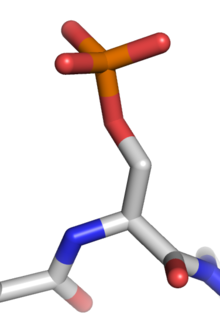
Phosphorylation is the process of transferring a phosphoric acid residue from a phosphorylating donor agent to a substrate , usually catalyzed by enzymes and leading to the formation of phosphoric acid esters [1] :
- ATP + R-OH → ADP + R-OPO 3 H 2
In living cells, phosphorylation is one of the most common types of post-translational protein modification . The processes of phosphorylation and dephosphorylation of various substrates are one of the most important biochemical reactions. They are catalyzed by special enzymes secreted into a special class of kinases , or otherwise phosphotransferases.
So, for example, phosphorylation or dephosphorylation of a protein often regulates the functional activity of a given protein (enhances it, or vice versa, “turns off” this protein functionally).
Phosphorylation is also necessary to obtain active coenzyme forms of many B vitamins . For example, with the double phosphorylation of thiamine , cocarboxylase (a coenzyme of the carboxylase enzyme ) is formed, with the phosphorylation of pyridoxal (the aldehyde form of vitamin B6), pyridoxal-6-phosphate, which is a coenzyme of many amino acid metabolism enzymes, with the phosphorylation of nicotinamide (vitamin PP) - nicotinotinamidefendenide which is a coenzyme in many important redox reactions, etc.
Also, with the phosphorylation of hexoses , the process of glycolysis begins. Phosphorylation of ADP provides energy storage in the form of ATP for its subsequent expenditure. And this is only a small part of the phosphorylation reactions that occur in living cells.
Protein phosphorylation
Reversible phosphorylation of amino acid side chains is a widespread method for regulating the activity of key cell proteins, including enzymes and signaling pathway proteins. About one third of all eukaryotic proteins are believed to be phosphorylated.
The existence of phosphoproteins was already known at the end of the 19th century. At that time, it was believed that their function is the accumulation of nutrients, since phosphocasein was found in milk, and phosphovitins - in egg yolk. Only in the 50s of the XX century it became clear that phosphoproteins are ubiquitous. In a 1954 experiment on casein phosphorylation by mitochondrial homogenate from rat liver cells, it was shown that protein phosphorylation is enzymatic in nature [2] . Historically, phosphorylation of proteins by serine residues was first discovered, then phosphorylation of threonine residues became known. The first tyrosine kinase was discovered in 1980, it was a product of the Routh sarcoma virus src gene [3] .
The protein phosphorylation reaction is understood to mean the addition of a phosphate group via a phosphoester bond (O-phosphorylation) to the hydroxyl group of the side chain of a serine , threonine or tyrosine residue, while the phosphate donor is ATP . In the vast majority of cases, phosphorylation occurs precisely on these three amino acid residues. However, phosphorylation is also found in nature at the residues of histidine and arginine (N-phosphorylation), aspartate and glutamate (A-phosphorylation) [4] . Phosphoric acid esters formed during phosphorylation are very stable, therefore special enzymes, protein phosphatases, are required for their destruction. This creates the basis for fine regulation of the level of protein phosphorylation by controlling the level of the corresponding protein kinases and protein phosphatases.
The introduction of a phosphoric acid residue into a protein molecule, as a rule, changes its properties. This is due to the chemical nature of the phosphate group, which can form hydrogen bonds and electrostatic interactions with the components of the protein molecule. As a result, the spatial structure of the protein and, as a result, its activity and ability to bind to other molecules can change.
Notes
- ↑ phosphorylation // IUPAC Gold Book
- ↑ Burnett, G. and Kennedy, EP The enzymatic phosphorylation of proteins (Eng.) // J Biol Chem : journal. - 1954. - Vol. 211 . - P. 969-980 . - PMID 13221602 .
- ↑ Hunter, T. and Sefton, BM Transforming gene product of Rous sarcoma virus phosphorylates tyrosine (English) // Proceedings of the National Academy of Sciences of the United States of America : journal. - 1980. - Vol. 77 . - P. 1311-1315 . - PMID 6246487 .
- ↑ Arena, S., Benvenuti, S., and Bardelli, A. Genetic analysis of the kinome and phosphatome in cancer (English) // Cell Mol Life Sci : journal. - 2005. - Vol. 62 . - P. 2092-2099 . - DOI : 10.1007 / s00018-005-5205-1 . - PMID 16132230 .