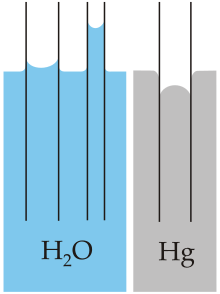
Capillarity (from the Latin capillaris - hairy ; from here comes the term hairiness, previously encountered in Russian-language scientific literature) or the capillary effect - the phenomenon of raising or lowering liquid in capillaries - narrow tubes, channels of arbitrary shape, porous bodies. In the field of gravity (or inertial forces, for example, by centrifuging porous samples), liquid is raised in cases of channels wetting with liquids, for example, water in glass tubes, sand, soil, etc. Liquid is reduced in tubes and channels not wetted by liquid e.g. mercury in a glass tube.
Due to capillarity, the vital activity of animals and plants, various chemical processes, everyday phenomena (for example, lifting kerosene through a wick in a kerosene lamp, wiping hands with a towel) are possible, however, it is important to note that in biological objects the capillary mechanism of fluid movement is not the only one ( osmosis plays an important role )
Content
Applications
The action of wet rags, sponges, towels, napkins, capillary pens, lighters is based on the capillary effect.
The capillary effect is used in non-destructive testing (capillary control or penetrating substance control) to identify defects with access to the surface of the controlled product. Allows you to identify cracks with an opening of 1 μm, which are not visible to the naked eye.
It is also used in paper chromatography .
See also
- Capillary
- Meniscus (hydrostatics)
- Wetting
- Juren's formula
Literature
- Prokhorenko P.P. Ultrasonic capillary effect / P.P. Prokhorenko, N.V. Dezhkunov, G.E. Konovalov; Ed. V.V. Klubovich. 135 s Minsk: “Science and Technology”, 1981.
- Volosnost // Brockhaus and Efron Encyclopedic Dictionary : in 86 volumes (82 volumes and 4 additional). - SPb. , 1890-1907.
Links
- Gorin Yu. V. Index of physical effects and phenomena for use in solving inventive problems (TRIZ-tool) // Chapter. 1.2 Surface tension of liquids. Capillarity.
- Capillary phenomena, video