The decapod crustaceans ( lat. Decapoda ) is an extensive detachment of the class of higher crayfish , containing about a third of all its species - about 15,000 modern and 3,000 fossil species [1] . The decapod cancers are characterized by a symplastic structure of the heart muscle, unlike other multicellular ones, whose heart has a cellular structure. Of particular commercial interest are representatives of the lobster family.
| Decapod crustaceans | |||||||||||||||||||||||||||
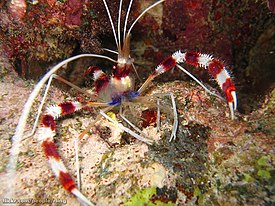 Ribbon Coral Shrimp ( Stenopus hispidus ) | |||||||||||||||||||||||||||
| Scientific classification | |||||||||||||||||||||||||||
|---|---|---|---|---|---|---|---|---|---|---|---|---|---|---|---|---|---|---|---|---|---|---|---|---|---|---|---|
| |||||||||||||||||||||||||||
| International scientific name | |||||||||||||||||||||||||||
Decapoda Latreille , 1802 | |||||||||||||||||||||||||||
| Suborders | |||||||||||||||||||||||||||
| |||||||||||||||||||||||||||
Content
Taxonomy
The classification within the order of decapod crustaceans is based on the structure of the gills and legs, as well as how their larvae develop. According to these characteristics, the order of decapod crustaceans is divided into two suborders, Dendrobranchiata and Pleocyemata . Dendrobranchiata contains a variety (but not all) of the shrimp . The structure of Pleocyemata includes all other decapod crustaceans (including real shrimp ) [2] . The decapod crustaceans from the suborder Pleocyemata (with the exception of the Stenopodidea and Caridea groups) are united in the Reptantia clade [3] , a common feature for this group is that they mainly walk along the bottom rather than swimming.
- Suborder Dendrobranchiata
- Superfamily Penaeoidea
- Superfamily Sergestoidea
- Suborder Pleocyemata
- Infraorder stenopodide (Stenopodidea)
- Shrimp Infraorder (Caridea)
- Erion Infraorder (Eryonoidea)
- Spiny lobster (Achelata)
- Infraorder Astacidea
- Moor Crawfish Infraorder (Thalassinidea)
- Half- Tailed Infraorder (Anomura)
- Crab Infraorder (Brachyura)
Gallery
Litopenaeus vannamei
Heterocarpus ensifer
Austropotamobius pallipes
Upogebia deltaura
Panulirus interruptus
Polycheles sculptus
Coenobita variabilis
Callinectes sapidus
Notes
- ↑ Grave S. De, Pentcheff ND, Ahyong ST, Chan TY, Crandall KA, Dworschak PC, Felder DL, Feldmann RM, Fransen CHJM, Goulding LYD, Lemaitre R., Low MEY, Martin JW, Ng PKL, Schweitzer CE, Tan SH, Tshudy D., Wetzer R. A classification of living and fossil genera of decapod crustaceans (Eng.) // The Raffles Bulletin of Zoology . - Lee Kong Chian Natural History Museum 2009. - Vol. 21 (suppl.). - P. 1-109.
- ↑ Elena Mente. Reproductive Biology of Crustaceans: Case Studies of Decapod Crustaceans. - Science Publishers , 2008. - P. 16. - ISBN 978-1-57808-529-3 .
- ↑ G. Scholtz & S. Richter. Phylogenetic systematics of the reptantian Decapoda (Crustacea, Malacostraca) (Eng.) // Zoological Journal of the Linnean Society : journal. - 1995. - Vol. 113 , no. 3 . - P. 289—328 . - DOI : 10.1006 / zjls.1995.0011 .
Literature
- Marin I.N. Small atlas of decapod crustaceans of Russia. - M .: KMK, 2013 .-- 145 p. - ISBN 978-5-87317-887-2 .
- Anosov S. E. Illustrated identifier of Decapoda of the Antarctic sector of the Atlantic and adjacent waters . - M. , 2012.
- Knipovich N. M. The Decapods of Crayfish // Brockhaus and Efron Encyclopedic Dictionary : in 86 volumes (82 volumes and 4 additional). - SPb. , 1890-1907.