Basilosaurids ( lat. Basilosauridae ) - a family of extinct cetaceans that lived in the Eocene seas [1] . The basilosaurus belonging to this family is a purely marine animal.
| † Basilosaurids |
|
| Scientific classification |
|---|
| No rank : | Bilateral symmetrical |
|
| International scientific name |
|---|
Basilosauridae Cope , 1867 |
| Synonyms |
|---|
- according to PBDB [1] :
- Hydrarchidae Bonaparte, 1850
- Hydrarchina Bonaparte, 1850
- Prozeuglodontidae Moustafa, 1954
- Stegorhinidae Brandt, 1873
- Zeuglodontae Bonaparte, 1849
- Zeuglodontidae Bonaparte, 1849
|
Geochronology
Eocene56.0–33.9 Ma | million years | Era | F-d | Era |
|---|
| | Th | TO
but
th
n
about
s
about
th | | 2,588 | | | 5.33 | Pliocene | N
e
about
g
e
n | | 23.03 | Miocene | | 33.9 | Oligocene | P
but
l
e
about
g
e
n | | 55.8 | Eocene | | 65.5 | Paleocene | | 251 | Mesozoic |
◄ Nowadays◄ Cretaceous-Paleogene extinction |
|---|
|
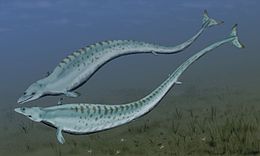
Reconstruction of the appearance of the
basilosaurusDespite all the similarities with modern whales, basilosaurids lacked a frontal-fat protrusion, the so-called melon, which allows the existing cetaceans to effectively use echolocation . The brain of basilosaurids was relatively small, from which it can be assumed that they led a solitary lifestyle and did not have such a complex social structure as some modern cetaceans.
In connection with the transition to a purely aquatic lifestyle, basilosaurids exhibit degradation of the hind limbs - although they are well formed, they are small and can no longer be used for movement. However, perhaps they played a supporting role in mating. The pelvic bones of basilosaurids are no longer associated with the spine, as was the case with representatives of the Protocetidae family. The discovery of the hind limbs at the basilosaurus confirmed the evolution of cetaceans, which descended into the water for the second time [2] .
According to the Paleobiology Database website, as of March 2018, the family includes 14 extinct genera [1] :
- Genus Ancalecetus Gingerich & Uhen, 1996
- Genus Basilosaurus Harlan, 1834 - Basilosaurus
- Genus Basiloterus Gingerich et al. 1997
- Genus Basilotritus Goldin & Zvonok, 2013
- Genus Chrysocetus Uhen & Gingerich, 2001
- Genus Cynthiacetus Uhen, 2005
- Genus Dorudon Gibbes, 1845
- Genus Masracetus Gingerich, 2007
- Genus Ocucajea Uhen et al. , 2011
- Genus Platyosphys Kellogg, 1936
- Genus Saghacetus Gingerich, 1992
- Genus Stromerius Gingerich, 2007
- Genus Supayacetus Uhen et al. , 2011
- Genus Zygorhiza True, 1908
The genus Eocetus , placed by some taxonomists in this family, is assigned to the family Protocetidae [3] .
