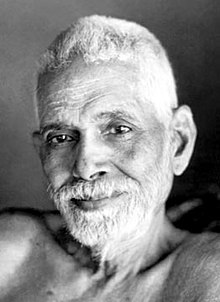
Sri Ramana Maharshi ( December 30, 1879 - April 14, 1950 ) - a famous Indian philosopher and sage . Creator of philosophical teachings based on advaita-vedanta . His philosophy of self-knowledge is focused on the concept of “ I ” and on questions to oneself: “Who am I?”, “What am I?”, Etc. [1] .
Content
- 1 Biography
- 2 Philosophy
- 3 See also
- 4 notes
- 5 Literature
- 6 Related Links
Biography
Sri Ramana Maharshi (nee Venkataraman Aiyar) was born on December 30, 1879 in the village of Tiruchuli (now in the South Indian state of Tamil Nadu ) [1] in a brahmin family. At the age of 16, while studying in college, he went through the experience of death, which led him to understand that he was not a body, but an immortal spirit . This completely changed him. Having thus become a jnani (sage), he left the house and went to the sacred mountain of Arunachala , which is considered the embodiment of Shiva or the Absolute , in the city of Tiruvannamalai , where he remained until his physical death on April 14, 1950. blindfold, for a long time he lived on the offerings of pilgrims. For a long time, he kept Mauna (silence), so when the first students came to him, partly had to restore speech. In 1907, he became known as Bhagavan Sri Ramana Maharshi (Maharshi - Sanskrit (including sandhi ) pronunciation of the word "Maharishi", which means "great sage," and the name Ramana is short for Venkataraman) - blessed Lord Ramana, great sage. An ashram grew around him, from which the teaching was spread that the natural, initial state of man is liberation, which he can gain through self-examination (atma-vicara) through the search for answers and experiences to the question “Who am I?”. Among the famous direct students of Sri Ramana Maharshi are Papaji , Annamalai Swami, Sri Muruganar , K. Lakshmana Sharma (known under the pseudonym “Who”), Robert Adams, Yogi Ramsuratkumar , Papa Ramdas , A. Devaraja Mudalyar, Swami Bharatananda [2] and many others. Indirect followers of the Ramana Maharshi are Arunachala Ramana, Caesar Teruel and others.
The judgments of Ramana Maharshi influenced the famous American philosopher and writer Ken Wilber .
Philosophy
Maharshi is referred to as neo-advaita . His main method is meditative self-examination through the question "Who am I?" Ramana claims that before you try to know the world around you, you must know yourself.
| Your duty is to be, not to be this or that. "I am that I am" concludes all Truth, and the method of practice is summed up in two words: "be calm." And what does silence mean? It means “Destroy yourself,” for any name and form is a cause of excitement. “I Am I” - Atman , your true nature. “I am this or that” is the ego, your illusory nature. When I am preserved only as I, this is the Atman. When it suddenly deviates from itself and says “I am this and that” - this is already the ego. |
Following the method of the Maharshi and asking, “Who is this“ I? ”, The seeker explores the origin, nature and source of himself, the self-awareness of the“ I ”. He discovers that the "I", which, according to the general opinion, conducts all these practices, is not existing, but only an appearance. As a result, he discovers his true nature - that the only Reality is the higher Self, absolute calm, unclouded by excitement; One-without-the second, whose nature is sat-chit-ananda (being-consciousness-bliss).
You ask yourself: “Who am I?” And try to keep the whole mind focused on getting an answer to this question. True, various uninvited thoughts will arise inside you and try to distract your attention. However, for all these thoughts, the thought “I” is a source and food. Therefore, as soon as this or that thought appears, ask, not allowing its development: “Who is aware of this thought?” The answer will be: “I”. Then ask yourself: “Who is this 'I' and where from?”; while there is a calming of the thought that has arisen. As thoughts arise, they should be destroyed using the self-inquiry “Who am I?” When all thoughts disappear, then the central or root thought - “I”, mind or ego - will also cease to exist, and the true nature, the true “I ”, One thing will shine - silently, spontaneously, not described by the mind, something that can be experienced only after the mind (that is, thoughts) ceases to exist. To abide in one's True nature (Skt. Atman), because the ego, the thought “I am a body”, has disappeared completely, without a trace, like a river that has become one with the ocean - these are the sages and are called Liberation (moksha-mukti).
See also
- Papaji
- Nisargadatta Maharaj
- Swami Abhishiktananda
Notes
- ↑ 1 2 Ramana Maharishi (Venkataramana Aiyar) // Hinduism. Jainism. Sikhism: Dictionary. - M .: Republic. M.F. Albedil, A.M. Dubyansky. 1996.
- ↑ Meeting Maharaj by Cathy Boucher
Literature
- Atma Ananda (Nikolaev M.) Ramana Maharshi. After three deaths. Ritambhara, Postum, 2008 .-- 128 p. ISBN 978-5-91478-006-4 ; 2008 year
- Conversations with Sri Ramana Maharshi. Comp. and per. from English O.M. Mogilever. - 2nd ed., Rev. / M. - Tiruvannamalai: Ganga Publishing House - Sri Ramanashram, 2006. - T. 1. - 472 p. ISBN 5-98882-017-4
- Conversations with Sri Ramana Maharshi. Per. from English Yu. A. Butor and O.M. Mogilever, comp. O. M. Mogilevera / M. - Tiruvannamalai: “The Ganges” - Sri Ramanashram, 2006. - T. 2. - 478 p. ISBN 5-98882-004-2
- Branton P. Journey to Secret India. Per. from English - M.: Sphere, 2002 .-- 416 p.
- Godman D. Memoirs of Ramana Maharshi. Meetings leading to transformation. Per. V. Remizova. M .: Ganga, 2014.488 s. ISBN 978-5-906154-44-6
- Godman D. Life with Ramana Maharshi. Memoirs of Annamalai Swami. M .: Ganga, 2011.288 s. ISBN 978-5-98882-131-1
- Godman D. Transforming encounters with Ramana Maharshi. Per. V. Ivanova. M .: Ganga, 2014.376 s. ISBN 978-5-906154-52-1
- Godman D. The Light of Arunachala. Conversations with Ramana Maharshi and Annamalai Swami. M .: Ganga, 2011.320 s. ISBN 978-5-98882-132-8
- Godman D. The Power of Presence. Meetings leading to transformation. M .: Ganga, 2012.V.1. 384 p. ISBN 978-5-98882-171-7
- Godman D. The mind has disappeared, I am the Being. Biographies and teachings of Sri Lakshmana Swami and Matra Sri Sarada. Comp. and per. from English O.M. Mogilever. St. Petersburg: Inner Way, 2010. 304 p. ISBN 978-5-903696-14-7
- Day after day with Bhagavan Sri Ramana Maharshi. From the diary of A. Devaraj Mudalyar. St. Petersburg, Tiruvannamalai: Inner Path, Sri Ramanashram, 2013 .-- 496 p. ISBN 978-5-4391-0054-5
- The spiritual teaching of Raman Maharshi (Foreword by K. G. Jung). M., 1990
- Kaida A.A. Advaita Vedanta and Sri Ramana Maharshi: innovations in practice. // The Way of the East: Traditions and Modernity. Symposium Series, The Way of the East Conference, Issue 28. / Materials of the V Youth Scientific Conference on Philosophy, Religion, and Culture of the East St. Petersburg: St. Petersburg Philosophical Society, 2003. P.42-43.
- Kaida A. A. The method of self-examination of Sri Raman Maharshi as a means of spiritual development. // The Way of the East: The Problem of Methods. Symposium Series, The Way of the East Conference, Issue 10. / Proceedings of the IV Youth Scientific Conference on Philosophy, Religion, and Culture of the East St. Petersburg: St. Petersburg Philosophical Society, 2001. C.6-7.
- Maha Yoga, or Tradition of the Upanishads in the light of the teachings of Bhagavan Sri Ramana. Comp. and per. from English O.M. Mogilevera, 2009 .-- 320 p.
- Letters from Sri Ramanashram. Everlasting Living Wisdom and Love of Bhagavan Sri Ramana Maharshi. St. Petersburg, Tiruvannamalai: Inner Path, Sri Ramanashram, 2014. 640 pp. ISBN 978-5-4391-0110-8
- Premananda. Arunachala Shiva. Comments on the teachings of Sri Ramana Maharshi “Who Am I?” K .: Open Sky. - 402 s. ISBN 978-617-7161-15-7
- Premananda. Notes to Awakening. K .: Open Sky, 2014 .-- 370 p. ISBN 978-617-7161-07-2
- Fedorenko G.G. Atma-vicara Ramana Maharshi in the context of advaita-vedanta.// 20th Century Philosophy: Schools and Concepts. Materials of the work of the section of young scientists “Philosophy and Life”. Materials of the scientific conference November 21, 2000 St. Petersburg, 2001, p. 280-283.
- Sri Muruganar. Guru Wachaka Kovai. A collection of oral instructions from Sri Ramana Maharshi. Translated from English by A. Kiselev, O. Korotkov. M .: Ganga, 2014.596 s. ISBN 978-5-906154-86-6
- Sri Muruganar. Padamalai. Instructions of Raman Maharshi. Translated from English by M. Rotter. M.: Ganga, 2015.552 s. ISBN 978-5-9906742-8-8
- Sri Ramana Maharshi. Be who you are. Sri Ramana Maharshi's Instructions. Comp. D. Godman. (compilation and translation by Mogilever O.M.) M .: Ganga, 2005.
- Sri Ramana Maharshi: The Message of Truth and the Direct Path to Myself (compilation and translation by Mogilever O.M.) Leningrad, 1991.
- Sri Ramana Maharshi: Life and the Way. Comp. and per. from English O. M. Mogilever / Ed. N. Sutara. - SPb. - Tiruvannamalai: “Ecopolis and Culture” - Sri Ramanashram, 1995. - 416 p.
- Sri Ramana Maharshi. Collection of works. Comp. and per. from English O.M. Mogilever. - 2nd ed., Rev. and add. - M. - Tiruvannamalai: Publisher K.G. Kravchuk - Sri Ramanashram, 2003 .-- 494 p.
- Sri Ramana Gita (Song of Sri Ramana). Per. with use. Skt. orig. and comp. Russian ed. O. M. Mogilever / St. Petersburg. - Tiruvannamalai: “Ecopolis and Culture” - Sri Ramanashram, 1996. - 240 p.
Related Links
- Official website of Sri Ramana Maharshi: https://web.archive.org/web/20130828074451/http://www.sriramanamaharshi.org/
- Website dedicated to Bhagavan Sri Ramana Maharshi (ru)
- List of Sri Ramana Maharshi Books at the Russian State Library
- Library of the Russian site, books in electronic version (c)
- The film "Sage Arunachaly" in Russian, translation by Oleg Markovich Mogilever
- Arunachala - Holy Mountain
- Tiruvannamalai - photo gallery
- Picasa Web Album