The Battle of Fossalt ( Italian: Battaglia di Fossalta ) - the battle of May 26, 1249, during which the militia of Bologna , part of the Lombard League , defeated the forces of the Holy Roman Empire , who defended Modena .
| Battle of Fossalt | |||
|---|---|---|---|
| Main Conflict: Guelph and Ghibelline Wars | |||
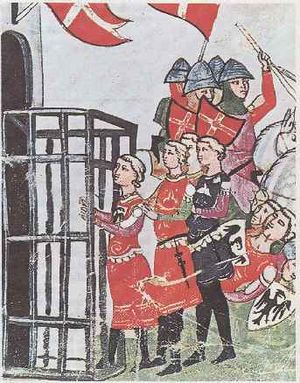 The Bologna militia introduces the captive king Enzo into the city. | |||
| date | May 26, 1249 | ||
| A place | surroundings of modena | ||
| Total | Lombard League victory | ||
| Opponents | |||
| |||
| Commanders | |||
| |||
| Forces of the parties | |||
| |||


Content
Background
The lands of Bologna, where Guelphs prevailed, bordered on the possessions of Modena, which remained faithful to the Holy Roman Empire, which contributed to the emergence of conflicts. The subject of controversy since the 12th century has been the claims of both sides on the monastic estates of Nonantola and jurisdiction over . The confrontation lasted with different results for the rivals, but was interrupted for the period of the struggle of the Lombard League , which included both cities, with Emperor Frederick Barbarossa . With the onset of the 13th century, rivalry between cities resumed. In 1226, Bologna joined Milan , Piacenza , Brescia , Treviso and Padua as part of the renewed Lombard League, and Modena ended up in a pro-imperial camp with Parma , Reggio Emilia , Pavia and Bergamo , the lands of Modena became a battlefield between opposing forces in the 1230s and the 1240s.
In the city itself, the struggle between the Guelph party Aigoni (Aigoni) with the participation of the families of Rangoni, Bosketti, Sassuolo, Savignano and others, and the Ghibellines led by the Grasolfi family continued. In 1247, the defeated Aigoni were expelled and took refuge in Bologna [1] [2] .
In 1248, with the support of Bologna, Aigoni captured the Modena Nonantola and Savignano sul Panaro . By this time, the military-political situation in the confrontation between the Lombard League and the new Emperor Frederick II was not in favor of the latter: the Ghibellines were defeated in February 1248 by the siege of Parma , and the new Guelph victory could finally tip the scales in their favor.
Battle
In 1249, the King of Sardinia, Enzo , the bastard of Emperor Frederick II and the Imperial General Vicar, arrived in Cremona on his own wedding with a relative of the influential Gibellin Ezzelino da Romano (his bride’s name has not been preserved). In February of the same year, after a siege, he stormed the rebel castle of Rolo nel Reggiano, ordering to hang about a hundred of his defenders [3] .
At noon on May 26, 1249, King Enzo stepped out of Cremona to help Modena, attacked by the Bologna militia, led by the submarine Filippo degli Ugoni. The papal army under the command of the legate of Cardinal Ottaviano Ubaldini and the detachment of the Marquis Ferrara Azzo VII d'Este contributed to the Bologna. This entire invading army on the way to Modena stopped at the Panaro River with the aim of guiding a crossing for a convoy and siege vehicles.
At three o'clock in the afternoon, Enzo reached Panaro and attacked the Bologna sappers , busy logging for the construction of the bridge. Those in a panic rushed to wade across the river, but the sudden massive attack of the Bologna cavalry from the flanks took the imperial troops by surprise and crushed their battle formations. Enzo gave a signal to retreat, but he himself with his German knights remained to cover the withdrawal of the main forces. In Fossalt, due to the rising water level in Tiepido, the movement of the imperial troops slowed down, the formation was disturbed, and from this point to Modena itself it continued in the form of an erratic escape.
The battle developed along the line that connected the Emilian road , starting from the gates of St. Ambrose, crossed the turbulent River in the town of Fossalt and continued to San Lazzaro, one and a half kilometers from the gates of the same name Modena.
In San Lazzaro, King Enzo was thrown from the saddle and taken prisoner. Together with him, 1,200 infantrymen and 400 knights were captured, including the commander of the militia and Reggio Emilia Marino da Eboli’s . Modena was besieged and surrendered a year later. After some time, the prisoners were released for ransom, except for King Enzo, who remained an honorary captive of Bologna until his death, which followed 22 years later [4] .
Notes
- ↑ Aigoni (Italian) . Enciclopedie on line . Treccani Date of treatment February 3, 2016.
- ↑ Grasolfi (Italian) . Enciclopedie on line . Treccani Date of treatment February 3, 2016.
- ↑ ENZO di Svevia, re di Sardegna (Italian) . Dizionario Biografico degli Italiani - Volume 43 . Treccani (1993). Date of treatment February 5, 2016.
- ↑ Andrea Frediani. La storia del mondo in 1001 battaglie . - Newton Compton Editori, 2015 .-- ISBN 978-88-5418-803-7 .
Links
- Francesca Roversi Monaco. FOSSALTA (Italian) . Federiciana . Treccani (2005). Date of treatment January 28, 2016.