
A donor in solid-state physics (see also semiconductors ) is an impurity in a crystal lattice that gives an electron to a crystal. Introduced with covalent type of bond. There are single-charge and multiply-charged donors . For example, in crystals of elements of the fourth group of the periodic system of elements ( silicon , germanium ), single-charge donors are the elements of the fifth group: phosphorus , arsenic , antimony . Since elements of the fifth group have a valency of 5, four electrons form a chemical bond with four neighboring silicon atoms in the lattice, and the fifth electron is weakly bound (binding energy of the order of a few hundredths of an electron-volt) and forms the so-called hydrogen - like impurity center , whose energy is simply estimate from the solution of the Schrödinger equation for a hydrogen atom , taking into account that the electron in the crystal is a quasiparticle and its effective mass differs from the electron mass , and also that the electron moves not in vacuum , but in a medium with a certain (about 10) dielectric constant .
The atoms of donor impurities, which are introduced into the semiconductor and give it one or more electrons, create an excess of electrons and form the so-called n-type semiconductor . The donor atom holds the extra electron weakly, and at a sufficient temperature this electron can go into the conduction band and participate in the electrical conductivity of the crystal.
An additional electron bound to a donor atom forms the so-called donor level in the band gap . A donor level is called shallow if its energy (measured from the bottom of the conduction band ) is comparable to the characteristic energy of thermal motion at room temperature. where - temperature, and - Boltzmann constant . This energy is about 26 mEV . Shallow donors can be not only impurity atoms, but also complexes of structural defects (for example, so-called thermodonors in silicon ). Many impurities and point defects (for example, gold and copper in silicon , vacancies , are deep donors. Unlike shallow donors, they have little effect on the electrical resistivity , but significantly reduce the lifetime of non-equilibrium charge carriers .


The excess electron is attracted by the Coulomb force to the ion of the donor, which has an excess positive charge compared to the semiconductor atoms. Due to such attraction, donor levels form a hydrogen-like series with energies that can be calculated using the formula
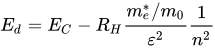
Where - donor level energy - the energy of the bottom of the conduction band, - Rydberg constant (about 13.6 eV), - effective electron mass , - mass of a free electron, Is the dielectric constant of a semiconductor, and n is an integer that can take values from one to infinity, but in practice only a few of the lowest levels with small n are important.


Due to the fact that the effective masses of electrons in semiconductors are small and the dielectric permeabilities are rather large (about 10), the energy of donor levels is small, and the localization radii of the corresponding wave functions are rather large ~ 10 nm, spread over several periods of the crystal lattice.
See also
- Acceptor (physics)
Literature
- Anselm A.I. Introduction to the theory of semiconductors. - 2nd ed., Ext. and pererabat .. - M .: Science, 1978. - 615 p.