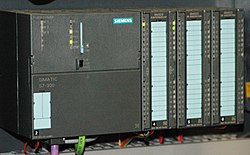
Programmable logic controller (abbr. PLC ; English programmable logic controller , abbr. PLC ; a more accurate translation into Russian - a controller with programmable logic), a programmable controller is a special kind of electronic computer. Most often, PLCs are used to automate technological processes . The main mode of operation of the PLC is its long-term autonomous use, often in adverse environmental conditions , without serious maintenance and with little or no human intervention.
Sometimes systems of numerical control of machines are built on the PLC.
PLC - devices designed to work in real-time systems.
PLCs have a number of features that distinguish them from other electronic devices used in industry:
- unlike a microcontroller (single chip computer) - a chip designed to control electronic devices - a PLC is an independent device, and not a separate chip.
- in contrast to decision-making and operator-oriented computers , PLCs are oriented to work with machines through advanced input of sensor signals and output of signals to actuators ;
- unlike embedded systems, PLCs are manufactured as separate products, separate from equipment controlled by it.
In control systems of technological objects, logic commands, as a rule, prevail over floating point arithmetic operations, which allows for relatively simple microcontroller (8 or 16 bits wide tires ) to get powerful systems operating in real time . In modern PLCs, numerical operations in their programming languages are implemented on a par with logical ones. All PLC programming languages have easy access to manipulate bits in machine words, unlike most high-level programming languages of modern computers.
Content
History
The first logical controllers appeared in the form of cabinets with a set of interconnected relays and contacts. This scheme could not be changed after the design phase and therefore received the name - rigid logic . The first in the world programmable logic controller in 1968 was Modicon 084 (1968) (from the English. Modular digital controller ), which had 4 kB of memory.
The term PLC was introduced by Odo Joseph Struger (Allen-Bradley) in 1971. He also played a key role in the unification of PLC programming languages and the adoption of the IEC61131-3 standard . Together with Richard Morley (Modicon) they are called 'fathers of the PLC'. In parallel with the term PLC in the 1970s, the term microprocessor controller was widely used.
In the first PLCs that came to replace the relay logic controllers, the operation logic was programmed with an LD connection circuit. The device had the same principle of operation, but the relays and contacts (except input and output) were virtual, that is, they existed in the form of a program executed by a PLC microcontroller . Modern PLCs are freely programmable.
Types of PLCs
- Basic PLC,
- Programmable (intelligent) relays ,
- Software PLCs based on IBM PC-compatible computers ( SoftPLC ),
- PLC based on the simplest microprocessors (i 8088/8086/8051 , etc.),
- ECM (Electronic Engine Control).
PLC device
Often a PLC consists of the following parts:
- central chip (microcontroller, or FPGA chip), with the necessary strapping;
- real-time clock subsystem;
- non-volatile memory;
- serial input / output interfaces (RS-485, RS-232, Ethernet)
- protection circuits and voltage conversion at the inputs and outputs of the PLC.
Typically, the PLC input or output cannot be immediately connected to the corresponding output of the central chip. These outputs are characterized by low voltage levels, usually from 3.3 to 5 volts. The inputs and outputs of the PLC should normally operate at 24 V DC or 220 V AC. Therefore, between the output of the PLC and the output of the chip, it is necessary to provide amplifying and protective elements.
Management System Structures
- Centralized : I / O modules are installed in the PLC basket. Sensors and actuators are connected by separate wires directly, or by means of matching modules to the inputs / outputs of the signal modules;
- Distributed : sensors and actuators remote from the PLC are connected to the PLC via communication channels and, possibly, expander baskets using master-slave connections (eng. Master-Slave).
PLC Interfaces
- RS-232
- RS-485
- Modbus
- CC-Link
- Profibus
- DeviceNet
- ControlNet
- CAN
- AS-Interface
- Industrial Ethernet
Remote control and monitoring
- SCADA
- operator panels
- Web interface
PLC programming languages
PLC programming uses IEC standardized languages (IEC) of IEC61131-3 standard.
Programming languages (graphic)
- LD (Ladder Diagram) - Ladder Diagram Language - The Most Common PLC Language
- FBD (Function Block Diagram) - Function Block Language - 2nd most common language for PLC
- SFC (Sequential Function Chart) - Language of state diagrams - used for programming automata
- CFC (Continuous Function Chart) - Not IEC61131-3 Certified, Further Development of FBD
Programming languages (textual)
- IL (Instruction List) - Assembler-like language
- ST (Structured Text) - Pascal-like language
- C-YART - C-like language (YART Studio)
Structurally, in IEC61131-3, the execution environment is a set of resources (in most cases, this is a PLC, although some powerful computers running multi-tasking operating systems provide the ability to run several softPLC programs and simulate several resources on one CPU). The resource provides the ability to perform tasks. Tasks are a set of programs. Tasks can be triggered cyclically, at an event, with a maximum frequency.
A program is one of the types of POU software modules. Modules (POUs) can be of type program, function block, and function. In some cases, non-standard languages are used to program the PLC, for example: Flowcharts of algorithms С-oriented software development environment for PLC. HiGraph 7 is a control language based on the system state graph.
PLC programming tools in IEC 61131-3 languages can be specialized for a single PLC family or universal, working with several (but not all) types of controllers:
- CoDeSys
- ISaGRAF
- ISR "KRUGOL"
- Beremiz
- Klogic
PLC programming
- Configurable: Several programs are stored in the PLC, and the desired version of the program is selected via the PLC keyboard;
- Freely programmable: the program is loaded into the PLC through its special interface from a personal computer using the manufacturer’s special software, sometimes using a programmer .
PLC programming is different from traditional programming. This is due to the fact that PLCs execute an endless sequence of program cycles, in each of which:
- reading of input signals, including manipulations, for example, on the keyboard by the operator;
- calculating output signals and checking logical conditions;
- issuing control signals and, if necessary, controlling the operator interface indicators.
Therefore, when programming a PLC, flags are used - boolean variables of the signs that the program passes through certain branches of conditional branches. Hence, when programming a PLC, a certain skill is required from the programmer.
For example, the initial system initialization procedures after a reset or power on. These procedures need to be performed only once. Therefore, a Boolean variable (flag) of completion of the initialization is introduced, which is set when the initialization is completed. The program analyzes this flag, and if it is set, it bypasses the execution of the initialization code.
See also
- Microcontroller
- Industrial controller
- Industrial Automation
- Controller
Literature
- Michelle J. Programmable Controllers: Architecture and Application . - M .: Mashinostroenie, 1986
- E. Parr. Programmable controllers: a manual for the engineer. - M .: BINOM. Laboratory of Knowledge, 2007. - 516 p. ISBN 978-5-94774-340-1
- Petrov I.V. Programmable controllers. Standard languages and techniques of applied design / Ed. prof. V.P. Dyakonov. - M .: SOLON-Press, 2004. - 256 c. ISBN 5-98003-079-4
- Denisenko V.V. Computer control of the technological process, experiment, equipment. - M: Hot Line-Telecom, 2009. - 608 p. ISBN 978-5-9912-0060-8
- Minaev I. G. Programmable logic controllers. A practical guide for a novice engineer. /AND. G. Minaev, V.V. Samoylenko - Stavropol: AGRUS, 2009. - 100 p. ISBN 978-5-9596-0609-1
- Minaev I. G. Programmable logic controllers in automated control systems / I. G. Minaev, V. M. Sharapov, V. V. Samoilenko, D. G. Ushkur. 2nd ed., Pererab. and add. - Stavropol: AGRUS, 2010. - 128 p. ISBN 978-5-9596-0670-1
- O.A. Andryushenko, V.A. Vodichev. Electronic programmable relays of the EASY and MFD-Titan series. - 2nd ed., Corr. - Odessa: Odessa National Polytechnic University, 2006. - p. 223.
- Minaev I.G. Freely programmable devices in automated control systems / IG Minaev, V.V. Samoylenko, D.G. Ushkur, I.V. Fedorenko - Stavropol: AGRUS. 2016. - 168 s. ISBN 978-5-9596-1222-1