The DC-7 crash in New York is a plane crash that occurred on the evening of Friday November 30, 1962, at Idlewild International Airport in New York City . The Douglas DC-7B airliner of the American company Eastern Air Lines (EAL) was completing a passenger flight from Charlotte ( North Carolina ), when the crew decided to leave for the second round when landing in conditions of rapidly deteriorating weather. After a short time, the plane crashed near the airfield and collapsed, with the death of 25 people.
| Flight 512 Eastern Air Lines | |
|---|---|
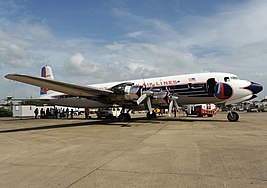 Douglas DC-7B of Eastern Air Lines | |
| General information | |
| date | November 30, 1962 |
| Time | 21:45 EST |
| Character | Fell when leaving for the second round |
| Cause | Crew error |
| A place |  Jameika Bay , Idlewild Airport , New York ( USA ) Jameika Bay , Idlewild Airport , New York ( USA ) |
| Aircraft | |
| Model | Douglas DC-7B |
| Airline | Eastern air lines |
| Departure point | Douglas , Charlotte |
| Destination | Idlewild , New York |
| Flight | EA-512 |
| Board number | N815D |
| Date of issue | September 5, 1956 (delivery date) |
| Passengers | 45 |
| Crew | 6 |
| Dead | 25 |
| Survivors | 26 |
Aircraft
Douglas DC-7B with registration number N815D (serial number - 45084, serial - 711) was released by Douglas Aircraft Corporation in 1956 and on September 5 it arrived at the customer - American airline Eastern Air Lines [1] . The total flight time of the N815D was 18,411 hours 6 minutes, including 281 hours from the last major inspection. Four piston aircraft engines were Wright 972TC18DA-3/4 models and equipped with Hamilton Standard propellers model 34E60-363 [2] . Passenger capacity was 70 seats [3] .
Crew
The crew consisted of two pilots, a flight engineer and a pair of stewardesses [4] [5] :
- The aircraft commander is 43-year-old Edward J. Bechtold . He has been with Eastern Air Lines on April 26, 1945, and the last DC-7B type test was held on June 14, 1962. Had a total raid of 15,644 hours, including 2,700 hours on the DC-7.
- The co - pilot is 45-year-old Julius A. Wagner. At Eastern Air Lines since March 15, 1951, and the last qualification test for the DC-7B type took place on January 26, 1962. He had a total raid of 9042 hours, including 1610 hours on DC-7, of which 71 hours in the position of commander.
- Flight Engineer - 31-year-old Robert L. Voorhees . He had the qualification of a flight engineer, as well as a pilot of single and multi-engine aircraft. He has been with Eastern Air Lines since August 26, 1957, and the last DC-7B type examination was held on September 27, 1962. He had a total flight time of 4080 hours, including 149 hours as a DC-7 flight engineer and 718 hours as a DC-7 pilot.
- Stewardesses
- Patricia J. Richards ( English Patricia J. Richards ). At Eastern Air Lines since June 24, 1961.
- 21-year-old Helen L. Fournier. The airline Eastern Air Lines April 16, 1962.
Flight History
Flight to New York
The N815D aboard that day operated a regular passenger flight EA-512 from Charlotte to New York . The official weather forecast provided for partial darkening at Idlewild Airport, fog and haze, visibility of 3 miles (4.8 km ), sometimes a decrease to 2 miles (3.2 km ). Lighting equipment at the airport worked in full, but the approach radar was turned off. In the office of EAL Airlines, the crew received a forecast according to which there will be a clear sky or separate clouds over the destination airport. After completing the preparations, at 19:41 [* 1] flight 512 with 46 passengers (including 1 official) and 5 crew members on board flew from Douglas Airport [6] . Carrying out instrument flight , the crew sequentially established communication with dispatch centers in Atlanta , Washington and New York , as well as with the airline’s offices at the service frequency [7] .
Meanwhile, at 7:27 p.m., the Weather Bureau updated the weather forecast for Idlewild Airport: zero dimming on the ceiling [cloudiness], visibility zero, fog, partly cloudy, visibility on the ground 1 - ½ miles through the fog. Evidence that this weather forecast was brought to the crew of Flight 512 was not subsequently found by investigators. At 20:15, Idlewild Airport itself, in turn, refuses the TEL autograph transceiver on the control tower, which was necessary to transmit written information from the office of the Federal Civil Aviation Administration . Then it turned out that direct telephone communication between the air traffic controllers and the Weather Bureau did not work [7] . After it was discovered that the visibility meters in the “4 right” lane began to work with violations, they were therefore turned off, which was reported to the Weather Bureau at 20:30 [8] .
At 20:23 flight 512 during the next radio exchange with the EAL airline office received an instruction: If in Idlewild [weather conditions] are lower than the [weather] minimum for landing, then you are allowed [to leave] to Philadelphia (alternate aerodrome) . The crew confirmed receipt of this information, after which the dispatcher added: ... several other flights left for Newark [7] .
Approach
At 08:45 p.m., the crew contacted the New York District Air Traffic Control Center, which instructed Flight 512 to be in the waiting area above Sandy Hook at an altitude of 11,000 feet (3,400 m ). At 20:52 the dispatcher transmitted the estimated landing time - 22:07, and at 20:57 he said: ... an indefinite delay due to the weather . The crew confirmed the receipt of information. Airplanes at this time landed on the “22 left” (22L) lane, but then all arriving were transferred to the “4 right” (4R - the same lane as 22L). At 21:02 from flight 512, they requested a weather report at the airline’s office, to which the dispatcher transmitted visibility information: ... now one mile ... Flight EAL 330 interrupted the approach to lane 22L [8] . In turn, the New York control center at 21:07 aired: All planes on the Idlewild-Approach frequency, last weather at 02:05 [GMT] (21:05 EST): partial dimming, [visibility] mile from half, fog, runway “4 right”, visibility meters on the runway do not work [9] .
Around 21:10, the crew again contacted the airline’s office and reported: We are waiting over Sandy Hook. Estimated time to obtain permission to approach from 40 minutes to an hour, height 9000 feet (2700 m ); it is reported that visibility is now one and a half miles . After a couple of minutes, flight 512 again called the EAL radio operator and requested information about the airport, which was reported: Idlewild pressure altitude - 9640 feet (2940 m ), Idlewild airfield pressure, according to the Weather Bureau - 30.30 inches (770 mm) RT .art. [9] .
At 9:24 p.m., on instructions from the New York Center, flight crew 512 established contact with the approach dispatcher and reported that they were in the waiting area above Sandy Hook, in response to which the dispatcher transmitted: Use ILS lane four right, landing on lane four right. The wind is quiet. Weather in Idlewild: the sky is partially closed, the visibility is 1-1½ miles through the fog, the altimeter setting is three zero three one [30,31]. Exact radar disabled. The middle marker and the middle beacon of the four right lane do not work; Visibility meters in lane four right do not work . The crew confirmed the receipt of information [10] .
At 21:27, the crew of the United Air Lines (UAL) Douglas DC-6 propeller-driven aircraft interrupted the approach to 4R and left for the second round. As the pilots explained in negotiations with the approach controller, the ground fog was at least 50 feet (15 m ) thick and very thick, to which the controller replied that he was sitting at the level of the seventh floor and also could not see the ground. However, from 9:24 p.m. to 9:37 p.m. five jet planes of Eastern, United, American and TWA airlines successfully landed in the same lane. At 21:30, updated weather information was broadcast on the airport: northeast wind 6 knots, partly cloudy, visibility near the ground 1½ miles, fog 1 km, airfield pressure 30.31 inches (770 mm) RT. Art. [11] .
At 21:33 from flight 512, they reported a decrease to 6,000 feet (1800 m ) in the Sandy Hook area, to which the dispatcher identified him on the radar and gave a vector for landing on the right 4 lane [11] . At 21:39:11, the crew reported that it was 9 miles (14 km) southwest of the distant driven radio beacon, which was instructed to switch to the frequency of the takeoff and landing controller. At 21:39:59, the approach dispatcher himself broadcast on his frequency that visibility in the strip had decreased to ¾ mile (1.2 km). At the same moment, United's Douglas DC-7 propeller plane landed on 4R lane, whose commander later said that after passing the long-distance drive, he saw the glow of approach lights through the fog, but could not see the lane. Nevertheless, the pilot decided to perform a visual approach, monitoring the position on the glide path by instruments, until he was directly above the strip, after which he could see it. At 21:41, another United aircraft landed, whose commander later said that during the flight above the fog he observed the entire strip, but in the fog he could recognize only the light of the approach lights, and visibility was less than ¾ mile; it was definitely not to be determined, due to the sparkle of the strip lights in the fog. At the same time, the Belgian company Sabena got permission to take off from the right 7 lane (located a mile northwest of the right lane 4), but its crew reported that it would be delayed due to heavy fog [12] [13] .
Holocaust
When the N815D reported on the passage of an external radio beacon, the dispatcher said that he would now turn on the flashing beacons for approach lights for verification. At 21:43, the take-off and landing controller gave permission to flight 512 for landing, to which the crew reported: Okay. Blinkers are dull . The dispatcher in response transmitted: Got it. I have to turn them off now . This was the last radio communication with the N815D [13] . At this time, according to meteorological observations, visibility in the 4R band fell to 1/8 mile (about 200 meters), but they did not report this on the air [14] . The crew itself did not report either the passage of the middle drive or the observation of the strip. Two dispatchers only saw the red beacon of the plane disappear half a mile from the beginning of the strip, after which at 21:44 the local dispatcher instructed the flight crew 512 to report when they saw the strip. However, there was no answer [15] .
According to the testimonies of the surviving passengers, the DC-7 approached the landing configuration with the landing gear and flaps extended. Various approach lights were observed, then below the white stripes of the beginning of the strip flashed, and the plane at that moment followed at a slight angle to the axis of the strip from right to left. Then the blue lights of taxiways flashed on the left when the noise of an increase in the engine mode was heard, while the liner sank a little tail [15] . Suddenly, at 21:45, the tower controllers saw a bright orange flash appear at a distance of about 4000 feet (1200 m ) from the initial end of the “4 right” strip and 400 feet (120 m ) to the left of its axis. Airport emergency services were immediately involved, as the American Airlines crew reported on the passage of the long-distance drive, and that there was a fire ahead of them. This crew was instructed to fly around the report strip. Soon from the liner reported: Runway four right. We clearly see below like a fire ... to the left of the strip [14] .
At 21:45 at a distance of 3460 feet (1050 m ) along the vector 37 ° from the middle of the initial end of the 4R strip, flying at a speed of 135 knots (250 km / h) in dense fog with a left roll of 37 °, the reed N815D hooked a reed with both of its left propellers growing in shallow water in Jameika Bay . Then, at a distance of 3600 feet (1100 m ) from the initial end of the strip, the left wing crashed into the earthen hill and separated, with the fuel tanks bursting open and the fuel leaking from them igniting. Then the right plane separated, after which the fuselage was torn in half approximately along the partition between the first-class salons. 24 passengers (6 from the tourist class and 18 from the first) and 2 stewardesses managed to run outside before the fire from spilled fuel swept the plane, killing two pilots remaining on board, a flight engineer and 22 passengers (including service) [3] [16] .
Investigation
The catastrophe occurred in conditions of rapidly thickening fog, however, weather information was not broadcast on time. When the visibility at the airport is less than 4 miles, information about it must be transmitted by the tower controllers, but the controllers of the airline itself (in this case Eastern Air Lines) are responsible for this. When the approach dispatcher at 21:39:59 broadcasted on its frequency that visibility on the strip had decreased to ¾ miles, the crew of Flight 512 did not hear this information, as it switched to the frequency of the takeoff and landing dispatcher. The landing controller, in turn, due to non-working gauges on the strip, determined the visibility value “by eye” and believed that it was more than the meteorimum for Idlewild Airport - ½ mile, whereas in fact the weather over the airfield was already worse [17] [18] .
However, the crew of the N815D should have heard two messages from the crews of other aircraft, which, at the frequency of the take-off and landing controller, reported low visibility at the airport. The first was flight 406 also of EAL, which landed before flight 512, and whose crew, reporting on the release of the strip, also reported that visibility dropped to 50-60 feet (15-18 meters). Another message came from the crew of Sabena, which was supposed to take off from the 7R strip, but decided to linger, expecting better weather. But the decision of the N815D board commander to make a landing could be affected by the fact that immediately before them at 21:44 the UAL plane nevertheless made a landing, while clarifying that the glare from the lights of the strip prevented; therefore, from Flight 512 they were asked to reduce the intensity of these lights. However, realizing that the fog was becoming too thick, the crew, at an altitude of only 25 feet (7.6 m ) and being actually to the left of the lane, nevertheless decided to go to the second lap, for which, in accordance with current instructions, increased engine mode, began cleaning the chassis, at the same time setting the flaps in the take-off position [19] [20] .
But no one on board felt that the plane began to rise, as it would be when climbing at an angle of 9 °. Instead, after a few seconds, the Douglas crashed into the ground with the chassis already retracted (normally retracted in 7 seconds) and flaps released at 20 °. The propeller blades were mounted at an angle of 36–38 °, and the engines themselves rotated at a frequency of 2422–2463 rpm, developing a power of 1890–2035 hp. In fact, when leaving the second circle, it was enough for the crew to first increase the engine power to the maximum, and then transfer the aircraft to takeoff configuration during the climb. However, due to ignoring the fact that there is almost no headroom, the flap angle was immediately reduced, while the engine power was not set to full maximum. Not having time to gain speed, “Douglas” went into a stall and, losing height, fell to the ground [21] .
Reason
According to the commission from the Civil Aviation Council , the accident happened because the crew violated the technique of leaving for the second circle in fog, which was not reported in time [22] .
Notes
Comments
- ↑ North American Eastern Time (EST) is indicated hereinafter.
Sources
- ↑ Registration Details For N815D (Eastern Air Lines) DC-7 . Plane Logger. Date of treatment March 7, 2019.
- ↑ Report , p. iii.
- ↑ 1 2 Sixth Major Air Disaster Within A Week. (English) , The Bee Danville Virginia (December 3, 1962). Date of treatment March 7, 2019.
- ↑ Report , p. i.
- ↑ Report , p. ii.
- ↑ Report , p. 2.
- ↑ 1 2 3 Report , p. 3.
- ↑ 1 2 Report , p. four.
- ↑ 1 2 Report , p. five.
- ↑ Report , p. 6.
- ↑ 1 2 Report , p. 7.
- ↑ Report , p. eight.
- ↑ 1 2 Report , p. 9.
- ↑ 1 2 Report , p. eleven.
- ↑ 1 2 Report , p. ten.
- ↑ Report , p. 12.
- ↑ Report , p. sixteen.
- ↑ Report , p. 17.
- ↑ Report , p. 18.
- ↑ Report , p. nineteen.
- ↑ Report , p. 13.
- ↑ Report , p. 21.
Literature
- Douglas DC-7B, N815D, Eastern Air Lines Inc., New York International Airport, Jamaica, New York November 30, 1963 . Civil Aeronautics Board (October 10, 1949). Date of treatment March 7, 2019.
Links
- ASN Aircraft accident Douglas DC-7B N815D New York-Idlewild International Airport, NY (IDL ) . Aviation Safety Network . Date of treatment March 7, 2019.
- Crash of a Douglas DC-7B in New York: 25 killed . Bureau of Aircraft Accidents Archives . Date of treatment March 7, 2019.