Teuku Jacob ( indon. Teuku Jacob ; December 6, 1929 , Peureulak, Aceh - October 17, 2007 , Yogyakarta ) - Indonesian anthropologist , rector of the University of Gaja Mada in 1981-1986. An activist of the Indonesian liberation movement after World War II , member of the People’s Consultative Congress in 1982-1987, holder of the Order of the Star of Mahaputra , laureate of the Paul Brock Medal of the National Center for Scientific Research (France).
| Teuku Jacob | |
|---|---|
| indone. Teuku jacob | |
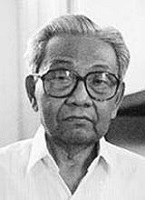 | |
| Date of Birth | |
| Place of Birth | Peureulak, Aceh |
| Date of death | |
| Place of death | |
| A country | |
| Scientific field | anthropology |
| Place of work | Gaja Mada University |
| Alma mater | Gaja Mada University University of Utrecht |
| Academic degree | Ph.D |
| Academic rank | Professor |
| supervisor | G. von Koenigswald |
| Awards and prizes |  |
Biography
Teuku Jacob was born in 1929 in Peureulak on the island of Sumatra [1] (at that time - the Netherlands East Indies ). After World War II, Jacob took an active part in the Indonesian liberation movement, in particular, being a leading nationalist radio program during Indonesia’s four-year struggle for independence [2] .
Since 1953, Jacob, who studied at the Yogyakarta University of Haji Mada , worked there as an assistant professor of anatomy at the medical faculty, then as an assistant in the department of anthropology. He graduated from Haj Mada University in 1956, continuing his education at Arizona University and Howard Universities in the USA and Utrecht University in the Netherlands, where he defended his doctoral dissertation in 1968, but then returned to Haj Mada University. He began his independent research work in 1962 at excavations in Sangiran [3] , before which he had time to work with the famous paleoanthropologist Gustav von Koenigswald [2] . From 1973 to 1975, Jacob was the secretary of the medical faculty of the University of Haj Mada, from 1975 to 1979 - his dean, and from 1981 to 1986 he served as university rector [1] . Throughout his academic career, Jacob made a significant contribution to the development of paleoanthropology in Indonesia (in his obituary in the journal Science, professor at the University of Chicago Russell Tuttle says that “he was Indonesian paleoanthropology for a long time”). Thanks to him, new fossils of Homo erectus were found in Indonesia [2] , he developed a numbering system for human fossils and criticized the theory of prehistoric cannibalism [1] . In addition to Sangiran, where dozens of important finds were made under his leadership, Jacob also led the work at a newer archaeological site in Sambungmakan [3] .
In the last years of his life, after his official retirement, Jacob continued to work in the laboratories of the University of Haji Mada. At this time, new attention was drawn to him as a result of the scandal surrounding the remains of representatives of the alleged fossil human species - Homo floresiensis . Jacob, who was a principled opponent of this theory and insisted that on the Indonesian island of Flores , only the remains of representatives of the undersized subraces of Homo sapiens, a member of the Australian-Melanesian race [1] , were found, seized almost all the bones found and kept them for several months. Then the bones were returned partially broken, with traces of incisions and unsuccessful gluing. Jacob's lab worker said the damage was the result of trying to cast brittle bones. After that, Liang Bois Cave, where the bones were found, was closed for two years by the Government of Indonesia for any excavation [4] .
In addition to the scientific, Teuku Jacob also led political activities. From 1982 to 1987 he was a deputy of the People’s Consultative Congress , and in 2002 he became a holder of the Order of the Star of Mahaputra of the V degree [1] . His scientific regalia includes a research award from the Indonesian Medical Association (1984) [3] , a Paul Brock medal from the National Center for Scientific Research (France, 1980), a gold medal from the Indian Alternative Medicine Council (1993), and the Hamengkubuvono IX Prize (Indonesia, 1997) [1] .
Teuku Jacob died in 2007 in Yogyakarta from an exacerbation of a long-standing liver disease, leaving behind the widow Nuraini and daughter Neela Nurilani. He is buried in the cemetery of Gaj Mada University [1] .
Notes
- ↑ 1 2 3 4 5 6 7 Obituary: Influential paleontologist T. Jacob dies at 77 . The Jakarta Post (October 19 2007). Date of treatment January 24, 2016.
- ↑ 1 2 3 A Gigantic Presence // Science. - 2007. - Vol. 318, No. 5852. - P. 895. - DOI : 10.1126 / science.318.5852.895d .
- ↑ 1 2 3 Sri Wahyuni. In search of ancestral origin . The Jakarta Post (August 28 2002). Date of treatment January 25, 2016.
- ↑ Djuna Ivereigh. Bones of contention (inaccessible link) . Cosmos (October 2007). Date of treatment January 25, 2015. Archived on February 7, 2016.
Hobbit cave digs set to restart (inaccessible link) . BBC News (January 25, 2007). Date of treatment January 25, 2015. Archived on August 10, 2014.