Okklyudin is an integral protein with a molecular mass of 65 kDa, which is located in tight junctions and is their main component along with claudins [1] . In humans, okludin is encoded by the OCLN gene and is a 522-amino acid polypeptide [2] [3] .
| Okklyudin | |||||||||||||
|---|---|---|---|---|---|---|---|---|---|---|---|---|---|
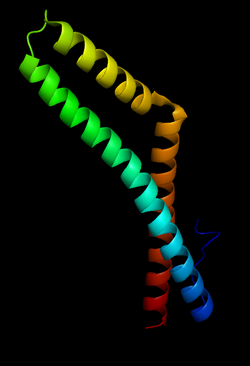 PDB | |||||||||||||
| |||||||||||||
| Identifiers | |||||||||||||
| Symbol | ; BLCPMG; PPP1R115 | ||||||||||||
| External IDs | GeneCards : | ||||||||||||
| EC number | |||||||||||||
| |||||||||||||
| Orthologists | |||||||||||||
| View | Person | Mouse | |||||||||||
| Entrez | |||||||||||||
| Ensembl | |||||||||||||
| Uniprot | |||||||||||||
| RefSeq (mRNA) | |||||||||||||
| RefSeq (protein) | |||||||||||||
| Locus (UCSC) | |||||||||||||
| Search PubMed | |||||||||||||
This protein was first described in 1993 by Shoichiro Tsukita [1] .
Content
OCLN gene localization
The OCLN gene is located on the long (q) arm of chromosome 5 at position q13.1. It starts from 69492292 base pairs and extends to 69558104 base pairs, having a length of 65813 base pairs. As a result of alternative splicing , two isoforms are expressed [4] .
Protein Structure
In the human structure, 9 domains are distinguished, divided into two groups. The first group combines 5 domains located intracellularly and extracellularly, and the second group combines 4 transmembrane domains. These 9 domains are as follows:
- N-terminal domain (66 amino acids)
- transmembrane domain 1 (23 amino acids)
- extracellular loop 1 (46 amino acids)
- transmembrane domain 2 (25 amino acids)
- intracellular loop (10 amino acids)
- transmembrane domain 3 (25 amino acids)
- extracellular domain 2 (48 amino acids)
- transmembrane domain 4 (22 amino acids)
- C-terminal domain (257 amino acids).
The C-terminal domain is necessary for the proper creation of tight junctions. It also interacts with several cytoplasmic proteins in the connective disk and signaling molecules responsible for cell survival, and its N-terminal domain is involved in compacted tight junctions. The extracellular loop of oklyudin is involved in the regulation of paracelular permeability, and the extracellular domain 2 is involved in localization by close contact.
Functions
Okklyudin is important for the functioning of close contacts. It determines the density of tight junctions and plays an important role in providing a barrier function.
Notes
- ↑ 1 2 Furuse M., Hirase T., Itoh M., Nagafuchi A., Yonemura S., Tsukita S., Tsukita S. Occludin: a novel integral membrane protein localizing at tight junctions (neopr.) // Journal of Cell Biology . - 1993. - T. 123 , No. 6 Pt 2 . - S. 1777-1788 . - DOI : 10.1083 / jcb.123.6.1777 . - PMID 8276896 .
- ↑ Ando-Akatsuka Y., Saitou M., Hirase T., Kishi M., Sakakibara A., Itoh M., Yonemura S., Furuse M., Tsukita S. Interspecies diversity of the occludin sequence: cDNA cloning of human, mouse, dog, and rat-kangaroo homologues (English) // Journal of Cell Biology : journal. - 1996 .-- May ( vol. 133 , no. 1 ). - P. 43-47 . - DOI : 10.1083 / jcb.133.1.43 . - PMID 8601611 .
- ↑ Entrez Gene: OCLN occludin .
- ↑ OCLN occludin [Homo sapiens (human)] - Gene - NCBI