The pentagonal hexecontahedron (from other Greek πέντε is “five”, γωνία is “angle”, ἑξήκοντα is “sixty” and ἕδρα is “face”) is a semiregular polyhedron (Catalan body), dual to the snub-dodecahedron . Composed of 60 identical irregular pentagons .
| Pentagonal hexahedron | |||
|---|---|---|---|
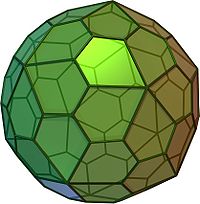 The "right" option ( rotating model , 3D model ) | |||
 "Left" option ( rotating model , 3D model ) | |||
| Type of | catalan body | ||
| The properties | convex , isohedral , chiral | ||
| Combinatorics | |||
| Items |
| ||
| Facets | irregular pentagons: | ||
| Vertex configuration | 20 + 60 (5 3 ) 12 (5 5 ) | ||
| Face configuration | V3.3.3.3.5 | ||
| Dual polyhedron | snub dodecahedron | ||
Scan
| |||
| Classification | |||
| Designations | gD | ||
| Symmetry group | I (chiral icosahedral) | ||
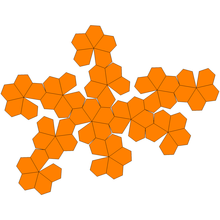
Has 92 peaks. In 12 peaks (located in the same way as the tops of the icosahedron ), 5 faces converge along their sharp angles; in 20 vertices (located in the same way as the vertices of the dodecahedron ), 3 faces converge along those obtuse angles that are farther from the sharp; in the remaining 60 peaks, two faces converge with their obtuse angles close to an acute one, and one with an obtuse angle farthest from an acute one.
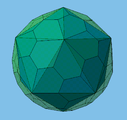
12 peaks are located just like the tops of the icosahedron
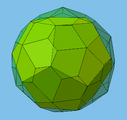
20 vertices are located just like the vertices of a dodecahedron
The pentagonal hexecontahedron has 150 edges - 60 “long” and 90 “short”.
Unlike most other catalan bodies, the pentagonal hexecontahedron (along with the pentagonal icositetrahedron ) is chiral and exists in two different mirror-symmetric (enantiomorphic) versions - “right” and “left”.
Metric specifications and angles
In determining the metric properties of the pentagonal hexecontahedron, it is necessary to solve cubic equations and use cubic roots - whereas for achiral catalan bodies, nothing more complicated than square equations and square roots is required. Therefore, the pentagonal hexecontahedron, unlike most other Catalan bodies, does not allow Euclidean construction . The same is true for the pentagonal icocitetrahedron, as well as for archimedean bodies dual to it.
In the formulas below, the constant Is the only real root [1] of the equation
Where - ratio of the golden ratio; this root is equal
If the three “short” sides of the face have a length , then the two “long” sides have a length
The surface area and volume of the polyhedron are expressed as
The radius of the inscribed sphere (touching all faces of the polyhedron at their centers of inscribed circles ) will be equal to
radius of a half-inscribed sphere (touching all edges) -
the radius of the circle inscribed on the face -
face diagonal parallel to one of the “short” sides -
It is impossible to describe a sphere near the pentagonal hexecontahedron so that it passes through all the vertices.
All four obtuse corners of the face are equal the acute angle of the face (between the "long" sides) is
The dihedral angle at any edge is the same and equal
Notes
- ↑ See the roots of this equation .
Links
- Weisstein, Eric W. The Pentagon HexaContahedron on Wolfram MathWorld .