Dziga Vertov (at birth David Abelevich Kaufman [1] , later known as Denis Abramovich and Denis Arkadevich Kaufman ; December 21, 1895 [ January 2, 1896 ], Bialystok - February 12, 1954 , Moscow ) - Soviet film director and screenwriter, one of the founders and documentary theorists. He enriched the cinema with a variety of camera techniques and techniques, including the “ hidden camera ” technique [2] . His film “The Man with the Camera ” (1929) is often called the greatest of all documentaries in history [3] .
| Dziga Vertov | ||||
|---|---|---|---|---|
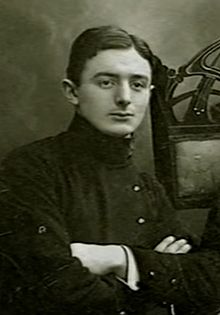 In 1913 | ||||
| Birth name | David Abelovich Kaufman | |||
| Date of Birth | December 21, 1895 ( January 2, 1896 ) | |||
| Place of Birth | Bialystok , Grodno Province , Russian Empire | |||
| Date of death | February 12, 1954 (58 years old) | |||
| Place of death | Moscow , USSR | |||
| Citizenship |  Russian Empire of the Russian Empire of the  the USSR the USSR | |||
| Profession | filmmaker screenwriter movie theorist producer | |||
| Direction | socialist realism | |||
| Awards |
| |||
| IMDb | ||||


The younger brother of cameramen Boris Kaufman and Mikhail Kaufman . Wife - Elizabeth Svilova .
Biography
| I, the servant of the working class, give all my strength to the service of this class, not by compulsion, but consciously and voluntarily.Dziga Vertov |
David Abelovich Kaufman was born on December 21, 1895 ( January 2, 1896 ) in Bialystok ( Grodno Province , Russian Empire ; now Poland ) into the family of second-hand bookmaker Abel Kushelevich Kaufman [4] , who owned a book warehouse and two bookstores, and Khai-Esther Rakhmielevna Halpern, married in Bialystok in 1894. He studied at a music school, at the Petrograd Psychoneurological Institute , at Moscow University . In 1915, he began to use the pseudonym Dziga Vertov (from the Ukrainian . Dziґa - a spinning top ). In 1917 he worked in the newsreel department of the Moscow Film Committee . In 1918 - 1919 - compiler-editor of the magazine "Kinonedelya". Since 1920 - a documentary filmmaker, initiator of the release of the film magazine " Kino-Pravda " (1922-1924). Under his leadership, the first Soviet cartoon "Today" (1923) was made. He worked at the studios " Kultkino ", the 3rd State Film Factory [5] , Kiev Film Factory VUFKU (1927-1930), " Mezhrabpomfilm ", TSSDF . He is the author of the scripts of several of his documentaries, the feature film “You, the Front!” (1942), the animated film “Humoresques”. The author of several articles on cinema theory. The film " Cinema Eye " in 1924 received a medal and a diploma from the World Exhibition in Paris . With the transfer of Vertov to Ukraine, the Kinoki group [6] broke up, of which he was the leader.
Vertov is the director of one of the first sound documentaries, The Donbass Symphony (Enthusiasm, 1930). He shoots Three Songs About Lenin (1934), a film in the genre of figurative film journalism, which the newspaper Pravda called the Song of the Whole Country. The film " Lullaby " (1937) is dedicated to the twenty-year path of the country, passed after the revolution. During the Great Patriotic War he directed the films “Blood for Blood, Death for Death” (1941), “Oath of the Young” and “In the Ala-Tau Mountains” (both 1944), dedicated to the struggle of the Soviet people against Nazism and work in the rear. All further Vertov film projects were rejected by the authorities.
From 1944 until his death, he worked as an editor-in-chief on the newsreel “News of the Day” (a total of 55 issues).
Dziga Vertov died on February 12, 1954. Initially, he was buried at the Miussky cemetery next to his mother, in 1967 he was reburied at the Novodevichy cemetery (plot number 6).
In the literature
Dziga Vertov speaks under the name of “Extreme-Vzglyadov, a great fighter for the idea of a cinema fact” and the author of the film “Impartial lens” in the original edition of the novel “The Golden Calf ” by Ilf and Petrov . The hero of Ilf and Petrov removes the urn in close-up, so that it "takes on the appearance of the mouth of a forty-two-centimeter gun", and also "considers pictures under the wheels of the train to be its specialty" [7] .
Rewards
- Order of the Red Star (01/11/1935)
Memory
- In the cinema
- 2013 - Red Mountains (isp. Podgorodinsky Gleb )
Documentary films dedicated to Dziga Vertov:
- 1966 - A World Without a Game
- 2002 - Two documentaries about the Kaufman brothers were released in Russia: “ Dziga and His Brothers ” by Yevgeny Tsymbal and “All Vertovs” by Vladimir Nepevny ( Alexander Burov was the operator of both).
Filmography
- 1918 - Anniversary of the Revolution
- 1919 - Movie Week
- 1920 - The Battle of Tsaritsyno
- 1922 - History of the Civil War
- 1922 - The Social Revolutionary Process
- 1924 - Soviet toys
- 1924 - Cinema Eye
- 1925 - Movie Truth
- 1926 - Sixth of the world
- 1926 - Walk, Council!
- 1928 - Eleventh
- 1929 - Man with a movie camera [8]
- 1930 - Enthusiasm: Donbass Symphony
- 1934 - Three songs about Lenin
- 1937 - In memory of Sergo Ordzhonikidze
- 1937 - Lullaby
- 1938 - Three heroines
- 1942 - You, the front!
- 1944 - In the mountains of Ala Tau
- 1954 - News of the day
Literature
- Hicks, J .. Dziga Vertov: defining documentary film. - London; New York: IBTauris, Palgrave Macmillan, 2007 .-- 194 p.
- Articles and notes by John Mackay on various aspects of Vertov's life and work. [one]
- Mackay, John. DZIGA VERTOV: LIFE AND WORK. Drafts available [2]
- Dziga Vertov: Cinema thing [foreword A. Scherbenko] // Formal method: Anthology of Russian modernism. Volume 2: Materials / comp. S. Ushakin. - Moscow; Yekaterinburg: Cabinet Scientist, 2016.S. 11-180
- Roshal L.M. Dziga Vertov. - M.: Art, 1982. - 264 p., 24 p. silt - (Life in art).
Notes
- ↑ In the birth record, available on the Jewish genealogy website JewishGen.org, the name is recorded as David Abelowicz Kaufman ( Polish: Dawid Abelowicz Kaufman ). The patronymic of the brothers Moses (1897) and Boris (1903) is also Abelovich , only the younger brother Semyon (1899) is recorded with the patronymic of Abelevich .
- ↑ “Hidden Camera” // Great Soviet Encyclopedia : [in 30 vol.] / Ch. ed. A.M. Prokhorov . - 3rd ed. - M .: Soviet Encyclopedia, 1969-1978.
- ↑ Survey results of 846 film critics from Sight & Sound (2012)
- ↑ Bialystok Jewish Population Index
- ↑ 3rd Moscow film factory "Cartoon" - the former studio of I. Ermolyev , located near the Kiev station.
- ↑ MOVIES AND FILM EYES
- ↑ Notes to Volume 2 of the Golden Calf (inaccessible link) . Date of treatment October 25, 2015. Archived March 5, 2016.
- ↑ Man with a movie camera (Alloy Orchestra), 01:06:40, 1929 on YouTube
Links
- Dziga Vertov - Encyclopedia of Russian Cinema
- Dziga Vertov on the Internet Movie Database
- Biography, filmography of the director Dziga Vertov
- The film "Man with a Camera" on the Internet Archive
- Articles about Dzig Vertov on the website of the magazine "Session"
- Fragments of the films "Cinema Eye" and "Cinema Truth"
- Dziga Vertov
- Kaufman brothers
- Articles and notes by John Mackay on various aspects of Vertov's life and work. [3]