Ludwik Vladislav František Kondratowicz ( Polish: Ludwik Władysław Franciszek Kondratowicz , better known as Vladislav Syrokomlya [3] , Polish. Władysław Syrokomla ; September 17 (29), 1823 , Smolgov Folk Farm , September 18 , 1862 , Bobruiska , Minsk , Poland ) ) - Belarusian-Polish poet, local historian , literary historian, translator.
| Ludvik Kondratovich | |
|---|---|
 A. Shemesh . Portrait of Vladislav Syrokomli. | |
| Birth name | Ludwik Władysław Franciszek Kondratowicz |
| Aliases | NN, Vladislav Syrokoml |
| Date of Birth | September 17 (29), 1823 |
| Place of Birth | Smolgov Farm , Bobruisk Uyezd , Minsk Province , Russian Empire [1] |
| Date of death | September 3 (15), 1862 (38 years old) |
| A place of death | Vilna |
| Citizenship | Russian empire |
| Occupation | poet , playwright , translator |
| Years of creativity | Since 1844 |
| Language of Works | Polish , Belarusian [2] |
| Debut | poem "The Postman", 1844, in the journal "Athenaeum" (Vilna) |
| Autograph | 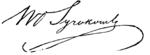 |
| (belor.) | |
Content
- 1 Biography
- 2 Literary activity
- 3 Translation
- 4 Highlights
- 5 Translations
- 6 Editions
- 7 Memory
- 8 Notes
- 9 Literature
- 10 Links
Biography
He was born in a rather poor noble family of the Kondratovich clan coat of arms “ Syrokomlya ”, engaged in agriculture in rented farmhouses . He studied in Nesvizh and Novogrudok . He served in the management of the Radziwill estates in Nesvizh . In 1844 he married Paulina Mitroshevskaya and left the service. In 1844-1853 he rented a farm in Zaluchye, from 1853 in the Boreykovschina near Vilna , engaged in agriculture and literary work.
He lived in Vilna for a long time since 1852. His apartment on German Street became a popular literary salon, where the poet Anthony Edward Odynets , historian Mikolay Malinovsky , local historian and collector Yevstakhy Tyshkevich , musician and composer Stanislav Monyushko visited [4] . He was an associate member of the Vilna Archaeological Commission created on the initiative of Count Tyszkiewicz. In 1860-1862 he was a permanent employee of the Adam Kirkor newspaper “Vilensky Vestnik” . In 1856-1858, in 1861 he traveled to Warsaw and Krakow . He was under the tacit supervision of the authorities. Participation in national-patriotic demonstrations caused an arrest and then forced settlement under supervision in Boreykovschina.
At the beginning of 1862, due to his illness, he was allowed to return to Vilna, where he died in the house on the current street of Barbara Radzivill ( Barboros Radvilaitės g. 3 ). According to various sources, the funeral involving from 6 to 20 thousand people turned into an impressive national-patriotic anti-government manifestation. Nikolai Leskov , who arrived in Vilna shortly after Syrokomli’s funeral, wrote that “almost all of Vilna was at the burial”, and evaluated the poet in this way:
Syrokomlyu is known, not only in Lithuania and Poland, but also in general, in all Slavic lands, and where he was known, he was loved there for his sympathetic talent and steadily honest direction. He never sought anyone's favors, and cared very little, or, better to say, did not care about his reputation at all. He did not possess the art of disguising himself, and did not know how to hide his weaknesses, which, however, did no harm to anyone but the deceased, who had suffered many, many injuries in his life. As far as I can judge from the now heard tales of Syrokoml, he had a lot in common in character and disposition with the late Taras Grigorievich Shevchenko , but his position in Vilna was much more difficult than that of the Shevchenko in St. Petersburg. [5]
He was buried in the Rasu cemetery in Vilna. For many years, only the tall pine cross marked the grave of Syrokomli, until through the efforts of the widow and children a tombstone appeared with an iron cross and a granite slab with an inscription in Polish - a quote from his poem [4] [6] .
Literary activity
He made his debut in print with the ballad “The Postman” in the Vilnius magazine of Józef Kraszewski “Atheneum” (1844). In the Russian translation of Leonid Trefolev, she became a popular Russian folk song " When I served as a coachman in the mail ...". In 1851-1851 he published his translations into Polish of Polish poets who wrote in the Baroque era in Latin .
Since 1853 he published small collections of “havends” ( Polish gawęda ) - varieties of poetic ballads that imitate the ingenuous story of a person from the people. Another genre cultivated by Syrokomley is “obrazek” ( Polish obrazek ), that is, a “picture” close to havende by stylistic means, a “scene” from folk life. He also wrote poems about the past of Lithuania from the era of the medieval wars with the crusaders ("Margher") to the war of 1812 with Napoleon . The author of several plays staged by the Vilnius Theater. Of the dramatic works of Syrokomli, the play Caspar Karlinsky was most successful. The author of a two-volume history of literature in Poland (1851-1852). He published the volume of poems by Jozef Bucky “The Reborn of Buck” (Vilna, 1855).
He published several books with local history travel notes - “Wycieczki po Litwie w promieniach od Wilna” (“Walking in Lithuania in the radius of Vilna”) in two volumes (1857, 1860), “Dziennik podróży po Litwie i Żmudzi” (“Diary of a trip to Lithuania and Zhmudi "; 1858), " Niemen od źródeł do ujścia " (" Neman from source to mouth "; 1861) [4] .
Only two of the Belarusian-language works have survived: the poem "Good News" (1848, 1861, a review of the " spring of peoples ") and the lyrical miniature "Birds already sing everywhere."
Translation Activities
In addition to translations of Polish-Latin poets, he also translated individual works by Beranger , Goethe , G. Heine , M. Yu. Lermontov , N. A. Nekrasov , P. V. Kukolnik , and the poem KF Ryleyev “Voinarovsky”. A separate publication in Vilna was released "Kobzar" by Shevchenko translated by Syrokomli.
The most important works
- Marger. A poem from the history of Lithuania ( Margier , 1855); see opera Margher Konstantin Gorsky
- The Yanko Grave digger ( Janko Cmentarnik , 1856)
- Jan Demborog ( Urodzony Jan Dęboróg ; a poem oriented as an example to the poem “ Pan Tadeusz ” by A. Mickiewicz )
- About Zablotsky and soap.
- Count Vontorsky. Comedy from the 16th century.
- Shed in the forest ( Chatka w lesie , 1855-1856; drama)
Translations
Syrocomli's works were mainly translated by poets of democratic orientation M. L. Mikhailov , V. S. Kurochkin , I. V. Fedorov-Omulevsky , L. N. Trefolev (including verses of the famous song “When I served as a coachman in the mail” ), L.I. Palmin , and also P.V. Bykov , P.A. Kozlov , L.A. May .
Among the translators of the Soviet era, one can name such names as M. Zamakhovskaya , V. K. Zvyagintseva , M. A. Zenkevich , L. N. Martynov , M. Zhivov , M. Pavlova, S. Mar.
The first translators of Syrokomli to Lithuanian were poets - singers of the village Valerionas Zagurskis-Ažukalnis, Mikalojus Godlevskis, Julius Anusavičius. In the Ausra published by Jonas Basanavičius, the poem Margher was published in the Lithuanian translation of priest Simonas Norkus-Narkevičius, translations of Pyatras Arminas-Trupinelis. At the turn of the 19th-20th centuries, translations of Adomas Jakstas (Alexandras Dambrauskas), Pranas Vaichaitis , Jonas Machis-Kekstas, Ludas Gira were published. In 1936, a new translation of the poem Margiris by Antanas Valaitis was published. Syrokomli local history essays have been translated into Lithuanian [7] .
The selected works of V. Syrokomli, as well as his local history essay “Traveling through my former outskirts: memories, research on history and customs”, were translated into Belarusian. In the XIX century, Janka Luchina translates Syrokomlu, at the beginning of the XX century - Yanka Kupala , followed by Irina Bogdanovich , Vladimir Dubovka , Gennady Kiselyov , Oleg Loiko , Maxim Lujanin , Vladimir Markhel , Mikhas Mashara , Evgenia Pflyaumbaum , Kostus Zvirko and others [8] .
Editions
- Ludvik Kondratovich (V. Syrokomlya). Selected works. Translation from Polish. - Moscow: State Publishing House of Fiction, 1953.
Memory
On the two-story house where the poet died, above the gate in 1897 (according to other sources at the beginning of the 20th century [4] ) a memorial table in Polish was walled up: “Tu zakonczył żywot Władysław Syrokomla 3/15 września 1862 r.” (“Here Vladislav Syrokoml ended his life on September 3–15, 1862 ”). This is the only such inscription in the city only in Polish (the rest in 1939 were either removed or replaced with inscriptions with text in Lithuanian or in two languages, Lithuanian and Polish) [9] . The house in which Syrokomlya died is included in the Register of Cultural Property of the Republic of Lithuania, code 10640 [10] .
In the Church of St. John near the northern wall in 1908, a monument to Vladislav Syrokomle with a bronze bust was unveiled according to the project of the sculptor by Pius Veljenski , made by Pyatras Rimsha [11] [4] .
In the former small estate of Boreikovschina (now the village of Bareikishkes in Vilnius region , where the poet lived intermittently in 1853-1861, a memorial exposition was opened in the surviving house in 1973 (in connection with the 150th anniversary of his birth), a memorial exposition was attached to the building The estate was restored in 2011, now the museum of Vladislav Syrokomli is operating here. Poetry holidays are held in Bareikiškės every spring [12] [13] [4] .
The name of V. Syrokomli is the secondary school in Smolgovo, streets in Minsk , Grodno , Nesvizh , Novogrudok , Vilnius (in Novaya Vilna ; V. Sirokomlės g. [14] ), in the villages of Nymežys and Rukainiai, Vilnius district [4] [15] . In Warsaw, two streets are dedicated to the poet: one is Ludwik Kondratovich Street, the other is Vladislav Syrokomli.
In 1989, the 19th secondary school in Vilnius (in the Šnipiškės district, Polish language of teaching) was named after Vladislav Syrokomli. In 2004, in connection with the 50th anniversary of the school, a bas-relief of the poet was installed on the wall of the school building (author - sculptor Jacek Špak from Radom ) [16] .
Belarusian poets Y. Luchin , A. Plow , Y. Kupala dedicated their poems to the memory of Syrokomli. His image was introduced in the novel by A. Maldis, “Autumn in the Middle of Spring” (1984).
Notes
- ↑ Now the village of Smolgovo, Luban district of the Minsk region , Belarus .
- ↑ Uladzіslaў Syrakomlya // Marakoў L.U. Represavaniya literatara, navukoўtsy, working asvety, grammar and cultural dzheyachy Belarus, 1794-1991. Enz. daednik. At 10 tons. T. 1. - Mn. , 2003. - ISBN 985-6374-04-9 .
- ↑ The alias is left from his middle name and the name of his family coat of arms "Syrokomlya
- ↑ 1 2 3 4 5 6 7 Vilnijos vartai .
- ↑ Nikolai Leskov. "From one travel diary"
- ↑ Krukovsky, Adrian. At the grave of Syrokomli . Baltic archive . Russian creative resources of the Baltic states (1907 (2012)). Date of treatment December 26, 2016.
- ↑ Paškevičius, 2016 , p. 395–396.
- ↑ Syracomlya St. Selected creations / Uladzіslaў Syrakomlya / laying., Pradm., Kament. K. Tsvіrkі. - Minsk: Belaruskaya Navuka, 2011. - S. 565-568. - 584 p. - (“Belarus Knigazbor”: Seryya I. Mastatsky Literature). - 1000 copies. - ISBN 978-985-08-1260-5 .
- ↑ Paškevičius, 2016 , p. 394-395.
- ↑ Namas (lit.) . Kultūros vertybių registras . Kultūros paveldo departamentas prie Kultūros ministerijos. Date of treatment December 26, 2016.
- ↑ Venclova, Tomas. Wilno. Przewodnik / Tłumaczenie Beata Piasecka. - R. Paknio leidykla, 2006 .-- S. 109. - 216 p. - ISBN 9986-830-47-8 . (polish)
- ↑ About us . Self-government of Vilnius region . Vilniaus rajono savivaldybė. Date of treatment December 26, 2016.
- ↑ Bareikiškės manor . Vilnius district Tourist information center . Vilniaus rajono turizmo informacijos centras. Date of treatment December 26, 2016.
- ↑ V. Sirokomlės gatvė Vilniuje (lit.) . Vilniaus katalogas . Vilniaus katalogas. Date of treatment December 26, 2016.
- ↑ Nemėžio seniūnija (lit.) . Vilniaus rajono savivaldybė . Vilniaus rajono savivaldybė ,. Date of treatment December 26, 2016.
- ↑ Svarbiausios mokyklos istorijos datos (lit.) . Vilniaus Vladislavo Sirokomlės vidurinė mokykla . Vilniaus Vladislavo Sirokomlės vidurinė mokykla. Date of treatment December 26, 2016.
Literature
- Bagalzyazh M.K. Syrakomlya Uladzіslaў // Thoughts and іsvetnііkі Belarusі. Entsyklapedichny davidnіk / gal. red B. I. Sachanka. - Minsk: Belarussian encyclapedia, 1995. - S. 565-568. - 672 p. - 6000 copies. - ISBN 985-11-0016-1 . (belor.)
- Tsvirka K.A. Life and culture of Belarus at the creation of the “Vyaskovag Lirnika”. - Minsk: Navuka i tehnika, 1975 .-- 200 p. - 2600 copies. - ISBN is missing. (belor.)
- Spasowicz W., Władysław Syrokomla. Studium literackie. - Lwów 2014.
- Paškevičius, Darius. Sodžiaus dainius // 100 istorinių Vilniaus reliktų nuo XIV a. iki 1944 m .. - Kitos knygos, 2016 .-- S. 394-399. - 840 s. - 1,500 copies - ISBN 978-609-427-207-3 . (lit.)
Links
- Syrokomlya, Vladislav // Brockhaus and Efron Encyclopedic Dictionary : in 86 volumes (82 volumes and 4 additional). - SPb. , 1890-1907.
- Kondratovich Louis (Literary Encyclopedia)
- Baranovskaja, Irena. Vladislavas Sirokomlė (lit.) . Vilnijos vartai . Vilniaus apskrities kraštotyra (2010, 2012). Date of treatment December 26, 2016.