The insignia of the Order of St. Anne [1] - an award for the lower military ranks of the Russian Empire, was a silver gilded medal depicting the order sign (red mastic paint).
| Insignia of the Order of St. Anne | |||
|---|---|---|---|
| |||
| A country |  Russian empire Russian empire | ||
| Type of | Mark of distinction | ||
| To whom is awarded | lower ranks | ||
| Status | not awarded | ||
| Statistics | |||
| Established | November 12, 1796 | ||

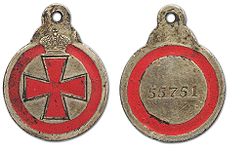
It was established on November 12, 1796 by Emperor Paul I for non-commissioned officers and privates, who served immaculately 20 years [2] . Those awarded with this sign were exempted from corporal punishment.
The first awarded badge was November 1, 1797, senior non-commissioned officer of the Life Guards Izmailovsky Regiment Vasily Guryev. Badge No. 2 received the rank and file of the same regiment Anton Titov, number 3 - the rank and file of the Life Guards of the Semenovsky Regiment, Ivan Stepanov, number 4 - the grenadier of the Life Guards, Preobrazhensky Regiment, Arseny Fedoseyev. In total, in 1797, 6042 people were awarded the mark [3] .
Prior to the establishment of the Insignia of the Order of St. George (St. George's Cross) in 1807, the insignia of the Order of St. Anne was also awarded for military distinctions [4] .
On July 11, 1864, in connection with the reduction of their service life from 25 to 7 years according to a new provision, the Order of St. Anna was awarded the distinction “for special feats and merits, not military ones”, for example, the capture of an important state criminal was a special merit. Long service awards were canceled. However, on December 12, 1888, the service award was returned and the badge began to award non-commissioned officers who served 10 years of unlimited service in the posts of sergeant -soldiers, military commanders and senior non-commissioned officers of combatant companies, squadrons or batteries.
The decoration of the Order of St. Anne was awarded simultaneously with the appointment of a lump sum of money, from 10 to 100 rubles, depending on the merit. The same sign, but without a bow from the sash and without a cash issue, was awarded to non-commissioned officers for 10 years of long-term immaculate service in combat units in the posts of sergeants, wahmisters and senior non-commissioned officers of combatant companies, squadrons or batteries [5] .
The award was canceled in December 1917 .
Notes
- ↑ In modern sources, the term Anninsky Medal has come into circulation, which is a gross mistake and is unacceptable for professional historians and falerists
- ↑ Site “Awards of Imperial Russia 1702 - 1917”. Insignia of the Order of St. Anne . medalirus.ru. Date of treatment December 30, 2012. Archived January 5, 2013.
- ↑ Military History Journal. 2014. No. 8. P. 76
- ↑ Annens medal . nubirus.chat.ru. Date of treatment December 30, 2012. Archived January 5, 2013.
- ↑ Charter on the insignia of the Order of St. Anne, established as a reward for lower military ranks . // Code of State Institutions, book VIII, section II, chapter 8th, branch 5th. Ed. 1892
Literature
- Peters D.I. Award medals of the Russian Empire of the XIX - XX centuries. Catalog. - Moscow: Archaeographic Center, 1996. - 291 p. - ISBN 5-86169-043-X .
- Chepurnov N.I. Award medals of the Russian State. - a book. - Moscow: Russian World, 2000 .-- 768 p. - ISBN 5-89577-024-X .
- Durov V., Mishedchenko Yu. Soldier awards. Insignia of the Order of St. Anne // Tseikhhaus: journal. - M. , 2001. - Vol. 16 . - No. 4 . - S. 8-9 .