Guadeloupe melanerpes [1] ( lat. Melanerpes herminieri ) is a bird of the woodpecker family , endemic to the islands of Bas-Ter and Grand-Ter in the Caribbean ( Lesser Antilles , Guadeloupe ). Named in honor of Felix Louis L'Herminier ( Fr. Félix Louis L'Herminier ) (1779-1833) - French naturalist who studied the flora and fauna of Guadeloupe [2] .
| Guadeloupe Melanerpes |
 |
| Scientific classification |
|---|
| No rank : | Bilateral symmetrical |
| Subfamily : | Real woodpeckers |
| Gender: | Melanerpes woodpeckers |
| View: | Guadeloupe Melanerpes |
|
| International scientific name |
|---|
Melanerpes herminieri ( Lesson , 1830) |
| Synonyms |
|---|
|
| Area |
|---|
|
| Security status |
|---|
Close to vulnerableIUCN 3.1 Near Threatened : 22680804 |
|
The only member of the woodpecker family on the islands. This is a relatively small bird with a long and fairly sharp beak, slightly bent down [3] . Length about 24 cm, the mass of males 86–97 g, the mass of females 69–78 g [4] . The color of the head, back and wings is black with a blue metallic sheen. The tail is brownish-black, not shiny. The lower part of the body is mostly blackish with a slight greenish or bluish tint, while the feathers of the chest and upper abdomen have dark red or dark burgundy peaks, due to which the plumage looks more mottled. The beak is black. Males and females are colored the same [5] .
Quite inconspicuous, though not silent woodpecker. Vocalization includes two main screams: a series of vibrating sounds “wa-wa-wa” when other birds meet and the same series of loud screams of “h-arr”, which is used both in communication and as a signal of presence. The drum roll is weak and slower than that of the Caroline melanerpes [3] . The flight is not the same as that of most woodpeckers - in a straight line, similar to the flight of a white woodpecker and red-faced melanerpes [6] [7] .
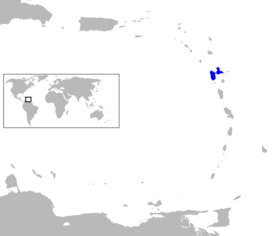
Guadeloupe melanerpes is common on the Caribbean islands of Bas-Ter and Grand-Ter , under the jurisdiction of the French department of Guadeloupe . Within the range, it inhabits all the main forest biotopes from sea level to the upper border of woody vegetation (about 1000 m): mangroves , boggy, moist semi-deciduous, seasonal tropical and moist tropical forests [8] . The densest settlements are marked by seasonal rainforests, to a lesser extent in marshy and humid rainforests. According to 2007 estimates, the total number of species is estimated at 8469 pairs, of which two-thirds live on Bas-Ter Island [9] .
Omnivore with a predominance of animal feed. It feeds on ants , termites , insect larvae, millipedes and other arthropods . Specialists distinguish the fruits of Clusius trees from plant foods, although the choice of plant foods is much wider (in one study, 17 plant species are listed, including cocoa ) [4] .
Ornithologists Pascal Villard and Claudie Pavis studied the composition of the food that the chicks feed on using a clip on their neck to prevent food from entering the stomach from the beak. After feeding, the contents of the beak were removed and yolk and protein of boiled chicken eggs were given instead. The analysis showed that the feed brought in comprised 44.3% of grasshoppers and other orthopterans , 20.2% of insect larvae ( lamellar , goldfish , and diptera ), 11% of the Caribbean leaf frog , and 10.5% of adult beetles. . Chicks were also fed with caterpillars , snails , insect pupae and millipedes [10] .
Monogam adheres to a strictly protected area throughout the year [8] . It usually reproduces between April and August, although earlier clutches are known. The nest arranges in a self-hollowed hollow, most often in a dead, but standing coconut palm at an altitude of 2 to 20 m above the surface of the earth [4] . For this reason, severe storms such as Hurricane Hugo in 1989, after which many palm trees on the islands died, can favorably affect the reproductive success of the species [8] . There are known cases of nests on other tree species and even on poles. Hans Winkler and David A. Christie report the following mean hollows: depth 31.9 cm, hollow diameter 12.1 cm, notch size 6.2 x 5.7 cm [4] . The same hollow can be used repeatedly. In clutch up to 5 eggs, incubation period of 14-16 days. Both parents incubate and feed offspring. Young people begin to fly at the age of 33-37 days, but for a long time (several months, sometimes up to a year) they stay near their parents [4] .
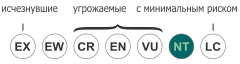
The number of Guadeloupe melanerpes is considered stable, however, due to the very small area of the range, natural disasters and economic activity can adversely affect the well-being of the species. The International Union for Conservation of Nature has assigned the bird the status of a species close to vulnerable position (category NT). Among the negative factors are deforestation and ennobling (removal of dead trees) of forests and the impact of hurricanes. Undesirable business activities include road construction and airport expansion. Rats introduced on the island can do some harm [11] .