Eolambia (lat.) Is a genus of herbivorous dinosaurs from the Neoiguanodontia treasure of the iguanodont group living in the Cretaceous period (105.3–93.5 million years ago) in the territory of modern USA [2] .
| † Eolambia |
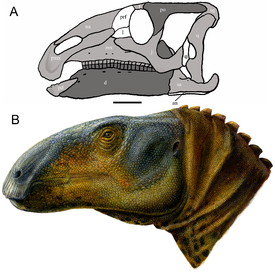
A - reconstruction of the skull,
B - reconstruction of the appearance |
| Scientific classification |
|---|
| No rank : | Bilateral symmetrical |
| Infraclass : | Archosauromorphs |
| No rank : | Archosauriformes |
| Infrastructure : | † Ornithopods |
| Parvotryad : | † Iguanodonts |
| Treasure : | † Ankylopollexia |
| Treasure : | † Neoiguanodontia |
|
| International scientific name |
|---|
Eolambia Kirkland , 1998 |
| Single view |
|---|
† Eolambia caroljonesa Kirkland, 1998 - spelling option [1] :
- Eolambia caroljonesi Kirkland, 1998
|
Geochronology105.3-93.5 Ma | million years | Period | Era | Aeon |
|---|
| 2,588 | Even | | | Ka | F
but
n
e
R
about
s
about
th | | 23.03 | Neogene | | 66.0 | Paleogen | | 145.5 | a piece of chalk | M
e
s
about
s
about
th | | 199.6 | Yura | | 251 | Triassic | | 299 | Permian | P
but
l
e
about
s
about
th | | 359.2 | Carbon | | 416 | Devonian | | 443.7 | Silur | | 488.3 | Ordovician | | 542 | Cambrian | | 4570 | Precambrian |
◄ Nowadays◄ Cretaceous-Paleogene extinction◄ Triassic extinction◄ Mass Permian Extinction◄ Devonian extinction◄ Ordovician-Silurian extinction◄ Cambrian explosion |
|---|
|

Dental bones samples holotype CEUM 9758
Content
In 1992, Carol Jones and her husband Ramal Jones, near , Utah County, discovered the fossil deposits in the anticline , which were later named Carol Quarry in her honor. Among the fossils were the remains of ornithopods , which were reported by James Kirkland in 1994. Based on these fossils, Kirkland described the type species Eolambia caroljonesa . The first part of the generic name comes from the Greek word eos / ἠώς, which means "dawn" or "morning", meaning "early". The second part is named after the Canadian paleontologist Lawrence Lamb , in whose honor the lambeosaurus was named. The name as a whole can be translated as "the dawn of the lambaeosaurins," and the species definition is named after the pioneer of the animal, Carol Jones. Before publication, the name Eohadrosaurus caroljonesi also appeared; The final name was proposed by Michael Skrepnik.
The CEUM 9758 holotype was found in the Massentuchite Straton of the Formation, in layers dating from the Cenomanian Cretaceous (approximately 98.5 million years ago), although early estimates dated his album . The sample consists of fragments of the skull . Partial skeletons of adults and adolescents, along with eggs and embryos, were also restored. Skeletons are nearly complete and belong to at least eleven different individuals.
The relatively flat and elongated holotype skull has a length of about a meter, on the basis of which Kirkland estimated the total length of the animal at 9 meters. However, another paleontologist, Gregory S. Paul, in 2010 estimated the body length to be 6 meters, and the weight to one ton.
Kirkland initially ranked the eolambia as a hadrosaurid family, considering it a typical representative of the lambeosaurine group [3] . Subsequent analysis showed that the eolambia belongs to the Neoiguanodontia clade and was a close relative of the probactrosaur [4] .
- ↑ † Eolambia caroljonesa (English) information on the Fossilworks website. (Retrieved April 23, 2016) .
- ↑ Eolambia . Paleobiology Database Classic . Date of treatment April 23, 2016.
- ↑ JI Kirkland. (1998). A new hadrosaurid from the upper Cedar Mountain Formation (Albian-Cenomanian: Cretaceous) of eastern Utah - the oldest known hadrosaurid (lambeosaurine?). Lower and Middle Cretaceous Terrestrial Ecosystems, SG Lucas, JI Kirkland & JW Estep (eds.). New Mexico Museum of Natural History and Science Bulletin 14 : 283-295.
- ↑ DB Norman. (2014). Iguanodonts from the Wealden of England: do they contribute to the discussion regarding hadrosaur origins ?. In DA Eberth & DC Evans (ed.), Hadrosaurs 10-43.
