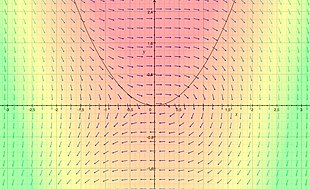
Divergence (from Latin divergere - to detect discrepancies) is a differential operator that maps a vector field to a scalar field (that is, applying a differentiation operation to a vector field results in a scalar field) that determines (for each point) how much the incoming and outgoing diverge from a small neighborhood of a given point field ”, more precisely, how much the incoming and outgoing flows diverge.
If we consider that an algebraic sign can be attributed to the flow, then there is no need to take into account the incoming and outgoing flows separately, everything will be automatically taken into account when summing up taking into account the sign. Therefore, a shorter definition of divergence can be given:
- divergence is a linear differential operator on a vector field that characterizes the flow of a given field through the surface of a sufficiently small (under the conditions of a specific problem) neighborhood of each interior point of the field definition field.
Divergence operator applied to a field are denoted as


or
- .

Content
- 1 Definition
- 2 Definition in Cartesian coordinates
- 3 Physical interpretation
- 4 Geometric interpretation
- 5 Divergence in physics
- 6 Properties
- 7 Divergence in orthogonal curved coordinates
- 7.1 Cylindrical coordinates
- 7.2 Spherical coordinates
- 7.3 Parabolic coordinates
- 7.4 Elliptical coordinates
- 8 Divergence in arbitrary curvilinear coordinates and its generalization
- 8.1 Properties of tensor divergence
- 9 See also
Definition
The definition of divergence looks like this:
Where - vector field stream through a spherical surface with an area limiting volume . Even more general, and therefore convenient to use, is to determine when the shape of an area with a surface and volume Any allowed. The only requirement is that it be inside the sphere with a radius tending to zero (that is, that the entire surface be in an infinitesimal neighborhood of a given point, that divergence is a local operation, and for this, tending to zero the surface area and the volume of its interior is obviously not enough). In both cases, it is understood that
This definition, in contrast to the one given below, is not tied to certain coordinates , for example, to Cartesian coordinates , which may be additional convenience in certain cases. (For example, if you select a neighborhood in the form of a cube or box , formulas for Cartesian coordinates are easily obtained).
The definition is easily and directly generalized to any dimension space: in this case, by volume is understood -dimensional volume, and under the surface area ( ) -dimensional area of (hyper) surface of the corresponding dimension.
Definition in Cartesian coordinates
Suppose that a vector field is differentiable in some domain. Then, in three-dimensional Cartesian space, the divergence will be determined by the expression
(here F is a certain vector field with Cartesian components ):
The same expression can be written using the null operator
Multidimensional, as well as two-dimensional and one-dimensional, divergence is determined in Cartesian coordinates in spaces of the corresponding dimension in exactly the same way (in the upper formula only the number of terms changes, and the bottom remains the same, implying the nabla operator of suitable dimension).
Physical Interpretation
From the point of view of physics (both in the strict sense and in the sense of the intuitive physical image of a mathematical operation), the divergence of a vector field is an indicator of the extent to which a given point in space (or rather a sufficiently small neighborhood of a point) is the source or sink of this field:
- - a field point is a source;
- - the point of the field is a sink;
- - there are no drains and sources, or they cancel each other out.
- - the point of the field is a sink;
A simple, although perhaps somewhat schematic, example is a lake (for simplicity, a constant unit depth with an everywhere horizontal velocity of water flow, independent of depth, thus giving a two-dimensional vector field in two-dimensional space). If you want to have a more realistic picture, you can consider the horizontal projection of speed integrated over the vertical spatial coordinate, which will give the same picture of a two-dimensional vector field in two-dimensional space, and the picture will qualitatively not differ much from our simplified first for our purposes, but be quantitatively its generalization (very realistic). In this model (in both the first and second versions), springs beating from the bottom of the lake will give a positive divergence of the current velocity field, and underwater drains (caves where water flows out) will give a negative divergence.
The divergence of the current density vector gives minus the rate of charge accumulation in electrodynamics (since the charge is saved, that is, it does not disappear and does not appear, but can only move across the boundaries of a certain volume in order to accumulate in it or leave it; and if somewhere positive and negative charges disappear - then only in equal amounts). (See Continuity Equation ).
Divergence of a field of force nature, like field strength in electrostatics, electrodynamics, or Newtonian theory of gravity, divergence also determines the position of field sources, which in this case are called charges (electric charge in the case of electrostatics and electrodynamics , mass in the case of Newtonian gravity ). In these theories, the divergence of the field strength, up to a constant factor [1] , is equal to the charge density (in electrostatics and electrodynamics it is the density of the electric charge, in the case of gravity it is the mass density; in addition, the case of gravity differs by the sign of this constant).
- for electric field and electric charge density, in SI ,
- for the Newtonian gravitational field.
Geometric Interpretation
Probably the most obvious and simple general geometric interpretation of divergence (in addition to the definition itself, which is also quite geometric) is the interpretation using its integral lines (also called force lines in the case of force fields or streamlines in the case of a fluid flow velocity field) for an image of a vector field or gas). The points where new lines appear (with the direction from this point) are the points where the field divergence is positive; where the lines end (with the direction of the line to a point), there the divergence is negative. Where new numbers of lines are constantly along their course, so the divergence of the field is zero.
- This interpretation is based on the agreement, according to which the lines under consideration are imposed on the condition that the density of lines near a given point is proportional to the magnitude of the vector field in this area (it is speculatively possible, so that the description of the field by these lines is quite detailed), consider density lines arbitrarily large, and even infinite, only the proportionality of the density somewhere around the magnitude of the field vector there is important). Otherwise, of course, at least in the case of a continuous distribution of sources (charges), any integral line of the field could be continued and the idea of their beginning or end would be somewhat meaningless somewhere, except perhaps for discrete places, and not continuously distributed sources.
If we take the set of directions of the steepest descent on the earth's surface as a vector field (in two-dimensional space), then the divergence will show the location of the peaks and troughs, and at the tops the divergence will be positive (the direction of descent diverges from the peaks), and negative at the troughs (to the troughs of the direction of descent converge). However, this does not determine the sign or equality to zero of the divergence of such a field on the slopes. [2]
Divergence in Physics
Divergence is one of the most widely used operations in physics. It is one of the few basic concepts of theoretical physics and is one of the basic elements of a physical language.
In the standard formulation of classical field theory, divergence occupies a central place (in alternative formulations it may not be in the very center of exposition, but still remains an important technical tool and an important idea).
In electrodynamics, divergence enters into two of the four Maxwell equations as the main structure. The basic equation of the theory of Newtonian gravity in the field form also contains divergence (gravitational field strength) as the main structure. In tensor theories of gravitation (including GR , and having in mind first of all) the basic field equation (in GR, but as a rule - one way or another - and in alternative modern theories too) also includes divergence in some generalization. The same can be said about the classical (i.e., non-quantum) theory of practically any of the fundamental fields, both experimentally known and hypothetical.
In addition, as can be seen from the above examples, divergence is applicable also in a purely geometric plane, and also - especially often - to various material flows (divergence of the velocity of a liquid or gas, divergence of the density of electric current, etc.).
Properties
The following properties can be obtained from the usual differentiation rules.
- Linearity : for any vector fields F and G and for all real numbers a and b
- If φ is a scalar field and F is a vector field, then:
- or
- The property that connects the vector fields F and G defined in three-dimensional space with the rotor :
- or
- Divergence from the gradient is the Laplacian :
- Divergence from the rotor :
Divergence in orthogonal curved coordinates
where - Lame coefficients .
Cylindrical coordinates
Lame Odds:
From here:
Spherical coordinates
Lame Odds:
From here:
Parabolic coordinates
Lame Odds:
- .
From here:
Elliptical coordinates
Lame Odds:
- .
From here:
Divergence in arbitrary curvilinear coordinates and its generalization
The formula for the divergence of a vector field in arbitrary coordinates (in any finite dimension) can be easily obtained from the general definition through the limit of the ratio of flow to volume, using the tensor notation of the mixed product and the tensor volume formula.
There is a generalization of the divergence operation to the action not only of vectors, but also of tensors of a higher rank.
In the general case, divergence is determined by the covariant derivative :
- where - coordinate vectors .
This allows you to find expressions for divergence in arbitrary coordinates for the vector:
- .
or tensor field:
- .
In general, divergence reduces the rank of the tensor by 1.
Tensor Divergence Properties
See also
- Divergence of a vector field. Ostrogradsky theorem. on YouTube
- Calculation of the divergence of a vector field. on YouTube
- Vector analysis
- Ostrogradsky - Gauss theorem
- Vector Analysis Formulas
- ↑ For the theory in vacuum, which is fundamental, this constant is a fundamental constant, depending only on the system of units of measurement; for a phenomenological theory, in a medium capable of polarizing, the matter is somewhat more complicated, since the proportionality coefficient is affected by the properties (polarizability) of the medium - however, for a homogeneous medium this coefficient also turns out to be constant, although not fundamental, but depending on the substance of the medium.
- ↑ If we define a vector field of this kind so that the modulus of the vector of this field is always unit (only indicating the direction), then using simple examples (say, for a completely symmetric mountain) it is easy to see that the divergence will be positive until the ramp ends (however, with imposing the condition for the identity of the direction vector of the fastest descent at the points of the vertices and holes it will not be determined, and the divergence in them will be infinite in magnitude); if we do not impose conditions for the unity of the vector, but take (as the simplest) minus the height gradient , then the divergence will depend on the convexity or concavity of the slope (at different points), which generally speaking can be different everywhere on the slope, both in sign and in size (in contrast to the peaks, which are always convex, and the holes, always concave, if we take into account the extreme points of the heights themselves).