The siege of Lviv in 1648 is an event of the uprising of Khmelnytsky . The Cossack-peasant West Russian army led by Bogdan Khmelnitsky together with the Crimean Tatars besieged Lviv .
| Siege of Lviv | |||
|---|---|---|---|
| The main conflict: the uprising of Khmelnitsky | |||
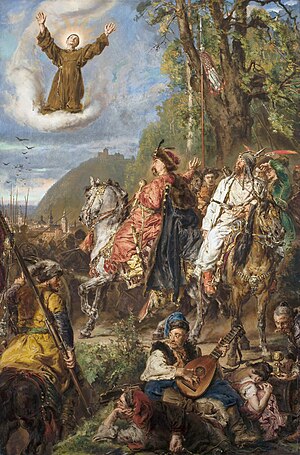 Khmelnitsky and Tugay Bay near Lviv. Painting by Jan Matejko ( 1885 ) | |||
| date of | October - November 1648 | ||
| A place | Lviv | ||
| Total | removal of the siege after receiving a purchase of 200-300 thousand zlotys | ||
| Opponents | |||
| |||
| Commanders | |||
| |||
| Forces of the parties | |||
| |||
| Losses | |||
| |||


Gaining victory over the victory over the Polish-Lithuanian forces, Khmelnytsky with his army quickly moved west and in the first days of October approached the main city of Chervona Rus - Lvov. The city was not ready for a siege, it was surrounded by a brick wall that had not been updated for a long time, and the dilapidated High Castle of the times of Casimir III towered over the city. The fortifications of Lviv did not allow its defenders to hope for a long defense due to the presence of siege artillery among the Cossacks. For a short time, the crowned troops led by Jeremiah Vishnevetsky and Nikolai Ostorog arrived in Lviv for a short time in Lviv, but both magnates, despite promises to defend the city, did not stay there and, taking the treasury, left for Zamost .
In order to deprive the besiegers of a convenient position for shelling the city, Lviv burned the city suburbs. Khmelnitsky, whose army was largely composed of mobiles, decided not to storm the city. Instead, he decided to use the psychological factor, sending troops led by Maxim Krivonos to capture the High Castle. The fortress quickly fell, but Krivonos himself was seriously injured, as a result of which he soon died. The quick capture by the Cossacks of the High Castle, as well as the brutal execution of prisoners before the eyes of the Lviv garrison, persuaded the townspeople to negotiate. As a result, the townspeople were able to negotiate the lifting of the siege for a huge purchase of 365 thousand zlotys (according to other sources - 220 thousand). In November 1648, the siege was lifted and Khmelnitsky went to the siege of Zamost . The Tatar horde for the most part returned to the steppe.
Interesting Facts
During the siege, the Cossacks stormed the Holy Mountain with the Cathedral of St. George located on it and cut out the Uniates hiding in it.
During the siege, Ivan Bryukhovetsky , later hetman of the Left-Bank Ukraine, was captured by the Tugai Bey Tatars. Tatars sacked and burned his ancestral village Bryukhovichi .
According to the information contained in the historical essay “ The Siege of Lviv in 1648 ”, by the famous Lviv historian of the 19th century Ludwik Kubala , the preservation of the city was promoted by Saint Jan from Dukla :
“This is an unexpected retreat of the enemy, and the salvation of their city from him, attributed to a miracle when Khmelnitsky and Tugai Bey saw in the evening clouds above the Bernardine monastery a kneeling figure of a monk with arms raised up, and before this terrible look they gave the order to retreat. The Bernardine fathers recognized him as Blessed John of Dukla. And therefore, after the Cossacks left Lviv, the whole city converged in a procession in his grave, and laid a crown on his grave, and the following year a column was erected in front of the Bernardine church, which still exists today ”
. It is precisely this legend that was captured in his painting by the Polish artist Jan Matejko .
Literature
- Apanovich, E. M. Historical places of events of the war of liberation of the Ukrainian people 1648-1644 Publishing House of the Academy of Sciences of the Ukrainian SSR, 1954