Düsseldorf ( German: Düsseldorf [ˈdʏsl̩ˌdɔɐ̯f]  to listen , n. Düsseldörp ) is a city in western Germany , in the Rhine-Ruhr region , the administrative center of the federal state of North Rhine-Westphalia and the seat of the state government of the Düsseldorf district. The population is 592.4 thousand people ( 2011 ) [8] . The first mention of Dusseldorf dates back to 1135 , the status of the city - from 1288 .
| City | |||||
| Dusseldorf | |||||
|---|---|---|---|---|---|
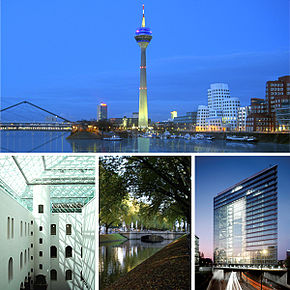 | |||||
| A country | |||||
| Status | administrative center of the earth administrative center of the district non-district city | ||||
| Land | North Rhine-Westphalia | ||||
| Administrative District | Dusseldorf | ||||
| Ober-burgomaster | |||||
| History and Geography | |||||
| First mention | |||||
| City with | 1288 | ||||
| Square | |||||
| NUM height | |||||
| Timezone | UTC + 1 , in summer UTC + 2 | ||||
| Population | |||||
| Population |
| ||||
| Density | 2 821 people / km² | ||||
| Nationalities | Germans - 84% other nationalities - 16% (2011) [2] | ||||
| Denominations | Catholics - 33% Protestants - 21% others - 47% (2011) [3] | ||||
| Katoykonim | düsseldorf, düsseldorf [4] | ||||
| Digital identifiers | |||||
| Telephone code | +49 211 | ||||
| Postcode | , , , , , , , , , , , , , , , , , , , , , , , , , , , , , , , , , , , and | ||||
| Car code | |||||
| Official code | 05 1 11 000 | ||||
Located in the center of the Rhine-Ruhr and European economic regions, Düsseldorf - along with Berlin , Frankfurt am Main , Munich and Hamburg - is one of the five largest economic, transport, cultural and political centers of Germany [9] [10] . It houses the headquarters of many large companies, including E.ON and Henkel Group . The city airport is an international hub . Düsseldorf has two harbors, as well as numerous higher educational institutions, in particular the Düsseldorf Academy of Arts and the University of Heinrich Heine .
Geography
Regulation

The city is located on the right bank of the Rhine in its lower reaches, at the confluence of the Dussel River. Currently, a number of Düsseldorf districts (Oberkassel, Niederkassel, Heerdt and Lörik) are located on the left bank of the Rhine.
The city is located a little south of the Ruhr region , in the Rhine-Ruhr agglomeration , which is one of the largest in Europe and the largest in Germany . In 20 cities and 14 districts , over 11 million people live in an area of over 10,000 km² [11] .
The highest point of the city - Sandberg (Sandberg) in the Hubbelrat region in the east reaches 165.20 m, the lowest is the confluence of the Schwarzbach river into the Rhine in the north - 28.23 m above sea level [12] . The geographical center of the city is in Dusseltal .
Dusseldorf lies in the Central European time zone .
Nearby cities
Düsseldorf borders in the north with Duisburg , Ratingen and Mülheim , in the east with Mettmann , Erkrath and Hilden , in the south with Langenfeld , in the west with Noyce , Merbush and Dormagen . In connection with the growth of cities, often the border between them is a purely legal concept and runs along one of the streets (especially the western borders of the city).
Climate
Dusseldorf's climate is predominantly oceanic , due to the relief open in the direction of the North Sea. The dominant westerly winds bring with them moist air masses . As a result, the city is characterized by mild, snowless winters and moderately warm and humid summers. In general, the weather is variable. At an average annual temperature of 10.6 ° C in Dusseldorf, about 800 mm of precipitation falls annually. The city is one of the regions with the mildest winters in Germany - snow here is on average only for eleven days a year. With 1504 sundial hours per year, Düsseldorf is one of the last places in the list of solar cities in Germany [13] .
| Dusseldorf Climate | |||||||||||||
|---|---|---|---|---|---|---|---|---|---|---|---|---|---|
| Indicator | Jan | Feb | March | Apr | May | June | July | Aug | Sep | Oct | Nov | Dec | Year |
| Average maximum, ° C | 4,5 | 6.2 | 9.8 | 13.8 | 18.5 | 21,4 | 23.1 | 23 | 19.7 | 15 | 8.9 | 5.5 | 14.2 |
| Average minimum ° C | −1.3 | −1.2 | 1,1 | 3.6 | 7.6 | 10.7 | 12,4 | 12.1 | 9.5 | 6.3 | 2,4 | −0.2 | 5.3 |
| Precipitation rate, mm | 62,2 | 48.3 | 63.6 | 54.8 | 73.5 | 85.9 | 84.3 | 77.1 | 61.6 | 55 | 55 | 71.9 | 793.2 |
| Source: [14] | |||||||||||||
| Dusseldorf Climateogram | |||||||||||
|---|---|---|---|---|---|---|---|---|---|---|---|
| I | F | M | BUT | M | AND | AND | BUT | WITH | ABOUT | N | D |
62.2 4.5 - 1.3 | 48.3 6.2 - 1.2 | 63.6 9.8 1.1 | 54.8 13.8 3.6 | 73.5 18.5 7.6 | 85.9 21.4 10.7 | 84.3 23.1 12.4 | 77.1 23 12.1 | 61.6 19.7 9.5 | 55 15 6.3 | 55 8.9 2.4 | 71.9 5.5 - 0.2 |
| Temperature in ° C • Sum of precipitation in mm Source: [14] | |||||||||||
Administrative structure
Dusseldorf consists of 10 urban districts (Stadtbezirk), which, in turn, are divided into 50 districts (Stadtteile) [15] . In each district there is a representative office (Bezirksvertretung), consisting of 19 members, elected in communal elections . The representative office is headed by its chairman (Bezirksvorsteher). Representative offices do not have their own budget and have only an advisory vote [16] .
- District 01 : Altstadt , Derendorf , Golzheim , Carlstadt , Pempelfort , Stadtmitte
- District 02 : Düsseltal , Flingern-Nord, Flingern-Süd
- District 03 : Bilk , Flehe , Friedrichstadt, Hafen , Hamm, Oberbilk, Unterbilk , Volmerswerth
- District 04 : Heerdt, Lörick, Niederkassel, Oberkassel
- District 05 : Angermund , Kaiserswerth , Kalkum , Lohausen, Stockum, Wittlaer
- District 06 : Lichtenbroich, Mörsenbroich, Rath, Unterrath
- District 07 : Gerresheim , Grafenberg, Ludenberg, Hubbelrath, Knittkuhl
- District 08 : Eller , Lierenfeld, Unterbach, Vennhausen
- District 09 : Benrath , Hassels, Himmelgeist , Holthausen, Itter, Reisholz, Urdenbach, Wersten
- District 10 : Garath , Hellerhof
Population
Strength
The industrialization of the 19th century gave a strong impetus to the growth of the population of the city. If in 1834 about 20 thousand people lived in Dusseldorf, then already in 1882 the population of the city for the first time exceeded the mark of 100 000 people [17] . Thanks to this, the city formally received the status of a large center - a grandstate ( German: Großstadt ) [18] . In 1905, there were already 250,000 people in the city, and by 1933 , after the takeover of Kaiserwerth and some other suburbs, this number doubled again.
The Second World War had a serious impact on the population of Dusseldorf. As a result of the bombing that began back in 1940, more than 5,000 residents were killed. About half of all buildings were destroyed, and of the remaining 90% were damaged. In total, during the war years, as a result of evacuations , flight, deportations and air raids, Dusseldorf lost about 57% of the population (306 thousand people), whose number decreased from 541 thousand in May 1939 to 235 thousand in March 1945 [17] .
With the end of the war, residents began to return to the city. In 1962, the population of Dusseldorf reached its historical maximum of 705,391 people [19] . The relocation of the city residents to the suburbs led to a decrease in this number, and in the 80-90s of the XX century the population of the city fluctuated around the mark of 570 thousand people. On January 1, 1975, the cities of Angermund and Monheim am Rhein entered Düsseldorf, which increased its population by another 56,920 people to 620,000, but as a result of a decision of the Land Constitutional Court in Munster at the suit of the Monheim Administration, from July 1, 1976 Monheim again became an independent city. [20]
Toward the end of the 20th century, the growth trend resumed - for example, in 2005, 573,449 people lived in the city, and by the end of 2011, 592,393 people were registered in the city. Since 2009, Dusseldorf is the seventh largest city in Germany and the second largest city in North Rhine-Westphalia . It is second only to Cologne , bypassing Dortmund and Essen [8] . By 2030, it is projected to increase the population of the city to 645,600 people [21] .
| Population Dynamics [17] | |||||||||||||||||||||||||||||||||||||||||||||||||||||||||||||||||||||||||||||||||||||
|---|---|---|---|---|---|---|---|---|---|---|---|---|---|---|---|---|---|---|---|---|---|---|---|---|---|---|---|---|---|---|---|---|---|---|---|---|---|---|---|---|---|---|---|---|---|---|---|---|---|---|---|---|---|---|---|---|---|---|---|---|---|---|---|---|---|---|---|---|---|---|---|---|---|---|---|---|---|---|---|---|---|---|---|---|---|
|
| ||||||||||||||||||||||||||||||||||||||||||||||||||||||||||||||||||||||||||||||||||||
- ↑ 1 2 3 4 5 6 7 8 9 10 11 12 13 14 15 16 17 18 19 20 21 22 23 24 25 Census results
- ↑ Estimated Based on the Number of Grocery Cards Used
National composition
The title nation of Düsseldorf is the Germans , accounting for 82.38% of the total population of the city. The largest national minorities are Turks (2.37%), Greeks (1.60%), Italians (1.10%), Japanese (0.85%) and people from the CIS countries (1.50%) (December 31, 2011 ) It should be noted that these data do not take into account persons who have acquired German citizenship (in particular, this applies to representatives of the Turkish and Russian-speaking diasporas ) [22]
Dialect
In some social layers of the city, the Düsseldorf dialect of the German language is still used - the Düsseldorf Platt ( German: Düsseldorfer Platt ). A member of the language group (in particular, being close to the Limburg language ), it adopted so many features from the dialects used to the south of Ripuar that it is often counted among them now. [23] By the name of the urban district of Benrath , the Benrath line , important in Germanic studies , dividing the Low German and High German dialects is named.
History
The first German settlements near the mouth of the Düssel River on the east bank of the Rhine existed before the year 500 [24] . The first written mention of a village called Dusseldorp dates back to 1135 .
On August 14, 1288, Count Adolph V von Berg granted Dusseldorf city status. This was preceded by a bloody power struggle between the Archbishop of Cologne on the one hand and Count von Berg and the inhabitants of Cologne on the other. The decisive battle was the Battle of Worringen on June 5, 1288, in which the Archbishop of Cologne, who protested against the granting of this status to Düsseldorf, was defeated.
After in 1380, Count William II received the title of imperial prince from King Wenzel , he decided to leave his residence from the remote Burg castle to Wuppere . The new capital of the county of Berg was strengthened, and in 1386, William himself and his wife Anna moved to a new castle on the Rhine promenade. In 1385, Düsseldorf became the residence of the Dukes of von Berg .
In 1384-1395, the city expanded significantly, the Basilica of St. Lambert was laid [25] .
Under William V, the Rich City became a regional center for the liberal arts and liberal Catholicism . [26] After the Jülich-Berg branch had no heirs in 1609, and in connection with the ensuing dispute over the right of succession between Brandenburg and the Palatinate-Neuburg , Spanish general Ambrosio Spinola began to rule the city on behalf of the emperor [27] .
After the end of the war for the cool heritage, Düsseldorf came under the rule of the Palatine Neuburgs.
Elector Johann Wilhelm von Palatinate , whom the Düsseldorfs called Jan Wellem, after the destruction of the residence in Heidelberg during the Augsburg League war, chose Düsseldorf as his main residence. This period is marked by significant urban development activity. The construction boom continued and with his successor Elector Karl Theodore, who founded many castles and institutes in Düsseldorf, laid the foundation for many collections. In his honor was named one of the central areas of the city - Karlstadt [27] .
Despite the fortification system erected around the city in 1732, during the Seven Years War it was captured by the French in 1757, and then capitulated to Duke Ferdinand of Braunschweig (1758).
During the Napoleonic Wars, Dusseldorf was again captured by the French in 1795 and was occupied by them until 1801, when, under the terms of the Luneville Peace Treaty, he was returned to Bavaria . Under the terms of the contract, the fortifications were to be demolished [28] . The north side of the fortifications was turned into a sheltered harbor .
According to the Schonbrunn Treaty, Dusseldorf again came under French influence and in 1806 became the capital of the great Duchy of Berg , a vassal state of France , founded by Napoleon I after his victory at Austerlitz in 1805 on the lands between the territories of the French Empire on the Rhine and the Kingdom of Westphalia. The great dukes were until 1808 - Joachim Murat , then - the emperor himself and, finally, from 1809 - his minor nephew Napoleon Louis Bonaparte . In 1810, Napoleon introduced his civil code , which led, in particular, to the emancipation of Jews in the Grand Duchy. The city itself continued to grow - the first esplanades appeared in it - the New Alley ( Neue Allee , now the Royal Alley ) and Napoleon Boulevard ( Boulevard Napoléon , now the Heinrich Heine Alley ) [28] .
After the defeat of Napoleon, the duchy of Berg, abandoned by French troops, was occupied by the army of the Prussian kingdom . Following the results of the Vienna Congress, Dusseldorf in 1815, together with all the Grand Duchy, finally passed to Prussia.
In 1816, the city became an independent administrative unit - the capital of the , but already in 1820 the city and the district were again united. After the creation of the Rhine province in 1822, its Landtag and Landeshauptmann were housed in Dusseldorf. In 1872, Düsseldorf again became autonomous [29] .
During this period, rapid growth of the city began. Already in 1880 there were six districts in Düsseldorf: Altstadt (the original Düsseldorf), on the northern coast of Düssel , Karlstadt (founded in 1767) in the south, built in 1690-1716 at some distance from Neustadt, Friedrichstadt in the southeast, and Königstadt and Pempelfort in the east [28] .
Immediately after noon on March 8, 1921, French reconnaissance aircraft appeared over the city. A little later, French and Belgian troops entered the city. Two years later, Düsseldorf and Duisburg, located to the north, served as bridgeheads for the Allies to occupy the Ruhr basin . After the German government adopted the Davis plan on September 1, 1925, the occupation of the Ruhr region and Düsseldorf was discontinued [30]
In 1929, the Düsseldorf district became part of the new Düsseldorf-Mettmann district, which was renamed the Mettmann district as part of the 1975 reform.
After the NSDAP came to power in Germany on April 11, 1933, the Hitler Youth carried out a massive burning of "junk literature" (among other things, books by Heinrich Heine were burned). On November 10, 1938, during the “Kristallnacht” , synagogues were burned down on Caserenstrasse and in the Benrath district. On October 27, 1941, the first prisoners sent to concentration camps in Poland were sent from a cargo station in the Derendorf area [31] . In the vicinity of Düsseldorf during the Second World War, there were concentration camps "Bert" and "Düsseldorf-Lauhausen", branches of "Buchenwald".
The first bombing of Dusseldorf in World War II began in 1940. By the time they were finished in 1945, over 5,000 civilians were killed under bombs, more than half of the houses were destroyed, 90% were damaged. All bridges across the Rhine, most streets, protective dams, underground and overpasses were destroyed. In April 1945, shortly before the end of the war, a group of citizens tried to strip the ruling National Socialist Party in power and go over to the side of the Allies without a fight. The attempt was suppressed, and some of its organizers were shot. However, morale was undermined and on April 17, 1945, American troops took the city almost without a fight [32] .
In 1946, Düsseldorf became the capital of North Rhine-Westphalia . Although factories and factories appeared in the city, it developed mainly as an administrative center. This is also evidenced by the nickname given to Düsseldorf in those years, “The Desk of the Ruhr Basin” ( German: Schreibtisch des Ruhrgebiets ). This led to the city becoming a large economic, commercial (especially after the construction of the Düsseldorfer Messe exhibition complex in 1971) and cultural (opera house - 1970, philharmonic society - 1978, collection of works of art of the North Rhine-Westphalia in 1986) center. In 1965, the University of Dusseldorf was opened [33] [34] .
Religion
Christianity
Catholicism
Since its founding, Düsseldorf has been part of the Cologne Archbishopric . Despite the strong influence of the Reformation , many Catholics lived in the city. They first belonged to the Noah dean’s office , and from July 28, 1621 - to a separate dean’s office with a center in Dusseldorf [35] . Napoleon planned to create a separate Düsseldorf bishopric, but the collapse of the Grand Duchy of Berg in 1813 did not allow these plans to materialize [36] .
About 195 thousand Catholics live in the city (2009), which makes up about 33% of the city’s population [37] . They are united in 5 deans: northern, central, southern, eastern and Benrath. The main Catholic churches in Dusseldorf are the Basilica of St. Lambert , the Church of St. Andrew , the Church of St. Maximilian and the Church of St. Cecilia .
The holy patron of the city is Apollinaris of Ravenna , whose relics are stored in the Basilica of St. Lambert [38] .
Protestantism
For the first time, the influence of the Reformation in Dusseldorf manifested itself in 1527, when, thanks to the reformist sentiments of Duke Wilhelm V of Bavaria, the Lutheran community was founded at the Church of St. Lambert [39] . After a change in the attitude of church authorities towards Protestantism in 1571, the oppression of Protestants began. The Lutheran community and the reformist community formed in 1573 were forced to hold meetings and services in the homes of their members until the persecution in 1590. From 1609 to 1614, Protestants were allowed to conduct open services (the Lutheran community led them in a room on Beregerstrasse, the reformists in the prayer house on Andreastrasse). After the radical-minded Wolfgang Wilhelm von Rfalz-Neuburg came to power in 1614, and until the middle of the 17th century, open services were again banned, and the communities returned to home meetings [40] . In 1651, within the framework of the right to freedom of religion, services were resumed in a house of worship on Bolkerstrasse . In 1683, the community managed to build its own church in the city center, but it was built in the back of the block, as it should not have access to the street. In 1916, it was named Neanderkirche ( German: Neanderkirche ) in honor of Pastor Joachim Neander [41] .
Since then, the Protestant community in the city has constantly grown and developed, and on October 1, 1934, the administration of Protestant churches in the Rhine region ( German Konsistorium der Rheinprovinz ) was transferred from Koblenz to Dusseldorf [42] .
Currently, there are 4 church districts in Dusseldorf: northern, eastern, southern and Mettmann, while the latter unites mainly parishes in the suburbs of the city. About 116 thousand Protestants (2009) live in the city, which makes up about 20% of the city’s population [37] .
Orthodoxy and Autocephalous Churches
Along with two major denominations, in Dusseldorf there are also a large number of Orthodox and autocephalous churches. United by a common commission of Orthodox churches, in Dusseldorf there are Greek Orthodox (Am Schönenkamp street ( German: Am Schönenkamp )), Russian Orthodox ( Church of the Intercession of the Holy Virgin on Ellerstrasse 213), Romanian Orthodox, Serbian Orthodox, Coptic (Pölenweg, district Grafenberg) and the Ukrainian Orthodox Church. [43]
Other Christian Churches
Near the northern park is a large Anglican church ; on Kantadorstrasse - the building of the central German Apostolic Church ; on Bruchstrasse - the Düsseldorf Christian Center ( Pentecostals ); Baptist communities on Aker, Louise, and Kantadorstrasse; Methodist Church on Hohenzollernstrasse; Old Catholic community on Aschaffenburger Strasse in the Reisholz district.
In Dusseldorf there are also 5 communities of the New Apostolic Church : Benrath, Derendorf, Eller, Flinger and Gerresheim; [44] The Mormon Church and several congregations of Jehovah's Witnesses , also in Russian.
Judaism
The Jewish community of Düsseldorf, with approximately 7,400 members, is the third largest in Germany. Instead of the old synagogue on Kazerenstrasse, destroyed during the Kristallnacht in 1938, a new one was built in 1958 on the Citenstrasse in the Derendorf district. The community owns a kindergarten, them. Yitzhak Rabin, a gymnasium and a home for the elderly. Almost 90% of the community members are emigrants from the countries of the former USSR. [45]
Buddhism
On the left bank of the Rhine in the Niederkassel area of the Japanese community, there is the only Buddhist temple of the Jodo-shinshu school in Europe. It is erected in a classic Japanese concrete style and is surrounded by a Japanese garden . Next to it are facilities for tea ceremonies and a library. [46]
In addition, in Dusseldorf there are centers of most Buddhist movements: rigpa , amitabha , kanzeon sangha ( Zen Buddhism ), the "diamond path" of Lama Ole Nydahl and also many other groups.
Islam
There are several Muslim communities in Dusseldorf, however, they are not united by a single center, but are formed on the basis of nationality ( Turks , Moroccans , Iranians ) of their members. [47]
Policy
In the XIII century, at the head of Dusseldorf stood the Schaffen . With the city of 1303, the burgomaster rules the city , and in the beginning he was also a Scheffen [48] . Along with it, from 1358 there was also a Council divided into the Old Council ( German Alter Rat ) appointed for life and re-elected every year by the Young Council ( German Junger Rat ). The representative of the Duke, who wore the title of Amtmann , also participated in the management of the city. Since the middle of the 15th century, along with the above bodies, there was also a public council for it. Gemeindeausschuss of 12 people who participated in the election of the mayor and the adoption of important decisions, but did not constitute a real tool for the influence of the townspeople [49] . After the transfer of Düsseldorf to French rule, a municipal council was organized in the city (renamed in 1815 the council of the German community Gemeinderat ), consisting of 30 members. From 1856 they began to be called city deputies ( German Stadtverordnete ), then - members of the city assembly ( German Ratsherren ), while their number changed many times. The head of the city wore the mayor during the French occupation, and after the transfer of Düsseldorf to the power of Prussia - the mayor-mayor.
During the period of National Socialism, the chief mayor was appointed by the NSDAP . After the Second World War, the military command of the British occupation zone, which included the city, appointed a new chief mayor and adopted a municipal constitution on the British model. According to her, the city council was elected by the population ( German Rat der Stadt ), its members were called deputies ( German Stadtverordnete ). The council elected from its composition the chief mayor, who played the role of chairman of the council and represented the city. Along with him, from 1946, the council elected the head of the city government ( German: Oberstadtdirektor ). A similar dual power lasted until 1999, when the mayor became the head of city self-government [50] . Also in 1999, the chief mayor is directly elected by the inhabitants of the city. Since 1999, the chief mayor of Dusseldorf has been Joachim Erwin ( CDU ). After the death of the latter in 2008, the post of chief mayor of Dusseldorf was held by Dirk Elbers ( CDU ) (2008-2014), and from September 2, 2014 - Thomas Geisel ( SPD ).
City Council
| CDU | SPD | Green Party | FDP | Left | Out of fraction | Total | |
| 2014 | 31 | 24 | eleven | 6 | four | 6 | 82 |
Coat of Arms
The original coat of arms of the city, containing only the anchor , was created at the same time as Düsseldorf received the rights of the city. The anchor symbolized the connection of the city and its inhabitants with the Rhine and Rhine shipping [51] .
Since the end of the 17th century, along with this simple coat of arms, the second was used, which depicted the seal of the Düsseldorf College of Schöffen ( German: Schöffenkollegiums ). It depicted the - the heraldic animal of the Duchy of Berg , holding an anchor in its paws. From the middle of the 18th century, this image completely replaced the old city coat of arms. [52]
After numerous changes to the coat of arms in the 19th and 20th centuries, the heraldry in 1938 removed most of the additions from the coat of arms and gave it a modern shape: the silver shield shows the two-tailed red lion of the Dukes von Berg in a blue crown holding a dropped blue anchor in its paws [51] .
Economics and Infrastructure
| Largest public companies based in Dusseldorf according to Fortune 2000 Global (2012) [53] . | ||
| Germany | Company | World |
| 17 | Henkel Group | 327 |
| 18 | Metro AG | 343 |
| 20 | E.ON | 409 |
| 42 | GEA Group | 1325 |
| 50 | IKB Deutsche Industriebank | 1710 |
Dusseldorf is one of the most economically developed cities in the Rhine-Ruhr region . Important factors leading to this, along with the location in the center of Germany’s largest metropolitan area , are the presence of Germany’s third largest international airport and exhibition center.
Dusseldorf is a leading center in the fields of advertising , European patent science, telecommunication technologies, the German "city of fashion". It hosts the world's largest model exhibition “Collections Premieren Düsseldorf” (CPD), an exhibition in the field of printing “Drupa”.
Losing only to Frankfurt , Düsseldorf is the second banking and exchange center in Germany, there is the Düsseldorf exchange [54] . The headquarters of many large companies ( Henkel , Vodafone Germany, Metro AG , E.ON , Rheinmetall ,, Degussa , NRW.BANK , WestLB , E-Plus ) are registered in the city. Daimler produces Mercedes-Benz Sprinter in Düsseldorf, Volkswagen AG - VW Crafter , and the largest Japanese colony in mainland Europe brought the city the nickname "Nippon am Rhein" [55] . The city also has the Düsseldorf Fair .
Transport
Düsseldorf Airport , located in the north of the city , is Germany 's third largest international airport . The passenger turnover of the airport, which is the hub of Lufthansa and Air Berlin , is 20.83 million people (2012). [56] . 60 airlines connect it with 180 cities in 50 countries. [57] An automatic monorail train Sky Train connects the terminal to a station for high - speed long-distance trains. Suburban trains ( S-Bahn ) leave from the station located under the terminal building. Cologne / Bonn , Dortmund and Weeze airports are also located in the immediate vicinity of the city.
Düsseldorf Central Station serves more than 1,100 trains daily. Along with commuter trains and regional express trains, it also serves high-speed ( InterCity / IC, EuroCity / EC) and super-fast ( Intercity-Express / ICE, Thalys ) long-distance routes. 5 lines of commuter trains in combination with 24 stations allow you to quickly get to any district of Dusseldorf, and to all nearby cities. Suburban lines are included in the tariff system of the Rhine-Ruhr transport association . After the closure and demolition of the Derendorf sorting station, the largest freight station of the Düsseldorf railway junction is the freight station of neighboring Neuss .
The railway network is complemented by 11 light rail routes (Stadtbahn), covering not only Düsseldorf itself, but also the nearby cities of Duisburg , Ratingen, Neuss , Meerbusch and Krefeld . Dropping underground in the center, the trains of the Düsseldorf metrotram pass in the outlying areas along the surface. 7 tram routes (Straßenbahn) and 92 bus routes allow you to get to any corner of the city and its environs. There are also six high-speed suburban bus routes (German Schnellbus) and three high-speed express bus routes - a metrobus. The system operator is [58]
For tourists there is a City-Tour sightseeing bus with an audio guide in German, English, Dutch, Spanish, French, Italian, Japanese, Arabic, Russian and Chinese.
A dense network of motorways covers Düsseldorf from all sides, partially crossing the city itself - in the north - A 44 ( Mönchengladbach - Bochum ), in the south - A 46 ( Heinsberg - Hagen ) and the A 59 departing from the Düsseldorf-South interchange (Düsseldorf Süd) Leverkusen direction, in the west - A 57 ( Cologne - Krefeld ) and in the east - A 3 ( Oberhausen - Cologne - Frankfurt ). [59] In addition, B 1, B 7, B 8, B 228, and B 326 pass through the city.
From May to October, passenger ships regularly sail along the Rhine to Duisburg and Dormagen- Zons [60] .
Düsseldorf is the only city in Germany in which pedestrian traffic lights use a yellow signal that prohibits the start of the transition, but makes it possible to complete the transition. A combination of red and yellow signals is also used, indicating the upcoming inclusion of a green signal.
Bridges
In Dusseldorf, 7 bridges were laid across the Rhine (listed in order from north to south):
- Flughafenbrücke
- Theodore Hoyce Bridge
- Oberkasseler bridge
- Rheinkniebrucke
- Hammer Eisenbahnbrücke (train)
- Josef-Kardinal-Frings-Brücke
- Fleher brücke
Culture and Education
Theaters
Classical and modern theater
The first theatrical performances in Dusseldorf date from 1585. The construction of the Düsseldorf Theater ( German: Düsseldorfer Schauspielhaus ) in its current form, with modern architecture and curved contours, was completed in 1970. It is located on Güstav-Grügens-Platz, named after its former art director Gustaf Gründgens , and is widely known throughout Germany. [61]
Other major theaters in the Rhine metropolis are the Forum Freies Theater , consisting of the youth theater Juta and Kammerspielen ; the classic Komödie Düsseldorf tabloid theater and led by the renowned theater family of the Heinersdorf Theater an der Kö , specializing in comedies and contemporary productions.
The largest children's theater in the city of Takelgarn Theater Studio, along with traditional comedies and divertissements , also includes Kinderteather , where children and young people take part in the productions. The Puppet Theater located on Helmholtzstraße, as well as the puppet theater located not far from it in the Wittgenstein Palace, are oriented both at children and adults.
Opera, musical theater and variety show
The German Rhine Opera ( German: Deutsche Oper am Rhein ) on Heinrich-Heine-Allee hosts performances of operas , ballets and operettas all year round. Built in 1925 as a planetarium, the Philharmonic ( German: Tonhalle Düsseldorf ) is the venue for concerts and other musical events in the field of classical, jazz and pop music.
On the promenade of the old town under the Reinkniebrücke bridge, Roncalli's Apollo Variete is a variety show - a classical variety show in the style of the early 20th century . The largest Düsseldorf theater, the Capitol Theater , located in the building of the former tram depot, specializes in musicals , shows and events [62] .
Cabaret
Germany’s oldest still-existing cabaret , Kom (m) ödchen , founded in 1946 by Kai and Laura Lorentz, is also located in Düsseldorf. [63]
Museums and Galleries
Art Museums
The first large collection of paintings was laid by Elector Johann Wilhelm and his wife Anna Maria Medici . It was housed in the [64] , which was specially built for it in 1709-1714, one of the first independent museum buildings in the world [65] . In 1805, during the reign of Elector Maximilian IV , who later became King of Bavaria Maximilian I, most of the collection was transferred to Munich and formed the basis of the collection of the Old Pinacotheca and the picture gallery of the Schleissheim Palace built in 1826-1836 [64] .
Already in the 19th century, the Düsseldorf Academy of Arts became one of the pillars of the Düsseldorf School of Art and a major training center for landscape painters and genre artists. In order to give school graduates the opportunity to present their works, in 1829, the was founded in the city, which today organizes regular exhibitions of contemporary art . Since 1967, the company’s exhibitions have been held in the modernist building of the on the Grabbeplatz square [66], built by the architect Konrad Beckmann. Kom (m) ödchen is also located in the same building.
The remaining exhibits of the Dusseldorf Art Gallery were housed in the Kunstpalast Museum . In addition to the main collection, which includes the works of old masters , including two large-format canvases by P.P. Rubens and the works of L. Cranach the Elder and paintings of the 19th century, in which the German art of the Düsseldorf school is especially represented, the collection also includes a collection of graphics, including about 70 thousand works. 14 thousand of them are a gift from the Düsseldorf Academy of Arts and are drawings and engravings by prominent German and Italian artists of the 15th – 20th centuries - such as A. Altdorfer and Michelangelo , P. Veronese and Rafael . Along with European art, the museum also houses a collection of Japanese woodcut and netsuke . [67]
In Dusseldorf, the capital of the federal state of North Rhine-Westphalia, there is also the Art Collection of the State of North Rhine-Westphalia . It includes two art museums: the “K20” in the Grabbepplac square and the “K21” in the “Stendehaus” ( German: Ständehaus ). K20 presents 20th-century art, in particular works of classical Art Nouveau . Until 1945 , art was represented by the work of the Fauvists and Expressionists , “ metaphysical painting ” ( Italian pittura metafisica ) and Cubism , as well as the works of artists from the “ Blue Horseman ” group, Dadaists and surrealists . Art after 1945 is represented primarily by the works of American artists - Jackson Pollock and Mark Rothko , Robert Rauschenberg and Andy Warhol [68] .
K21 contains works of art dating back to 1980 , including works by Marcel Broodtars and Nam Yun Pike . It also features photographic works by Andreas Gursky , Candida Höfer , Thomas Ruff , Thomas Strut and Jeff Wall , as well as video installations by Eiji-Liisa Atila and a sculpture by Thomas Schütte .
Museums of Literature, Theater, and Cinema
Two city museums are dedicated to Düsseldorf poets. The creativity of the national poet of Germany covers the Goethe Museum ( German: Goethe-Museum ), located in the . The collection, located on several floors of the castle, includes manuscripts, letters, first editions of many works, portraits and busts, and many other objects associated with it. The permanent exhibition has about 1,000 objects, and a separate research hall is available for visitors to use the library (about 20,000 volumes) and the rest of the collection (about 50,000 objects). [69] .
The most famous native of the city is dedicated to the Heinrich-Heine-Institut Institute , located in the Karlstadt district. It shows, among other things, a lot of original documents (both manuscripts of Heine himself and materials related to his life), part of the inheritance and his death mask .
Also in Karlstadt is a cinema museum ( German: Filmmuseum Düsseldorf ) with an adjacent cinema .
Natural History and Gardening
The most visited museum in Dusseldorf, with more than 400 thousand visitors a year, is the German marine zoo . Aquazoo-Löbbecke-Museum . Until the end of the 1980s, it was located in a bunker not far from the bombed in 1943, and then moved to a building specially built for it in the northern park. [70] The museum's concept provides a mixture of live animals and fossils, explanatory plaques and other objects grouped on a specific topic. For example, in the topic “ Adaptation of higher vertebrates to life in water” one can compare the bodies of live penguins , the original skeletons of a sperm whale , elephant seal and fossilized ichthyosaurus . Along with aquatic organisms, the museum also has collections of mollusks and geological exhibits.
Another attraction of the northern park is the Japanese garden donated by the Japanese community of the city, opened in 1976. In 1987, the all-German garden art exhibition [71] was held on the territory of the modern South Park.
Education
Being first the capital of the great duchy of Berg, and then - the Rhine province, Dusseldorf provided its residents with a decent level of education. Since the growing duchy needed a sufficient number of specialists, the first gymnasium (today called Görres-Gymnasium) was founded in 1545. Working with the support of Duke William, she graduated from church ministers and lawyers. [72] Since the 19th century, the city has become a center for the training of artists, and at the beginning of the 20th century a medical academy appears in it.
The largest educational institutions in Dusseldorf are:
- University named after Heinrich Heine ( German: Heinrich-Heine-Universität ), founded in 1907 as an academy of practical medicine and received university status in 1965 [73] . The main areas of teaching are the natural sciences , mathematics , law , medicine , foreign languages, philosophy , various economic and social specialties. About 17.600 students study at the university.
- Fachhochschule Düsseldorf - a higher specialized educational institution specializing in technical and economic specialties. Founded in 1971, it has facilities both on the territory of the University. Heinrich Heine, and in the north of the city (where technical specialties are concentrated). Currently, about 7800 students are studying in it [74] .
- The Düsseldorf Academy of Arts ( German Kunstakademie Düsseldorf ), founded in 1773, by the middle of the 19th century became the center of the Düsseldorf school of painting, which, however, extended far beyond the circle of students and teachers of the academy [75] . In 1970–80, a major conflict broke out between the professors of the academy and Joseph Beuys after the latter, together with unaccepted applicants, seized the academic secretariat. Currently, about 370 students are studying at the academy.
- Robert-Schumann-Hochschule, transformed from the conservatory founded in 1935 to them. Robert Schuman, offers, along with traditional music education, the specialty "Audio and Video Equipment".
- One of the training centers of the Essen Higher School of Economics and Management ( German: Fachhochschule für Oekonomie & Management ).
From August 27 to August 31, 2003, the second international youth Delphic Games were held in Dusseldorf under the auspices of the Council of Europe [76] [77] [78] [79] .
Publishers
- Grupello .
Attractions
The physical and cultural center of the city from the moment of its foundation to the present day is the Old Town ( German: Altstadt ). Lying between the Rhine in the west and the Heinrich Heine avenue in the east, it covers an area of about 0.5 km², which houses over 260 restaurants and cafes. Due to the large number of bars, both in the center of the old city and on the Rhine promenade , this area is nicknamed the “Longest Bar Counter in the World” ( German Längste Theke der Welt ) [80] . The old town is the center for the production and consumption of dark altbier beer, many bars also offer pilsner (usually directly from barrels), and recently, despite the traditional rivalry between Düsseldorf and Cologne , even Kölsch .
The main street of Dusseldorf is the Royal Alley , which runs from north to south, lying parallel to Heinrich-Heine-Allee and called the inhabitants of Kö ( German Kö ). The boulevard is divided by the channel flowing in the middle, in which Düssel flows and through which numerous bridges are thrown. The western side of the boulevard is occupied mainly by financial institutions, the eastern side - by shops. Most carnivals and festivities take place on Kö [81] .
To the south of the old city, upstream of the Rhine is Medienhafen . Built in 1970–80 on the site of the old harbor, which became unprofitable due to the decline in production volumes, Mediagavan is a complex of buildings in which are located the headquarters of various media ( WDR , nrw.tv, Antenne Düsseldorf, GIGA ), the Northern Landtag Rhine-Westphalia, Düsseldorf TV tower Rheinturm . Numerous cinemas and restaurants appeared next to them, providing a vibrant nightlife [82] .
- Benrath Palace
- Basilica of St. Lambert, Altstadt
- Market square with town hall
- Helforf Castle
- Calcum Castle
- Kaiserwerth imperial palace ruins
Parks
- Park at Benrath Palace
- Lancersher Park
- Castle Calcum Park
Lost Attractions
- Arab cafe
Sport
Cross country skiing
In December, every year in the city passes the stage of the World Cup in cross-country skiing (in the format "race in the city", in the very center of Dusseldorf on artificial snow). The competition program is traditional - sprint and team sprint (competitions are held by skate).
Soccer
The most famous city football team “ Fortuna ” is the German champion (1933), two-time winner of the German Cup (1979 and 1980), finalist of the Cup Winners' Cup (1979) [83] . In the 2010s, he mainly plays in the second Bundesliga. The team’s home stadium is Esprit Arena with 51,500 seats, opened in 2005 (in 2011, the Eurovision 2011 song contest was held at the stadium).
Hockey
Founded in 1935, the DEG Metro Stars team ( German: DEG Metro Stars ) is an eight- time German champion (1967, 1972, 1975, 1990-1993, 1996), the winner of the German Cup (2006), and vice-champion of Europe (1992). Since the 2006/07 season he has been playing at the new ISS-Dome stadium in the north of Dusseldorf (Rath district) with 12,500 seats. During hockey games, some of the stands are converted into 4000 standing places, so that the total capacity increases to 13,400.
Basketball
The men's basketball team Düsseldorf Magics, playing in the Burg-Wächter Castello in the south of Düsseldorf, has steadily taken places at the top of the second Bundesliga table in recent years.
The female team DJK Agon 08 Düsseldorf is a twelve-time German champion (1975, 1980-1988, 1990, 1991), a six-time German Cup winner (1980, 1981, 1983-1986, 1988) and a two-time finalist of the European Basketball Champions Cup (1983, 1986)
Twin Cities
Düsseldorf has six twin cities [84] :
- Reading ( United Kingdom , since 1988, ties between cities have existed since 1947)
- Haifa ( Israel , since 1988, friendships since 1978)
- Chemnitz (former GDR , now Germany , since 1988)
- Warsaw ( Poland , since 1989)
- Moscow ( Russia , since 1992, relations between cities have existed since 1968)
- Chongqing ( China , since 2004)
Friendly relations also exist with the cities of Belgrade ( Serbia ), Belo Horizonte ( Brazil ), Lillehammer ( Norway ), Mbombela ( South Africa ), Palma de Mallorca ( Spain ), Chiba ( Japan ), Toulouse ( France ) and Chicago ( USA) ) [85] .
Literature
- Fritz Dross. Kleine Düsseldorfer Stadtgeschichte. - Regensburg: Verlag Friedrich Pustet, 2007 .-- 160 p. - ISBN 978-3-7917-2051-7 .
- Hugo Weidenhaupt. Kleine Geschichte der Stadt Düsseldorf. - Düsseldorf: Triltsch-Verlag, 1979. - 271 p. - ISBN 3-7998-0000-X .
- Manfred Becker-Huberti; Markus Bollen. Düsseldorfer Kirchen: die katholischen Kirchen im Stadtdekanat Düsseldorf. - Köln: JP Bachem Verlag, 2009 .-- 176 p. - ISBN 978-3-7616-2219-3 .
- Jutta Gay. Streit am Rhein . - Köln: LUND Verlagsgesellschaft mbH, 2006 .-- 111 p. - ISBN 3938486031 .
Notes
- ↑ Mayors: high-speed train must connect Eindhoven & Düsseldorf
- ↑ Düsseldorf, Kreisfreie Stadt (inaccessible link - history ) . Regionaldatenbank Deutschland . Date of treatment May 2, 2018.
- ↑ Düsseldorf, Kreisfreie Stadt . Regionaldatenbank Deutschland . Date accessed May 5, 2018. (unavailable link)
- ↑ Gorodetskaya I. L., Levashov E. A. Dusseldorf // Russian names of inhabitants: Dictionary-reference book. - M .: AST , 2003 .-- S. 102. - 363 p. - 5,000 copies. - ISBN 5-17-016914-0 .
- ↑ archINFORM - 1994.
- ↑ https://www.destatis.de/DE/ZahlenFakten/LaenderRegionen/Regionales/Gemeindeverzeichnis/Administrativ/Aktuell/05Staedte.html
- ↑ Alle politisch selbständigen Gemeinden mit ausgewählten Merkmalen am 12/31/2018 (4. Quartal) - DESTATIS .
- ↑ 1 2 Bevölkerung im Regierungsbezirk Düsseldorf (German) (unavailable link) . Information und Technik Nordrhein-Westfalen (IT.NRW). Date of treatment January 29, 2013. Archived November 15, 2012.
- ↑ GaWC: Classification of cities 2010 . Globalization and World Cities Research Network (2010). Date of treatment January 29, 2013. Archived February 1, 2013.
- ↑ Standortprofil Düsseldorf (German) . Landshauptstadt Düsseldorf (07/04/2012). Date of treatment January 29, 2013.
- ↑ Charles H. Grier. Analyse geeigneter Vergleichsregionen für die Metropolregion Rhein-Ruhr (German) . - Düsseldorf: Bezirksregierung Düsseldorf.
- ↑ Düsseldorf - die wichtigsten Zahlen und Fakten (German) (unavailable link) . Landeshauptstadt Düsseldorf. Date of treatment January 29, 2013. Archived February 1, 2013.
- ↑ Die 30 sonnigsten Städte Deutschlands . Rheinische Post . Rheinische Post Verlagsgesellschaft mbH. Date of treatment February 8, 2013. Archived February 11, 2013.
- ↑ 1 2 Langjährige Mittelwerte (German) (unavailable link) . Deutsche Wetterdienst. Date of treatment February 8, 2013. Archived February 11, 2013.
- ↑ Stadtbezirke und Stadtteile (German) . Landeshauptstadt Düsseldorf. Date of appeal October 10, 2018.
- ↑ Bürgernahe Selbstverwaltung (German) (unavailable link) . Landeshauptstadt Düsseldorf. Date of treatment February 8, 2013. Archived February 11, 2013.
- ↑ 1 2 3 Statistisches Jahrbuch 2010 . - Düsseldorf: Amt für Statistik und Wahlen der Landeshauptstadt Düsseldorf, 2010 .-- P. 05-01-01.
- ↑ Düsseldorfer Zeitleiste, Zeitraum: circa 1880 bis 1900 (German) (unavailable link) . Stadtarchiv Düsseldorf. Date of treatment February 26, 2013. Archived March 9, 2013.
- ↑ Section "Statistics" on the official website of Dusseldorf, block "Population" (German)
- ↑ Landtag Nordrhein-Westfalen. Gesetzentwurf der Landesregierung, Gesetz zur Neugliederung von Gemeinden im Neugliederungsraum Düsseldorf (2. Düsseldorf-Gesetz). - Düsseldorf: Landtags-Drucksache, 1976 .-- P. 1, 4, 25.
- ↑ Bevölkerungsentwicklung in den kreisfreien Städten und Kreisen Nordrhein-Westfalens 2008 bis 2030 (German) . Ergebnisse der Bevölkerungsvorausberechnung 2008 bis 2030/2050 . IT.NRW. Date of treatment February 26, 2013. Archived March 9, 2013.
- ↑ Amt für Statistik und Wahlen. Düsseldorf - Bevölkerung (German) . Landeshauptstadt Düsseldorf. Date of treatment January 29, 2013. Archived February 1, 2013.
- ↑ Alfons Houben. Do beste platt - Düsseldorfer Mundartbrevier. - Düsseldorf: Triltsch Verlag, 1988 .-- 101 p. - ISBN 3-7998-0052-2 .
- ↑ Brockerhoff, Michael Germanen lebten an der Düssel (German) . Rheinische Post . Rheinische Post Verlagsgesellschaft mbH (July 16, 2012). Date of treatment February 1, 2013. Archived February 7, 2013.
- ↑ von Looz-Corswarem, Clemens Stadtgeschichte: Vom Dorf zur Residenzstadt (German) (link unavailable) . Stadtarchiv Düsseldorf. Date of treatment January 29, 2013. Archived February 1, 2013.
- ↑ Hugo Weidenhaupt. Kleine Geschichte der Stadt Düsseldorf. - 10. - Düs: Triltsch, 1993. - P. 46. - 288 p.
- ↑ 1 2 von Looz-Corswarem, Clemens Stadtgeschichte: Aufschwung als Residenzstadt (German) (link not available) . Stadtarchiv Düsseldorf. Date of treatment January 29, 2013. Archived February 1, 2013.
- ↑ 1 2 3 von Looz-Corswarem, Clemens Stadtgeschichte: Vom Dorf zur Residenzstadt, S.2 (German) (unavailable link) . Stadtarchiv Düsseldorf. Date of treatment January 29, 2013. Archived February 1, 2013.
- ↑ von Looz-Corswarem, Clemens Stadtgeschichte: Von der Hauptstadt eines Großherzogtums zur Industriestadt (German) (link not available) . Stadtarchiv Düsseldorf. Date of treatment January 29, 2013. Archived February 1, 2013.
- ↑ von Looz-Corswarem, Clemens Stadtgeschichte: Vom Ersten zum Zweiten Weltkrieg (German) (unavailable link) . Stadtarchiv Düsseldorf. Date of treatment January 29, 2013. Archived February 1, 2013.
- ↑ von Looz-Corswarem, Clemens Stadtgeschichte: Vom Ersten zum Zweiten Weltkrieg S.2 (German) (link not available) . Stadtarchiv Düsseldorf. Date of treatment January 29, 2013. Archived February 1, 2013.
- ↑ von Looz-Corswarem, Clemens Stadtgeschichte: Vom Ersten zum Zweiten Weltkrieg S.3 (German) (unavailable link) . Stadtarchiv Düsseldorf. Date of treatment January 29, 2013. Archived February 1, 2013.
- ↑ von Looz-Corswarem, Clemens Stadtgeschichte: Der Neubau der Stadt Düsseldorf nach dem Zweiten Weltkrieg (German) (link unavailable) . Stadtarchiv Düsseldorf. Date of treatment January 29, 2013. Archived February 1, 2013.
- ↑ Düsseldorfer Zeitleiste (German) (unavailable link) . Landeshauptstadt Düsseldorf. Date of treatment January 29, 2013. Archived February 1, 2013.
- ↑ Georg von Viebahn. Statistik und Topographie des Regierungs-Bezirks Düsseldorf . - Schreiner, 1836. - T. 1. - P. 39. - 304 p.
- ↑ Weidenhaupt, 1979 , p. 88-89.
- ↑ 1 2 Statistisches Jahrbuch 2010 . - Düsseldorf: Amt für Statistik und Wahlen der Landeshauptstadt Düsseldorf, 2010 .-- P. 05-01-03.
- ↑ Gay, 2006 , p. 38.
- ↑ Stadtmuseum: Handlung und Disputacion
- ↑ Boigrafish-bibliogrfishe Kirchenlexikon. PFALZ-NEUBURG, Wolfgang Wilhelm von,
- ↑ Stadtmuseum: Die Bolkerstraße
- ↑ Findbuch des Konsistoriums der EKiR
- ↑ Reinhard Thöle. Orthodoxe Kirchen in Deutschland. - Vandenhoeck & Ruprecht, 1997.- T. 85. - 112 p. - (Bensheimer Hefte). - ISBN 9783525871744 .
- ↑ Gemeinden im Bezirk Düsseldorf (German) . Neuapostolische Kirche - Bezirk Düsseldorf. Date of treatment February 18, 2013. Archived February 26, 2013.
- ↑ Geschichte der Jüdischen Gemeinde Düsseldorf (German) . Jüdische Gemeinde Düsseldorf. Date of treatment February 18, 2013. Archived February 26, 2013.
- ↑ Wir über uns (German) . EKŌ-Haus der Japanischen Kultur eV. Date of treatment February 18, 2013. Archived February 26, 2013.
- ↑ Moscheen in Düsseldorf (German) . moscheesuche.de. Date of treatment February 18, 2013. Archived February 26, 2013.
- ↑ A letter that gave Dusseldorf the status of a city.
- ↑ Das Rechnungsbuch der Stadt Düsseldorf aus dem Jahre 1540/41
- ↑ Düsseldorfer Stadtrecht (German) (unavailable link) . Landeshauptstadt Düsseldorf. Date of treatment January 29, 2013. Archived February 1, 2013.
- ↑ 1 2 Gay, 2006 , p. 22.
- ↑ Ein Wappen für Jedermann (German) (unavailable link) . Landeshauptstadt Düsseldorf. Date of treatment February 8, 2013. Archived February 11, 2013.
- ↑ The world's biggest public companies . Forbes Date of treatment February 26, 2013. Archived March 9, 2013.
- ↑ Düsseldorf - das Wirtschaftszentrum
- ↑ Der Düsseldorf Atlas, Geschichte und Gegenwart der Landeshauptstadt im Kartonbild. ISBN 978-3-89705-355-7 Emons Verlag 2004, 224 pp.
- ↑ Verkehrszahlen (German) . Flughafen Düsseldorf GmbH. Date of treatment February 18, 2013. Archived February 26, 2013.
- ↑ Flughafen Düsseldorf startet in den Sommer: Flugplan umfasst über 180 Ziele ab NRWs größtem Airport (German) . Flughafen Düsseldorf GmbH (03.15.2012). Date of treatment February 18, 2013. Archived February 26, 2013.
- ↑ Rheinbahn in Zahlen: Geschäftsjahr 2011 . Rheinbahn AG. Date of treatment February 22, 2013. Archived February 26, 2013.
- ↑ Unterwegs nach Düsseldorf: Mit dem Auto (link not available) . Landeshauptstadt Düsseldorf. Date of treatment February 22, 2013. Archived February 26, 2013.
- ↑ KD: Panoramafahrten in Düsseldorf Köln Düsseldorfer Deutsche Rheinschiffahrt AG (2013). Date of treatment February 22, 2013. Archived February 26, 2013.
- ↑ SchauPlätze - Theater in der Stadt (unavailable link) . Landeshauptstadt Düsseldorf. Date of treatment February 8, 2013. Archived February 11, 2013.
- ↑ Vassilios Katsogridakis. Vom Bahndepot zum Musical-Theater (German) .
- ↑ Hippen, Reinhard. Düsseldorfer Kabarett (German) // Prof. Dr. Gertrude Cepl-Kaufmann, Winfried Hartkopf, Winrich Meiszies Bilanz Düsseldorf '45. - Düsseldorf: Grupello Verlag, 1992 .-- S. 359 . - ISBN 3-928234-06-4 .
- ↑ 1 2 Die Bildenden Künste (German) (unavailable link) . Landeshauptstadt Düsseldorf. Date of treatment February 12, 2013. Archived February 15, 2013.
- ↑ Schwanke, Hans-Peter Als Florenz an den Rhein rückte (German) . Kunstmarkt (10.23.2008). Date of treatment February 12, 2013. Archived February 15, 2013.
- ↑ Der Kunstverein für die Rheinlande und Westfalen (German) (unavailable link) . Date of treatment February 12, 2013. Archived February 15, 2013.
- ↑ Bogomir Ecker, Thomas Huber. Künstlermuseum. Eine Neupräsentation der Sammlung des museum kunst palast, Düsseldorf / Jean-Hubert Martin, Barbara Til, Andreas Zeising. - Düsseldorf: Museum Kunst Palast, 2002 .-- 205 p. - ISBN 3-9808208-5-8 .
- ↑ Wiensowski, Ingeborg Kunstsammlung NRW: Die heimliche Nationalgalerie (German) . Spiegel Verlag (2010). Date of treatment February 12, 2013. Archived February 15, 2013.
- ↑ Goethe-Museum (unavailable link) . Landeshauptstadt Düsseldorf. Date of treatment February 12, 2013. Archived February 15, 2013.
- ↑ Geschichte Die Geschichte des Aquazoos (Unavailable link) . Landeshauptstadt Düsseldorf. Date of treatment February 12, 2013. Archived February 15, 2013.
- ↑ Jürgen Laskowski. Der Garten für uns alle / Bundesgartenschau Düsseldorf 1987. - Düsseldorf: Bundesgartenschau 1987 Düsseldorf GmbH, 1987. - 262 p. - ISBN 3-7779-0400-7 .
- ↑ Gründung des Gymnasiums, des heutigen Görres-Gymnasiums
- ↑ Chronik der Universität
- ↑ FH D: University of Applied Sciences . Archived February 24, 2013.
- ↑ Die Düsseldorfer Malerschule. Editor Dieter Graf. Kunstmuseum Düsseldorf 1979. ISBN 3-8053-0409-9
- ↑ Patronage of the Council of Europe (07.07.2003) (English) . Wikimedia Commons . Date of treatment October 8, 2011. Archived on June 20, 2012.
- ↑ Juliane Kinast. Goldmedalillen für Poesie und Hiphop // Westdeutsche Zeitung. - Düsseldorf, 8. Mai 2003. - No. 106 . (German)
- ↑ Lis Kannenberg. Olimpia für den Geist // Neue Rhein Zeitung. - Essen, 27. August 2003. - No. 198 . (German)
- ↑ Richard Heimann. Jugendspiele für Kunst und Kultur // Westdeutsche Zeitung. - Düsseldorf, 27. August 2003. - No. 198 . (German)
- ↑ Düsseldorf - Die Altstadt
- ↑ Die Königsallee
- ↑ Aus dem alten Handelshafen wurde der "MedienHafen"
- ↑ The “History” section on the Fortuna Düsseldorf official website . Archived July 4, 2007.
- ↑ International relations - City twinning agreements (inaccessible link) . Landeshauptstadt Düsseldorf. Date of treatment February 13, 2013. Archived February 1, 2013.
- ↑ Office of Economic Development - International relations (English) (unavailable link) . Landeshauptstadt Düsseldorf. Date of treatment February 13, 2013. Archived February 15, 2013.
Links
- Official site of the city of Dusseldorf (German)
- Dusseldorf Tourism Official Website (German )
- [www.dw.de/dusseldorf-city-disks-- drunken-houses/a-14852221-1 Dusseldorf and surroundings] (inaccessible link) . Archived February 11, 2013. - Photoreport Deutsche Welle