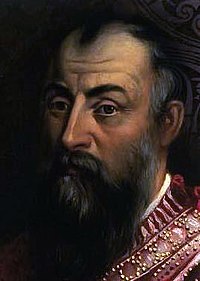
Earl of Tyrone Earl of Tyrone is an aristocratic title created three times in the Irish Peer system (1542, 1673, 1746).
Content
- 1 Counts of Tyrone, the first creation (October 1, 1542)
- 2 Baron Dungannon
- 3 Exiles
- 4 Late Applicants
- 5 Barons of Power (1535)
- 6 Counts of Tyrone, second creation (October 9, 1673)
- 7 Heirs to the title of Baron Power
- 8 Counts of Tyrone, Third Creation (July 18, 1746)
- 9 See also
- 10 Links
Counts of Tiron, First Creation (October 1, 1542)
The English kings from the Tudor dynasty, pursuing a policy of surrender and new awards, sought to subjugate the Irish tribal leaders and draw them to their side, giving them noble titles, gifts and landed estates.
In 1542, the king of the Irish kingdom, Tyr Eoghain and the head of the O'Neill clan, Conn Bakah O'Neill (c. 1480-1559), traveled to England, where he was introduced to Green King Henry VIII Tudor in Greenwich . Conn Bakah O'Neill brought homage to the English king, renounced his Irish royal title and independence. In return, Henry VIII Tudor granted him the title of Earl of Tyrone in the Irish Peer system, and his illegitimate son Matthew (Ferdochra) O'Neill received the title of Baron Dungannon and the right to inherit the title of count after the death of his father.
This caused dissatisfaction with the legitimate sons of Conn Bakach. The eldest of them, Shane O'Neill (1530-1567), in 1558 killed his half-brother Matthew, and Conn Bakach himself was expelled from Tyrone to Payle , where he died in 1559. After the death of his father, Shane O'Neill became the leader of the O'Neill clan and ruler of the kingdom of Tyr Eogain (Tyrone) in Ulster .
According to English feudal laws, Briand O'Neill (d. 1562), the eldest son of the murdered Matthew O'Neill, was supposed to inherit the title of Earl of Tyrone, but in practice he received only the title of 2nd Baron Dungannon. Queen Elizabeth Tudor of England proposed to recognize Shane O'Neill as the new Earl of Tyrone, since he actually ruled Tyrone and was the eldest of his legitimate sons, but the negotiations ended unsuccessfully. The young and unmarried Brian O'Neill was killed in 1562 by his relative, the tyrone of Tyrone, Turloch Lüneh O'Neill , who executed the order of Shane O'Neill. In 1567, after the death of Shane O'Neill in Antrim at the hands of the Scots, Thurloch Luineh O'Neill (1567-1593) became the actual ruler of Tyrone. The British government supported the rights of Hugh O'Neill (c. 1550-1616), 3rd Baron Dungannon and younger brother Briand O'Neill. In 1585, Hugh O'Neill was recognized by the English authorities as the Earl of Tyrone, and in 1593 the ruler of Tyrone, Thurloch Luyneh O'Neill, was forced to cede the supreme power to him in Tire Eogain .
Between 1594 and 1603, Hugh O'Neill, Earl of Tyrone , led an uprising in Ireland against English rule, known as the Nine Years War. In 1603, the counts Tyrone and Tyrkonnell, having been defeated in the uprising, were forced to surrender to the English command and concluded the Mellifont Peace Treaty. In September 1607, the counts of Tyrone and Tyrkonnell with their families and supporters secretly fled from Ireland to Europe. Their landholdings in Northern Ireland ( Ulster ) and hereditary titles were confiscated by the English administration. In 1614, the Irish parliament confirmed the condemnation of the runaway counts.
Despite their flight and confiscation of possessions, Hugh (Aod) O'Neill and his sons continued to be referred to as Earls of Tyrone. Currently, the Irish title of Count of Tiron is considered extinct. The descendants of the illegitimate brothers of Earl Hugh O'Neill consider themselves the heads of the O'Neill clan and are Spanish grandees with the title Earl of Tyrone.
Counts of Tyrone:
- Conn O'Neill (c. 1484–1559), 1st Earl of Tyrone (1542–1559)
- Matthew O'Neill (c. 1520–1558), 1st Baron Dungannon (1542–1558), illegitimate son of the previous
- Briand O'Neill (d. 1562), 2nd Baron Dungannon (1558) and 2nd Earl of Tyrone (1559), the eldest son of the previous
- Hugh O'Neill (c. 1550-1616), 3rd Baron Dungannon (1562), 2nd or 3rd Earl of Tyrone (1585-1607), younger brother of the previous
- Hugh O'Neill, Baron Dungannon (c. 1585-1609), 4th Baron Dungannon, son of the previous.
- Matthew O'Neill (c. 1520–1558), 1st Baron Dungannon (1542–1558), illegitimate son of the previous
Baron Dungannon
Main article: Baron Dungannon
The barony of Dungannon was created in 1542 for Matthew (Ferdochry) O'Neill, the illegitimate son of Conn Bakach O'Neill (c. 1480-1559), King Tyr Eogain (1519) and the 1st Earl of Tyrone (1542). After the death of his father, Matthew received the right to inherit the title of Earl of Tyrone. The elder sons and grandchildren of Count Tyrone bore the title of Baron Dungannon as a “courtesy title”.
In 1558, after the death of Matthew O'Neill, the new Baron of Dungannon was his eldest son, Briand O'Neill (1558-1562). In 1559, after the death of his grandfather, Conn Bach, O'Neill Briand was not recognized as the Earl of Tyrone, but continued to be called Baron Dungannon. In 1562, Briand O'Neill was assassinated by his relative Turloh Luneh O'Neill, acting on the orders of Shane O'Neill, the uncle of the rival Briand. After the death of Briand, the title of Baron Dungannon was inherited by his younger brother Hugh O'Neill (1550-1616), who in 1585 received a letter of recognition of his title of Earl of Tyrone. Hugh O'Neill (1586-1609), the eldest son of Hugh O'Neill from his second marriage, also bore the title of Baron Dungannon.
Barons Dungannon:
- 1542–1558: Matthew O'Neill, 1st Baron Dungannon (c. 1520–1558)
- 1558-1562: Briand O'Neill, de jure 2nd Baron Dungannon (d. 1562)
- 1562-1585: Hugh O'Neill, 3rd Baron Dungannon (c. 1550-1616)
- 1587–1608: Hugh O'Neill, Baron Dungannon , de jure 4th Baron Dungannon (c. 1585-1609)
In 1608, father and son, Hugh O'Neill, Earl of Tyrone , and Hugh O'Neill, Baron Dungannon, were stripped of their hereditary titles by the English government. Young Hugh and his father went to Rome, where he died in the summer of 1609.
Exiles
Hugh O'Neill and his family continued to use the title of Earl of Tyrone abroad. In Spain, O'Neill was recognized as Earls of Tyrone (Conde de Tyrone).
Hugh O'Neill (c. 1550-1616), fled from Ireland to Italy in 1607 , he was stripped of his hereditary titles and possessions in 1608 .
Henry O'Neill (c. 1586-1617), son of a previous second marriage to Joan O'Donnell. As a colonel of the Irish regiment, he served in the Spanish army in Flanders. Cavalier of the Order of Santiago
Shane (Juan, John, Sean) O'Neill (1599–1641), son of Hugh O'Neill from his fourth marriage to Katherine Majennis. Inherited the title of Count of Tyrone after the death of his father ( 1616 ). After the death of his half-brother, Henry received the rank of Colonel of the Irish Regiment. He was a knight of the Order of Calatrava and a majordom in Madrid. Died during the siege of Barcelona.
His younger brothers died young. Conn O'Neill (c. 1601-1627), died in custody at the Tower, and Briand O'Neill (1604-1617), was hanged in Brussels
Hugo Eugenio O'Neill, son and heir to Shane. It was legalized by King Philip IV after the death of Shane, but died young and childless.
Conn (Konstantino) O'Neill (d. 1660), son of Cormac O'Neill , the younger brother of Earl Hugh O'Neill, who died in the Tower of London. Shane O'Neill called him the second heir if Hugo Eugenio dies childless. Conn died before Hugo Eugenio and did not bear the title of Count. Owen Ruad Shane O'Neill (1585-1649), son of Art O'Neill and nephew of Hugo O'Neill, Earl of Tyrone, admitted that the rights to the count title belong to Don Constantino, who is in Spain. The descendants of Matthew O'Neill held the title of Earl of Tyrone until 1692 .
Hugh Oak O'Neill (1611-1660), son of Art Og O'Neill and nephew of Owen Ruad O'Neill . He participated in the Irish uprising of 1641-1642, where he fought under the command of his uncle Owen Ruad O'Neill. In 1660, after the restoration of the Stuarts in England, Hugh Oak turned to King Charles II with a request to restore the title of Count of Tiron, but did not receive the support of the monarch
Hugh O'Neill (after 1644 - c. 1670), son of Henry Ruad O'Neill and grandson of Owen Ruad O'Neill . In 1667 he became a knight of the Spanish Order of Calatrava.
Owen O'Neill (d. After 1689), son of Briand O'Neill, grandson of Conn O'Neill and great-grand nephew of Owen Ruad O'Neill . He was educated in Rome . After Owen, no one claimed the title of Count of Tiron until the 19th century .
Don Bernardo O'Neill (c. 1619–1681), Colonel of the Irish Regiment of Tiron, nephew of General Owen Ruad . He served as captain in Flanders since 1636 , participated in the war of the Irish Confederation, then returned to Flanders and received permission to form an Irish regiment in 1663. In 1673 he became Earl of Tyrone after the death of Hugh, son of Henry Mack Owen Ruad.
Eugenio O'Neill, son of Briand and grandson of General Owen Ruad. After the death of Don Bernardo in 1681, he became a titular colonel and 8th Earl of Tyrone.
Late Applicants
The heads of the O'Neill clan were the Tyrone O'Neill, the rulers of the kingdom of Tyr Eogain (counties of Tyrone). Their distant relatives, O'Neill from Clandeboy or Clanaboy in County Antrim, were the leaders of the clan at the end of the reign of Art Mac Aod O'Neill, from 1509 to 1514 , when the 1st Earl was young. The O'Neill from Clandeboy, like the O'Neill from Tyrone, were in the service of the Catholic Powers. In 1740, they moved permanently to Portugal.
Don Jorge O'Neill of Clanabo sent his pedigree from Lisbon to the heraldic service of Ulster. In 1896, he received a letter from Sir Henry Farnham Burke, Herald of Somerset, who admitted that Don Jorge had proved his royal descent from the kings of Ireland, whose lineage came from Hugh O'Neill, Earl of Tyrone. Although this origin did not give a peer title, Don Jorge O'Neill held the title of Count de Tiron, and his descendants used the title of Prince Clandeboy.
Barons Power (1535)
- Richard Power, 1st Baron Power (died November 10, 1539), son of Sir Pierce Power and Catherine Fitzgerald
- Pierce Power, 2nd Baron Power (1526 - October 16, 1545), the eldest son of the previous
- John Power, 3rd Baron Power (1529 - November 8, 1592), younger brother of the previous
- Richard Power, 4th Baron Power (c. 1553 - August 8, 1607), son of the previous
- John Power, 5th Baron Power (c. 1599–1661), son of John Og Power (d. 1600) and grandson of the previous
- Richard Power, 6th Baron Power (130–1690), Earl of Tyrone and Viscount Dessie since 1673 .
Counts of Tyrone, Second Creation (October 9, 1673)
Child titles: Viscount Dessie (1673) and Baron Power (1535)
- 1673-1690: Richard Power, 1st Earl of Tyrone (1630 - October 14, 1690), eldest son of John Power, 5th Baron Power (1599-1661), 6th Baron Power since 1661
- 1690-1693: John Power, 2nd Earl of Tyrone (c. 1665 - October 14, 1693), eldest son of the previous
- 1693-1704: James Power, 3rd Earl of Tyrone (1667 - August 19, 1704), younger brother of the previous
Heirs to the title of Baron Power
John Power (died 1724), mayor of Limerick
Henry Power (1699-1742)
John Power (died 1743), son of Edmond Power (d. 1698)
William Power (died 1755), son of Edmond Power (d. 1698)
James Power (died 1757), younger brother of the previous
Edmond Power, son of the previous
William Power (1745-1813), son of the previous
Edmond Power (1775-1830), son of John Power, grandson of Edmond Power
John William Power (1816-1851), son of the previous, MP from Dungarvan and Waterford County
Edmond James de la Poer (1841-1915), the eldest son of the previous, deputy and high sheriff of Waterford
John William Rivallon de la Poer (1882-1939), son of the previous, Lord Lieutenant of Waterford
Edmond Robert Arnold de la Poer (1911-1995), the eldest son of the previous
Anthony Edmond Rivallon de la Poer (b. 1940), eldest son of John Pierce Anthony de la Poer (1916–1943), nephew of the previous
Counts of Tyrone, Third Creation (July 18, 1746)
- 1746-1763: Marcus Beresford, 1st Earl of Tyrone (July 16, 1694 - April 4, 1763), the only Tristram Beresford, 3rd Baronet of Coleraine (1669-1701), and Nicola Sophia Hamilton (1666-1713). Married since 1717 to Katherine (1701-1769), daughter of James Power, 3rd Earl of Tyrone. Member of the Irish House of Commons from Coleraine (1715-1720), 4th Baronet from Coleraine (1701), Viscount Tyrone (1720) and Baron Beresford (1720), Grand Master of the Grand Lodge of Ireland (1736-1738).
- 1763-1800: George de La Poer Beresford, 2nd Earl of Tyrone (January 8, 1735 - December 3, 1800), the eldest son of the previous one and Catherine Power, in 1789 the title of Marquis of Waterford was created for him. Member of the Irish House of Commons from County Waterford (1757-1760) and Coleraine (1761-1763), Baron La Pauer (1769), Baron Tyrone (1786) and Marquis Waterford (1789).
All subsequent counts of Tyrone were the Marquises of Waterford
See also
- Kingdom of Tire Eogeine
- Marquis Waterford
Links
- Kidd, Charles, Williamson, David (editors). Debrett's Peerage and Baronetage (1990 edition). New York: St Martin's Press, 1990
- Leigh Rayment's Peerage Pages
- thepeerage.com