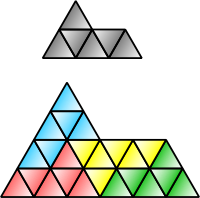
Fissile tile ( eng. Rep-tile ) [1] - the concept of mosaic geometry , a figure that can be into smaller copies of the figure itself. In 2012, a generalization of fissile mosaics called self-tiling tile set was proposed by the English mathematician in the journal Mathematics Magazine [2] .
Content
Terminology
Fissile tiles are denoted by rep- n [3] if the cut uses n copies. Such figures necessarily form tiling of the plane, in many cases forming a . Cutting fissile tiles using various sizes is called irregular fissile tiles. If such a cut uses n copies, the figure is denoted by irrep- n . If all the tiles have different sizes, cutting is called perfect. The figures rep- n or irrep- n are, obviously, irrep- ( kn - k + n ) for any k > 1 (we simply replace the smallest cutting element with n even smaller elements). The order of the tile, whether it is rep- or irrep-tile, is the smallest possible number of parts into which the tile can be cut (keeping the shape of the parts).
Examples
Any square , rectangle , parallelogram , rhombus or triangle is rep-4. Hexiamond “Sphinx” (upper figure) is rep-4 and rep-9 and is one of several well-known self-reproducing pentagons. Gosper's curve is rep-7. The Koch snowflake is irrep-7 - six smaller snowflakes of the same size, together with a snowflake of a three times larger area, can be combined to produce one larger snowflake.
A right-angled triangle with side lengths in the ratio of 1: 2 is rep-5, and its rep-5 cutting forms the basis of the aperiodic mosaic “Pinwheel” . By the Pythagorean theorem, the hypotenuse of a triangle rep-5 has a length of √5.
The international standard ISO 216 defines the dimensions of sheets of paper using √ 2 - the long side of a rectangular sheet of paper at the square root of 2 times the long short side. Rectangles with this shape are rep-2. A rectangle (or parallelogram) is rep- n if its is √n: 1 (but not only, for example, √3: √2 is rep-6, like √6: 1). The isosceles right triangle is rep-2.
Fissile Tile and Symmetry
Some fissile tiles, such as a square and a regular triangle , are symmetrical and remain identical when mirrored . Others, such as the sphinx , are asymmetric and exist in two different forms connected by specular reflection. Cutting the sphinx and some other asymmetric fissile tiles requires the use of both types - the original shape and its mirror image.
Fissile Tiles and Polyforms
Some fissile tiles are based on polyforms , such as polyamondas and polimino , or on shapes created by connecting regular triangles and edge-to-edge squares .
Squares
If a polymino is quadratic or can bridge a rectangle , then it will be a fissile tile, since a rectangle can be tiled with a square (which in itself is a special case of a rectangle). This can easily be seen in octamino elements consisting of eight squares. Two copies of some octamino elements fill the square, so these elements are also rep-16 fissile tiles.
Four copies of the same nonamino and nacking tiles pave the square, so these polyforms are also fissile rep-36 tiles.
Regular Triangles
In the same way, if a polyamond tilts a regular triangle, it will also be a fissile tile.
Right Triangles
Polyforms based on isosceles right-angled triangles (with angles of 45 ° -90 ° -45 °) are known as polyabolo . An infinite number of them are fissile tiles. Moreover, the simplest of all fissile tiles is a (single) isosceles right triangle. It is rep-2, if divided by the height of the hypotenuse . Rep-2 fissile tiles are rep-2 n tiles and rep-4,8,16 + triangles generate further fissile tiles. The tiles below are found by discarding half of the tiles and rearranging the remaining ones until they complement the mirror symmetry inside the right triangle. One tile resembles a fish formed by three regular triangles .
Fish-like fissile tile formed by three regular triangles | Fish-like fissile tile formed by four regular triangles |
Pentagonal fissile tiles
Triangular and square (quadrilateral) fissile tiles are common, and pentagonal fissile tiles are rare. For a long time it was believed that the sphinx is the only example, but the German / New Zealand mathematician Karl Scherer and the American mathematician George Sicherman [4] found additional examples, including a double pyramid and an elongated version of the sphinx. These pentagonal fissile tiles are illustrated on the pages of Math Magic , which is supported by the American mathematician Erich Friedman [5] [6] . However, the sphinx remains the only known pentagonal fissile tile, subcopies of which have the same size.
Pentagonal fissile tile discovered by Karl Scherer |
Fissile tiles and fractals
Fissile tiles as fractals
Fissile tiles can be used to create fractals or shapes that are self-similar in smaller and smaller sizes. A fractal (from a fissile tile) is formed by dividing the fissile tile (possibly) by deleting several copies of the divided shape, continuing the process recursively . For example, the Sierpinski carpet is formed in this way from a dividing tile (square) dividing into 27 smaller squares, and the Sierpinski triangle is formed from a dividing tile (regular triangle) by dividing into four smaller triangles. If you delete one of the copies, rep-4 L- trimino can be used to create four fractals, two of which are identical, if you do not take into account the orientation .
L-trimino geometric cut (rep-4) | L-Trimino Fractal (rep-4) |
Another L-trimino based fractal | Third L-Trimino Fractal |
Fractals as fissile tiles
Since fractals are self-similar, many of them are also self-sampling, and therefore are fissile tiles. For example, the Sierpinski Triangle is rep-3, tiled with three copies of itself, and the Sierpinski carpet is rep-8, tiled with eight copies of itself.
Sierpinski Triangle as three smaller copies of the Sierpinski Triangle | Sierpinski carpet as eight smaller copies of Sierpinski carpet |
Multiple Tile Fissile Tiles
Many of the known fissile tiles are rep- n 2 for all positive values of n . In particular, this is true for three trapezoids , including one formed of three regular triangles, for three pentamino (L-trimino, L-tetramino P-pentamino) and Sphinx heximond. [7]
Endless Mosaics
Among regular polygons, only a triangle and a rectangle can be cut into smaller equal copies of itself. However, a regular hexagon can be cut into six equilateral triangles, each of which can be cut into a regular hexagon and three regular triangles. This is the basis of the infinite tiling of the hexagon by hexagons. Thus, the hexagon is an irrep-∞ or irrep-infinite fissile tile.
See also
- Mosaic
- Self-reproduction
- Reptiles (lithography)
Notes
- ↑ In the terminology of Gardner’s book “Mathematical Leisure”. In English, the name rep-tile (from self- rep licating tile ) is used, which is a pun - reptile translates as reptile, amphibian. The term rep-tile was proposed by the American mathematician Solomon Golomb , see Gardner, 2001.
- ↑ Sallows, 2012 .
- ↑ From English rep licating - replication, repetition
- ↑ See also: Zicherman's Dice
- ↑ Math Magic, Problem of the Month (October 2002)
- ↑ See also: Friedmann Number
- ↑ Niţică, 2003 .
Literature
- M. Gardner . Mathematical leisure. - Moscow: Mir, 1972.
- M. Gardner . Rep-Tiles // The Colossal Book of Mathematics: Classic Puzzles, Paradoxes, and Problems. - New York: WW Norton, 2001 .-- S. 46–58. .
- M. Gardner . The Unexpected Hanging and Other Mathematical Diversions. - Chicago: Chicago University Press, 1991 .-- S. 222–233.
- CD Langford. Uses of a Geometric Puzzle // Math. Gaz. - 1940. - Issue. 260 .
- Viorel Niţică. MASS selecta. - Providence, RI: American Mathematical Society, 2003. - S. 205–217. .
- Lee Sallows. On self-tiling tile sets // Mathematics Magazine. - 2012.- T. 85 , no. 5 . - S. 323–333 . - DOI : 10.4169 / math.mag.85.5.323 . .
- Scherer, Karl. "A Puzzling Journey to the Reptiles and Related Animals", 1987
- Wells, D. The Penguin Dictionary of Curious and Interesting Geometry . London: Penguin, pp. 213-214, 1991.
Links
Rep-tiles
- Mathematics Center Sphinx Album: https://web.archive.org/web/20130409094814/http://blackdouglas.com.au/taskcentre/sphinx.htm
- Clarke, AL “Reptiles.” Http://www.recmath.com/PolyPages/PolyPages/Reptiles.htm .
- Weisstein, Eric W. Rep-Tile on Wolfram MathWorld .
- http://www.meden.demon.co.uk/Fractals/reptiles.html (2001)
- https://web.archive.org/web/20111027142835/http://www.uwgb.edu/dutchs/SYMMETRY/reptile1.htm (1999)