The Movement for the Fifth Republic ( Spanish: Movimiento V [Quinta] República, MVR ) is the Venezuelan left socialist party created on the basis of the Revolutionary Bolivarian Movement-200 in July 1997 to support Hugo Chavez 's candidacy in the 1998 presidential election . It got its name from the idea of Chavez about the need to create a new, Fifth Republic in order to replace the rotten regime of the so-called Fourth Republic.
| Fifth Republic Movement | |
|---|---|
| Spanish Movimiento Quinta República | |
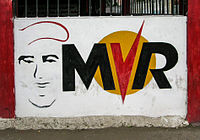 MVR logo painted on the wall | |
| Leader | Hugo Chavez |
| Founder | Hugo Chavez |
| Established | 1997 |
| Dissolution date | 2007 |
| Headquarters |  Venezuela Caracas Venezuela Caracas |
| Ideology | The left ; 21st century socialism , bolivarism , chavism |
| International | São Paulo Forum [1] |
| Allies and Blocks | Great Patriotic Pole |
| Seats in the National Assembly of Venezuela | 116 of 165 ( 2005 ) |
| Website | |
After the election of its leader as president, the Movement for the Fifth Republic becomes the ruling party and remains it until October 20, 2007 , after the formation of the Unified Socialist Party of Venezuela , created as a result of the merger around the MVR of a number of left-wing parties that supported Chavez.
Since its inception, the Fifth Republic Movement has positioned itself as the party of the Bolivarian Revolution and the political voice of the poor country.
Content
Fifth Republic
Venezuelan historiography recognizes the “four” republics, by which they mean the period of the country's existence between major regime changes. It is believed that the First Republic, also known as the "Venezuelan Confederation", was founded in 1811 and lasted until 1812 . The history of the Second Republic begins with the restoration in 1813 of the republican regime by Simon Bolivar after his Delightful campaign; it also did not last long, until 1814 . The third republic has been called the period since 1816 , when various partisan groups of supporters of independence from Spain united under the leadership of Bolivar in Llanos and formed an independent government, until 1819 , when the Congress in Angostura proclaimed the creation of Greater Colombia , of which Venezuela became a part. In 1830, Great Colombia collapsed and the independence of Venezuela was restored, laying the foundation of the Fourth Republic. In 1864, the Republic of Venezuela was transformed into the Federation of the United States of Venezuela , returning to its former name in 1953 . Although both of these periods began with the introduction of new constitutions, the fourth and twenty-fourth in a row, respectively, Venezuelan historiography recognizes them as a continuation of the Fourth Republic. [2]
Following his election, President Chavez initiated constitutional reform, culminating in the adoption of a new constitution in a referendum in December 1999 . Since then, the country is known as the “Bolivarian Republic of Venezuela” , thereby embodying Chavez’s desire to begin a new era in politics and governance.
History
Creation
The forerunner of the Fifth Republic Movement was the Revolutionary Bolivarian Movement 200 , an ultra - left military revolutionary movement founded by Hugo Chavez in 1982 with the goal of contributing to the victory of the ideas of the Bolivarian Revolution in Venezuela and throughout Latin America . In 1992, members of the movement led by Chavez tried to carry out a military coup to overthrow then- President Carlos Andrés Pérez , which ended in failure.
The first years after his release in 1994, Chavez opposed participation in the elections, believing that their results were predetermined, and the vote itself serves only to legitimize the established order. [3] This led to a split in the ranks of the movement led by him, as a result of which his long-time comrade Francisco Arias Cardenas left Chavez. [3] For some time, the leader of the RBD-200 was considering the possibility of another attempted coup . Later, some Chavez advisers, in particular, Luis Mikilena , convinced him to reconsider his skepticism about the elections, arguing that Chavez could win so convincingly that the establishment would be forced to admit his victory. [3]
Hugo Chavez formed a team of psychologists and sociologists from among university professors and students to conduct a large-scale case study . With their support, ordinary members of the Bolivarian movement interviewed tens of thousands of people across the country. The results showed that 70% of respondents are ready to support Chavez’s candidacy for president, while 57% said they would vote for him. [3] Chavez’s position regarding the election was also influenced by the victory of Arias Cardenas as a candidate for the Radical Reason party in the election of the governor of Zulia in December 1995 . [3] Despite this, many supporters of Chavez were still against participating in the elections, which led to a lengthy, throughout the year, internal party debate. Finally, in April 1997 , the National RBD-200 Congress decided to nominate Chavez for the presidency. As a result, some members of the movement left him in protest. [3] In July 1997, the National Electoral Council registered the Movement for the Fifth Republic party (the former name had to be abandoned because Venezuelan legislation does not allow parties to use the name of Simon Bolivar ). [3] Chavez’s decision to run for head of state did not arouse much interest among the international media , who did not consider Chavez a strong candidate, since polls showed a low, only 8%, level of his support. [3]
1998 Campaign
In the 1990s, Venezuela found itself in a protracted economic crisis , largely due to lower prices for oil and iron ore , the country's main export commodities, and accompanied by a devaluation of the national currency . By 1998, per capita GDP fell to the level of 1963 , amounting to only a third of the peak level of 1978 ; the purchasing power of average wages also amounted to one third of the 1978 level. [4] The situation was exacerbated by the political crisis, caused by both the economic downturn and the decline in living standards, and the numerous corruption scandals that led to a crisis of confidence in traditional parties.
The 1998 Venezuelan presidential election campaign showed that the electorate does not trust parties, preferring independent candidates, considering them unrelated to the establishment. Surveys of December 1997 showed that the most popular presidential candidates are independent candidates Irene Saes and Claudio Fermin. For Saez, “ Miss Universe 1981 ” [5] , and at that time almost 70% of those polled were ready to give their votes, [6] to Claudio Fermin, the candidate for the Democratic action , who was ready to cast their votes were ready to support 35% of respondents. [7] However, as early as April 1998, only 6% were going to vote for Fermin [7] , and the Saes rating, despite the multimillion-dollar advertising costs, fell to 15% by the summer of 1998. [6]
Along with the decline in popularity of Saes and Fermin, Chavez's rating grew. If in September 1997 only 5% of respondents were ready to vote for Chavez, then at the end of February 1998 - more than 10%, [8] , in May - 30%, and in August already 39%. [6] . The ranking of his main rival, Enrique Salas Roemer, governor of the state of Carabobo , in August 1998 was 21%. [7]
Chavez promised voters that he will eliminate the old political system and ensure the participation of independent and new parties in power, end corruption and eradicate poverty in Venezuela. During the election campaign, he actively used his charisma and oratorical abilities, trying to gain the trust and favor of the electorate, especially the working class and the poor, with an abundance of colloquial and crude words. [9] [10] All this allowed Chavez to win the presidential election by a significant margin, winning in 17 states out of 23. [7]
In the parliamentary elections held simultaneously with the presidential elections, the Fifth Republic Movement also came out successfully, winning 35 seats in the Chamber of Deputies out of 207 and 8 seats in the Senate out of 54, becoming the country's second-largest number of parliamentary mandates after the Democratic Action.
1999 Campaigns
Having come to power, Chavez initiated a reform of the constitution . To do this, in April 1999, a referendum was held to convene the Constitutional Assembly, the vast majority of the participants agreed with Chavez’s proposal. In the summer, elections to the Constitutional Assembly took place . To participate in them, supporters of the president - the Movement for the Fifth Republic, the Movement to Socialism , " Everything for the Fatherland ", the Communist Party of Venezuela , the People’s Electoral Movement and some small parties - united in the coalition "Patriotic Pole" ( English Polo Patriótico ), having won As a result, 121 out of 128 places. In December of the same 1999, another referendum was held , more than 70% of the participants voted in favor of approving the draft constitution developed by the Constitutional Assembly.
2000 Campaign
In the summer of 2000, early general elections were held , appointed due to the adoption of a new constitution. On one day, voters had to elect the country's president, deputies of the new, now unicameral parliament , as well as regional and local authorities. Chavez won almost 60% of the vote in the presidential election, the Movement for the Fifth Republic was able to win 92 out of 165 in the parliamentary elections, in addition, the candidates of the ruling party, with the support of their allies in the Patriotic Pole coalition, won the election of governors in 14 out of 23 states.
2000 Campaigns
In August 2004, a referendum was held on the recall of President Hugo Chavez , initiated by the opposition. Opponents of the authorities seemed to have good chances to win. In 2003 and early 2004, Chavez’s ratings were low, but as soon as the campaign began, polls began to show the growing popularity of the current president. Already in June, the superiority of Chávez’s supporters over opponents in various polls was from 5 to 12%, and the difference in favor of opponents of recall ranged from 8 to 31%. As a result, 58% (with the appearance of about 70%) voted against the early termination of powers of Hugo Chavez.
In October 2004, regular regional elections were held . 37.32% of voters voted for the Fifth Republic Movement across the country, which ensured the party victory in the election of governors in 19 states out of 22 and in mayoral elections in 194 municipalities out of 332.
December 4, 2005 held the next parliamentary elections in Venezuela . On November 29, five leading opposition parties refused to run for election, accusing the authorities of imminent falsification of the results of the popular vote. As a result, the turnout turned out to be only slightly above 25%, which was an unprecedented result in the history of the parliamentary elections in Venezuela. [11] As expected, the party of Hugo Chavez Movement for the Fifth Republic won almost 70% of all seats in the National Assembly, and all remaining seats were won by the Allied parties. In addition, the Movement for the Fifth Republic list received 89% of the vote in the elections to the Latin American [12] and Andean parliaments. [13] A two-thirds majority in parliament made it possible for the Fifth Republic Movement to amend the constitution without the support of other political parties. [14] [15]
December 3, 2006 held the next election of the President of Venezuela. From the very beginning of the election campaign, Chavez was very popular in the country, leading in most opinion polls throughout the campaign. As a result, he was able to confidently win the election, having achieved the highest rate and the largest difference in votes in the history of Venezuela since the 1958 election . For the Fifth Republic Movement, this was the third consecutive victory in the presidential election.
Party Dissolution
On December 18, 2006, Hugo Chavez announced plans to dissolve the party, hoping that 23 other parties that supported his government would follow suit and together form the United Socialist Party of Venezuela . [16]
Elections
Over the 10 years of its existence, MVR has taken part in 13 national and regional campaigns, winning all of them, with the exception of the 1998 Congress elections:
- Presidential elections of 1998 , 2000 and 2006 ;
- Legislative Election 1998 , 2000 and 2005 ;
- Elections to the Venezuelan Constitutional Assembly in 1999 ;
- Regional elections of 1998 , 2000 and 2004 ;
- Referendums of April 1999 , December 1999 and 2004 .
| Presidential elections |
|---|
| Parliamentary elections |
|---|
Notes
- ↑ Foro de São Paulo: Partidos (Spanish)
- ↑ Gustavo Planchart Manrique: "Constituciones de Venezuela" in Diccionario de Historia de Venezuela. Caracas : Fundación Polar, 1997 . ISBN 980-6397-37-1
- ↑ 1 2 3 4 5 6 7 8 Bart Jones: Hugo! The Hugo Chavez Story from Mud Hut to Perpetual Revolution . London : The Bodley Head, 2008 . p. 202-204
- ↑ Janet Kelly and Pedro Palma: "The Syndrome of Economic Decline and the Quest for Change" , in Jennifer McCoy and David Myers (eds), The Unraveling of Representative Democracy in Venezuela. Johns Hopkins University Press, 2006. p. 207
- ↑ St. Petersburg Times : "Miss Venezuela Chosen World's Most Beautiful" . 07.21.1981, p. 3A
- ↑ 1 2 3 Jennifer McCoy: "From Representative to Participatory Democracy?" , in Jennifer McCoy, and David Myers (eds), The Unraveling of Representative Democracy in Venezuela. Johns Hopkins University Press, 2006 . p. 276
- ↑ 1 2 3 4 Jennifer McCoy: "Chavez and the End of" Partyarchy "in Venezuela" . Journal of Democracy, 10 (3), 1999, pp. 64-77
- ↑ Jones, p. 215
- ↑ Alma Guillermoprieto: "Don't Cry for Me, Venezuela . " New York Review of Books, 10/6/2005
- ↑ JL McCoy & H. Trinkunas: Venezuela's "Peaceful Revolution" . Current history: A Journal of Contemporary World Affairs. March 1999. Vol. 98. No. 626, p. 49
- ↑ El Universal: CNE anuncia que la participación alcanzó 25 por ciento . December 4, 2005 (Spanish)
- ↑ CNE: Divulgación - Elecciones Parlamentarias 2005. Resultados Electorales para Diputado o Diputada al Parlamento Latinoamericano (Spanish)
- ↑ CNE: Divulgación - Elecciones Parlamentarias 2005. Resultados Electorales para Diputado o Diputada al Parlamento Andino (Spanish)
- ↑ BBC: Venezuela 'landslide' for Chavez . December 5, 2005
- ↑ CNE: Cronograma Elecciones de diputados y Parlamentarios 04 de diciembre 2005 (Spanish)
- ↑ The Washington Post : Venezuela starts to construct single ruling party . 12/18/2006 (English)