The Red Banner Transcaucasian Border District (abbreviated KZAKPO ) is a military administrative operational association ( border district ) of the border troops of the KGB of the USSR .
| Red Banner Transcaucasian border district KZakPO | |
|---|---|
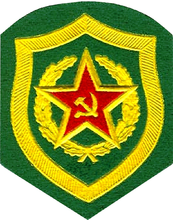 Patch border troops of the KGB of the USSR | |
| Years of existence | September 27, 1922 [1] March 15, 1993 [2] |
| A country |  the USSR the USSR |
| Subordination | to the commander of the PV KGB of the USSR |
| Enters into | KGB of the USSR USSR Armed Forces (until 21.03.1989) |
| Type of | border district |
| Includes | management , connections , parts , institutions |
| Function | border guard USSR |
| Number of | Union |
| Dislocation | Azerbaijan SSR , Armenian SSR , Georgian SSR Black Sea coast of the RSFSR |
| Colors | Green [3] |
| Participation in | The Great Patriotic War |
| Marks of Excellence |  |
Formation History
Predecessor of Formation in the Russian Empire
With the advancement of the Russian presence in the Transcaucasus from the first half of the 19th century, the planned organization of the protection and defense of the occupied lands was carried out. Mainly for this purpose the troops of the Don Cossack army were involved.
After the full accession of the Transcaucasian states to Russia in 1865, a decision was made to strengthen the protection of the southern border of the new subjects of the Russian Empire.
By 1870, 209 posts located at a distance of 1,400 kilometers were located on the land border. By this time, the units of the Don Cossack army were rotated into parts of the Kuban Cossack army with a total number of more than 5,000 people [1] .
By decree of Alexander III of October 15, 1893, on the basis of the border guard of the customs duties department of the Ministry of Finance, the Separate border guard corps was formed, which organized the border guard. On May 7, 1899, the 6th district was formed in the corps with administration in Tiflis .
The 6th Corps consisted of five brigades with the following headquarters deployment [4] :
- 25th Black Sea Brigade - Batumi
- 26th Kars Brigade - Kars
- 27th Erivan Brigade - Erivan
- 28th Elisavetpol Brigade - Elisavetpol
- 29th Baku Brigade - Baku
The task of the 6th district was to protect the land and sea borders with Persia and Turkey .
Interwar Period
On May 28, 1918, a Decree on the creation of the border guard of the Soviet Republic was signed.
On February 1, 1919, by order of the Revolutionary Military Council, the border guard was transformed into border troops. Border districts were renamed into border divisions, districts into border rifle regiments, subdistricts into battalions, distances into companies. In total, three border divisions were formed, each of which had five regiments and five cavalry divisions.
Due to the difficult situation on the fronts of the Civil War , on July 18, 1919, the Labor and Defense Council included the border troops in the army.
January 19, 1921 by a decision of the Council of Labor and Defense, border troops were withdrawn from the army.
Under the leadership of the Chairman of the Cheka, F. E. Dzerzhinsky, by June 1921, 15 border brigades were formed, totaling 36,000 men, which was less than half of the accepted staff of the border troops. The end of the Civil War in Transcaucasia was accompanied by numerous facts of banditry in the border zone committed by gangs penetrated from both Turkey and Persia. Due to the fact that the border brigades could not cope with the functions assigned to them, because of their small number, units of the Separate Caucasian Army were involved in guarding the border and controlling the border strip [5] .
In February 1922 the Transcaucasian Emergency Committee was established.
In July 1922, a branch for border protection and the fight against smuggling was created under the Transcaucasian Cheka . On September 27, 1922, by its resolution, the Council of Labor and Defense transferred the tasks of protecting the land and sea borders as a function of the State Political Administration. At the same time, a separate border corps of the GPU troops was created. All the land and sea units that at that time were involved in the protection of the state border were transferred to the corps. By the end of 1922, separate border companies and battalions were formed on the basis of units of the Separate Caucasian Army , which took over the state border. The Office of the Border Guard and the troops of the Transcaucasian GPU was created, which was located in Tiflis . [one]
. Since 1924, the formation of border detachments in the Caucasus began on the basis of separate border companies. For example, on the basis of the 5th separate border company of the Separate Prishibsky border detachment, the Lankaran border detachment was formed.
On March 8, 1939, the Transcaucasian Military District was divided into 3 separate border districts according to the Union republics [6] :
- Azerbaijan Border District - Baku
- Armenian Border District - Yerevan
- Georgian Border District - Tbilisi
Parts of the Transcaucasian District deployed on the territory of the RSFSR were transferred to the Black Sea Border District.
By the beginning of World War II, the formations that were part of the Transcaucasian Border District until March 8, 1939, were represented as follows [6] [7] :
- Junior Comprehensive School District School - Tbilisi
- Junior command staff district school - Baku
- Junior Nursing School District School - Yerevan
- 32nd Novorossiysk border detachment - RSFSR . At the first formation - Anapsky
- 33rd Gelendzhik border detachment - RSFSR
- 34th Sochi Border Detachment - RSFSR
- 35th Tuapse Border Detachment - Georgian SSR
- 36th Sukhumi Red Banner Frontier Detachment - Georgian SSR
- 37th Batumi Border Detachment - Georgian SSR
- 38th Akhaltsikhe border detachment - Georgian SSR
- 39th Leninakan border detachment after Lavrentiy Beria - Armenian SSR
- The 40th Oktemberyan border detachment named after Anastas Mikoyan - Armenian SSR. At the first formation - Kamarlinsky , also referred to in many sources as Erivansky .
- 41st Nakhchivan border detachment - Azerbaijan SSR
- 42nd Jabrayil border detachment - Azerbaijan SSR
- 43rd Geok-Tepa border detachment - Azerbaijan SSR
- 44th Lankaran border detachment - Azerbaijan SSR
- 9th Meghrinsky separate border commandant's office - Armenian SSR
- Sudzhuk separate border commandant's office - RSFSR
- 1st Caspian Detachment of Frontier Ships - Baku, Azerbaijan SSR
- 3rd Black Sea Border Squad Detachment - Ochamchira , Georgian SSR
- 4th Batumi border guard detachment - Georgian SSR
Great Patriotic War
On September 25, 1941, border regiments of the NKVD were created on the basis of the border detachments as part of the Transcaucasian border district, which later took part in hostilities on the Caucasian front. Unlike other regiments of the Red Army and the convoy troops of the NKVD , border regiments in their standard structure did not consist of companies , but outposts [7] .
On June 22, 1941, the 1st Caspian detachment of border ships was transferred to the Caspian Military Flotilla, whose ships and boats on August 25 of the same year participated in the landing of troops in Iranian ports. Since the beginning of active operations of the Luftwaffe over the water area of the Caspian Sea, ships and boats of the 1st Caspian detachment carried out air defense of the caravans of ships transporting oil. On July 30, 1942, a Junkers Ju 88 bomber was shot down by border guards from this unit. Subsequently, this unit participated in the defense of Stalingrad [7] .
On December 17, 1941, on the basis of the detachment of border ships, the 4th division of patrol ships with a deployment in Batumi and the 8th division of patrol ships with a deployment in Novorossiysk were created. Both divisions were transferred under the control of the headquarters of the Black Sea Fleet .
In connection with the approach of hostilities to the North Caucasus in May-June 1942, there was an increase in the number of border troops of all three Transcaucasian border districts. The coastal posts of the Georgian District on the Black Sea coast were reorganized into linear border outposts. The border detachments of the Armenian District were reinforced. The 36th and 37th Border Detachments received maneuverable groups of 250 people deployed in Sochi , Ochamchira , Gudauta , Sukhumi and Poti . The 36th and 37th frontier detachments were armed with anti-tank guns and 50-mm company mortars. To strengthen the protection of the Soviet-Turkish border, 3 NKVD border regiments from Moscow and Central Asia were transferred to the Georgian border district, which in September 1942 became part of the NKVD divisions that took part in the defense of the Caucasus [1] .
On February 4, 1943, the 4th Division of patrol ships participated in the landing of troops in the area of Stanichka (Cape Myskhako ), south of Novorossiysk . Among the landed paratroopers were also military personnel of the 23rd and 32nd border regiments of the NKVD.
From October 31 to December 11, 1943 the 4th division of patrol ships participated in the landing on the Kerch Peninsula [7] .
On March 26, 1944, the 24th Frontier Regiment of the NKVD formed in ZakPO, as part of the 2nd Ukrainian Front, fought to reach the state border of the USSR near the Prut River .
On July 15, 1944, the 1st Caspian detachment of patrol ships was withdrawn from the Caspian military flotilla and transferred to the control of the NKVD [7] .
Post-war period
On January 22, 1960, the Armenian Border District was reorganized into the Task Force of the Border Forces in the Armenian SSR.
A resolution of the Central Committee of the CPSU and the Council of Ministers of the USSR dated March 5, 1963, occurred the regular reform of the border troops of the KGB of the USSR, during which the Transcaucasian border was reconstructed based on the former Armenian, Azerbaijan, Georgian border districts and parts of the Black Sea border district of the RSFSR Black Sea coast. district [1] .
In the late 1980s, the Karabakh conflict intensified. Separatist sentiments are also growing and the political situation in the Transcaucasian Union republics is becoming more complicated. To reinforce the forces of the Transcaucasian Border District for the protection of the Soviet-Iranian and Soviet-Turkish border, the 103rd Guards Airborne Division , which was transferred from the Belarussian Military Forces, was reassigned to the border forces from January 4, 1990 to August 28, 1991 . district and the 75th motorized rifle division of the Transcaucasian Military District , stationed in the Nakhichevan Autonomous Soviet Socialist Republic [6] .
The period after the collapse of the USSR
After the collapse of the USSR, the troops of the Transcaucasian Border District, from February 2, 1992, already by the leadership of the Russian side, continued to guard the former state border of the USSR for some time.
At the interstate negotiations in Tashkent in May 1992, the government of Azerbaijan , Moldova and Ukraine refused to finance the joint border troops, which according to the proposed project were supposed to protect the former USSR state border, for the CIS states .
In 1992, with the intensification of hostilities in the Karabakh war , the 42nd Hadrut border detachment, whose management was deployed in the territory of Nagorno-Karabakh, got into a difficult situation. From the beginning of 1992, Gadrut became the object of attacks by Azerbaijani artillery, and therefore, from the end of March to May 27, 1992, the detachment's units were withdrawn to the city of Goradiz . At the request of the Azerbaijani side, by the summer of 1993, all Russian border detachments were withdrawn from the territory of Azerbaijan to the territory of Dagestan [1] .
At a meeting of the heads of state of the CIS countries on May 26, 1995 in Minsk , Azerbaijan, Moldova, Turkmenistan , Uzbekistan , and Ukraine, they refused to adopt the “Concept for the protection of the borders of the CIS member states with non-Commonwealth states”.
On November 3, 1998, an intergovernmental agreement was concluded between Georgia and Russia, according to which the Russian border troops were to transfer the border of Georgia with Turkey to the Georgian side and then withdraw them from the territory of Georgia. In 1999, the Russian border troops were withdrawn from Georgia [8] .
On September 30, 1992, Russia signed an agreement with Armenia on the status of the Russian border troops located on the territory of Armenia and the conditions for their functioning, according to which the state border of Armenia with Turkey (330 km section) and Iran (45 km) should be protected by the border troops Russia. This system of protection of these border sections has been completely preserved since the Soviet period [9] .
On March 15, 1993, by Decree of the President of Russia No. 341, the Transcaucasian Border District was disbanded. By the same decree, dated March 15, 1993, the North Caucasus Border District (SKPO) was created, which is considered the successor of the Transcaucasian Border District [2] .
Later, the North Caucasus Border District was renamed the Caucasus Special Border District (KPO) as part of the Federal Border Guard Service of Russia. On August 1, 1998, the Caucasus Special Border District changed its name to the North Caucasus Regional Office (SKRU) of the Federal Border Service (FPS). In 2003, the SKRU, along with the rest of the Federal Border Guard Service, was reassigned to the Federal Security Service. In 2005, the North Caucasus Regional Administration was renamed the North Caucasus Border Regional Administration (SKRPU) as part of the Border Service of the FSB of Russia. As of 2008, the border districts, as part of the FSB Border Service, were abolished. The Border Guard Service of the Federal Security Service of Russia has moved to a structural division of the Border Guard Service of the Federal Security Service of Russia into the Border Guard Authorities by region.
County composition
Troop location
The composition of the Transcaucasian border district before the collapse of the USSR, the units are arranged in order from east to west [6] [10] :
- District Office - Tbilisi , Georgian SSR
- Commandant's Office of the Okrug (w / h 2453) - Tbilisi
- 44th Lankaran border detachment (military unit 2038) - Azerbaijan SSR
- 43rd Prishibsky Red Banner Frontier Detachment (military unit 2013) - Azerbaijan SSR
- 42nd Hadrut Red Banner Border Detachment (military unit 2087) - Azerbaijan SSR
- 127th Meghrinsky border detachment (military unit 2393) - Armenian SSR
- 41st Nakhichevan border detachment (military unit 2062) - Azerbaijan SSR
- 125th Artashat border detachment (military unit 2392) - Armenian SSR
- The 40th Oktemberian Border Detachment named after A.I. Mikoyan (military unit 2037) - Armenian SSR
- 39th Leninakan Red Banner Frontier Detachment (military unit 2012) - Armenian SSR
- 38th Akhaltsikhe Red Banner Frontier Detachment (military unit 2021) - Georgian SSR
- 10th Khichaur border detachment (military unit 2358) - Georgian SSR
- 37th Batumi Red Banner Border Detachment named after the military Soviet-Bulgarian friendship (military unit 2016) - Georgian SSR
- 36th Sukhumi border detachment (military unit 2011) - Georgian SSR
- 32nd Novorossiysk Red Banner Frontier Detachment (military unit 2156) - RSFSR
- Separate checkpoint "Novorossiysk"
- Separate checkpoint "Batumi"
- Separate checkpoint "Tbilisi-airport"
- Separate checkpoint "Astara"
- Separate checkpoint "Julfa"
- 124th Separate Communications Battalion (military unit 2051) - Tbilisi
- 5th interdistrict school of sergeant staff (military unit 2419) - n.a. Tetri Tskaro , Georgian SSR
- district school of sergeant signaling and communications personnel (military unit 2446) - Artashat, Armenian SSR.
- 18th school of sergeant staff of communication facilities (military unit 9790) - Yerevan, Armenian SSR
- 20th Interdistrict School of Sergeant Staff (military unit 1481) - Prishib urban village, Azerbaijan SSR
- District Military Hospital - Tbilisi
- District Military Hospital (military unit 2435) - Baku, Azerbaijan SSR
- 6th construction company (military unit 3337) - Batumi, Georgian SSR
- 40th separate engineering and construction battalion (military unit 9844) - Anapa , RSFSR
- 12th Separate Aviation Training Regiment (military unit 2464) - Tbilisi
- 12th Military Depot (military unit 2432) - Tbilisi
- 6th Separate Brigade of Border Patrol Ships (military unit 2372) - Ochamchira , Georgian SSR
- 17th separate brigade of border patrol ships (military unit 2375) - Baku
- The 21st separate brigade of border guard ships (military unit 9881) - Poti , Georgian SSR.
District Commanders
A partial list of district commanders (chiefs of troops) [6] :
- Matrosov, Vadim Alexandrovich - April 1963 - April 1967;
- Peskov, Nikolai Denisovich - April 1967 - October 1970;
- Senkov, Leonid Yakovlevich - October 26, 1970 - May 8, 1972;
- Viktorov, Alexander G. - May 1972 - November 1975;
- Tolkunov, Vladimir Pavlovich - November 1975 - March 1977;
- Makarov, Nikolai Ivanovich) - March 1977 - May 1981;
- Sentyurin, Boris Efimovich - May 29, 1981 - July 20, 1984;
- Zgersky, Gennady Anatolyevich - July 1984 - March 1988;
- Petrovas, Iokubas Kirillovich - March 1988 - January 1991;
- Pleshko, Konstantin Konstantinovich - January 1991 - March 1993;
Heroes of the Soviet Union
Soldiers of the Transcaucasian Border District who participated in the Great Patriotic War and were awarded the title Hero of the Soviet Union [7] :
- Golubets, Ivan Karpovich . The site " Heroes of the country ." - June 14, 1942, posthumously.
- Grigory Alexandrovich Kuropyatnikov . The site " Heroes of the country ." - July 24, 1943.
- Taran Peter Tikhonovich . The site " Heroes of the country ." - October 25, 1943, posthumously.
- Gnatenko Grigory Ivanovich . The site " Heroes of the country ." - January 22, 1944.
- Denisov Vyacheslav Nikolaevich . The site " Heroes of the country ." - January 22, 1944, posthumously.
- Derzhavin Pavel Ivanovich . The site " Heroes of the country ." - January 22, 1944.
- Lednev Ivan Vasilievich . The site " Heroes of the country ." - January 22, 1944.
- Starshinov Nikolay Vasilyevich . The site " Heroes of the country ." - January 22, 1944.
See also
- Border troops of the KGB of the USSR
- Border District
Notes
- ↑ 1 2 3 4 5 6 Guarding the borders of the Fatherland. The history of the border service .. - M .: "Border", 1998. - p. 225, 277-309, 410-412, 468-469, 539-566. - 607 s. - ISBN 5-86436-078-3 .
- ↑ 1 2 Decree of the President of the Russian Federation of March 15, 1993 No. 341
- ↑ Moscow magazine. V.N. Kulikov. "The history of the green cap." Rubric: The Border Guard of Russia: Past and Present.
- ↑ Website of the Separate Border Guard Corps
- ↑ Border troops. Collection of materials and documents. 1918-1928. - M .: "Science", 1973. - p. 545-571. - 928 s.
- ↑ 1 2 3 4 5 “Border troops”. History of domestic special services and law enforcement agencies. The historical site of Valentin Mzareulova
- ↑ 1 2 3 4 5 6 The magazine "Border of Russia". No. 25 - 26 (5585 - 5586). 07/03/2012. Article "Chronicle of the most important events in the history of the Transcaucasian border district (1918 - 1944)" p.44-48
- ↑ Russian border guards leave Georgia
- ↑ Head of Rosgranitsa will visit Armenia on official visit
- ↑ Border troops of the KGB of the USSR by districts in the late 80s.
Literature
- E.D. Solovyov, A.I. Chugunov. Transcaucasian border // Border troops. Collection of materials and documents. 1918-1928. - Moscow: "Science", 1973. - P. 545-571. - 928 p. - 25 000 copies
- P. A. Ivanchishin, A. I. Chugunov. Transcaucasian border // Border troops. Collection of materials and documents. 1929-1938. - Moscow: "Science", 1972. - P. 109-125. - 776 p. - 20 000 copies
- E.V. Tsybulsky, A.I. Chugunov, A.I. Yuht. Southern border // Border troops. Collection of materials and documents. 1938-1941. - Moscow: "Science", 1970. - P. 501-560. - 815 p. - 20 000 copies
- A.I. Chugunov, T.F. Karyaeva, E.V. Sakharova. North Caucasus and the Black Sea coast. Guarding the southern border. // Border troops. Collection of materials and documents. 1941-1945. - Moscow: "Science", 1975. - P. 423-435, 601-611. - 708 p. - 5000 copies
- E.D. Solovyov, A.I. Chugunov. The border in the Caucasus // Border troops. Collection of materials and documents. May 1945-1950. - Moscow: "Science", 1975. - P. 513-544. - 760 p. - 25 000 copies
- IN AND. Boyarsky, V.I. Burduzhuk, V.I. Boriskin, A.S. Velidov. Guarding the borders of the Fatherland. The history of the border service .. - Moscow: "The Border", 1998. - P. 225, 277-309, 410-412, 468-469, 539-566. - 607 p. - 5000 copies - ISBN 5-86436-078-3 .
- IN AND. Boyarsky, V.I. Burduzhuk, Yu.I. Zavatsky, E.P. Egorov. Guarding the borders of the Fatherland. Border troops of Russia in wars and armed conflicts of the XX century. - Moscow: “Border”, 2000. - 504 p. - 5000 copies - ISBN 5-86436-294-8 .