Anbarrhacus adamantis (lat.) Is a species of extinct bipedal centipedes of the family Platyrhacidae , the only one in the genus Anbarrhacus . Described according to the model in Mexican amber [1] [2] .
| † Anbarrhacus adamantis |
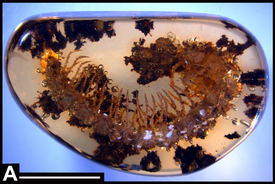
Extinct millipede Anbarrhacus adamantis in an amber sample |
| Scientific classification |
|---|
| No rank : | Bilateral symmetrical |
| Subtype : | Tracheo-breathing |
| Infraclass : | Helminthomorpha |
| Squadron : | Merochaeta Cook , 1895 |
| Gender: | † Anbarrhacus Riquelme & Hernández, 2014 |
| View: | † Anbarrhacus adamantis |
|
| International scientific name |
|---|
Anbarrhacus adamantis
Riquelme & Hernández, 2014 |
|
Anbarrhacus adamantis is described by a fossil sample found in the inclusion of a transparent piece of Mexican amber. Amber was found in Guadeloupe Victoria's quarry and was kept at the Institute of Anthropology and History in San Cristobal de La Casas ( Simohovel , Chiapas , Mexico ). The age of amber dates from 15 to 23 million years. Deposits formed in the ecosystem of mangrove forests on the banks of a river or stream [1] [2] [3] .
The holotype of the fossil millipede is an immature male [2] . It was studied by researchers from Independent University of Morelos State and described as a new genus and species in 2014 . The name of the genus Anbarrhacus is a combination of the Arabic word ánbar , meaning amber , and the suffix -rhacus , used for genera of the family Platyrhacidae. The specific name adamantis is from lat. adamantus ( diamond ) in connection with the characteristics of the body and tergites of this species [2] .
In addition to A. adamantis , two more species of fossil centipedes were described by representatives found in Mexican amber: Maatidesmus paachtun and Parastemmiulus elektron [1] [2] .
Head and antennae
A. adamantis Male A. adamantis creamy white with a yellowish tinge on the upper lip and legs. Yellowish to brown sternite. Body length - 19.8 mm. The body includes 17 segments and a head. The head is slightly wider than the next segment (callum). Antennals consist of 7 antenna meters. Antennomer 5 is the longest, and 1 and 7 are the shortest. Antenomeres 5 and 6 have long sets (hairs) at the apical end. Antennels retained 4 sensitive cones. The upper plates of the segments are strongly divided by grooves, forming metatergites and paranoids, and the lateral sides of metatergites have a characteristic granular texture and metatergites have a rhomboid texture. Segments expand from 1 to ⅔ of the body, then taper to segment 17. The male is relatively mature and has developed onion-shaped gonopods on the 7th segment [2] .
