Sahaliyania (lat.) Is a genus of herbivorous ornithopod dinosaurs of the hadrosaurids family from the Upper Cretaceous of Asia . The typical and only species Sahaliyania elunchunorum was named and described by the Belgian paleontologist Pascal Godfroix and colleagues in 2008. The generic name is formed from the Manchu "Sahaliyan", which means "black" and refers to the Manchu name of the Amur River - "Sahaliyan Ula". The species name refers to the name of the small Orochona people living in northern China near the city of Ulag , where dinosaur remains were discovered [1] .
| † Sahaliyania |
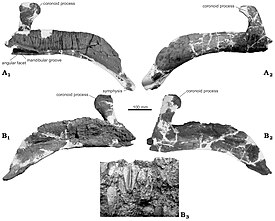
Lower jaw and teeth |
| Scientific classification |
|---|
| No rank : | Bilateral symmetrical |
| Infraclass : | Archosauromorphs |
| No rank : | Archosauriformes |
| Infrastructure : | † Ornithopods |
| Parvotryad : | † Iguanodonts |
| Superfamily : | † Hadrosavroids |
|
| International scientific name |
|---|
Sahaliyania
Godefroit et al. , 2008 |
| Single view |
|---|
† Sahaliyania elunchunorum
Godefroit et al. , 2008 |
Geochronology70.6–66.0 Ma | million years | Period | Era | Aeon |
|---|
| 2,588 | Even | | | Ka | F
but
n
e
R
about
s
about
th | | 23.03 | Neogene | | 66.0 | Paleogen | | 145.5 | a piece of chalk | M
e
s
about
s
about
th | | 199.6 | Yura | | 251 | Triassic | | 299 | Permian | P
but
l
e
about
s
about
th | | 359.2 | Carbon | | 416 | Devonian | | 443.7 | Silur | | 488.3 | Ordovician | | 542 | Cambrian | | 4570 | Precambrian |
◄ Nowadays◄ Cretaceous-Paleogene extinction◄ Triassic extinction◄ Mass Permian Extinction◄ Devonian extinction◄ Ordovician-Silurian extinction◄ Cambrian explosion |
|---|
|
Content
Zygomatic, jaw and square bones
Several hundred scattered bones were found in a large quarry near the city of Ulag, Heilongjiang Province, China, dated Maastricht , about 70-66 million years ago, the Yuliangze formation . More than 80% of the bones belong to the lambeosaurine hadrosaurus, named by the paleontologists Sahaliyania . The holotype GMH W453 consists of a partial skull (brain box). In addition, numerous individual bone specimens associated with Sahaliyania were found : zygomatic, jaw, square, tooth bones, shoulder blades, sternum, humerus, ilium, sciatic and pubic bones [1] .
Sahaliyania is diagnosed by the following symptoms: the paroccipital processes are long, very thin, with a slightly convex dorsal border and a concave ventral; lateral depressions on the dorsal surface of the frontal bone are better developed than other lambeosaurins and are not connected with the median elevation of the bone; the square-zygomatic notch of the square bone is displaced ventrally; the middle of the notch is significantly lower than the middle of the height of the square bone; the prefrontal plate is always more dilated dorsally than ventrally.
Sahaliyania differs from charonosaurus , olorotitan , parasavrolophus and corytosaurus by a significant ventral displacement of the rostral part of the dental bone, which forms an angle of about 30 degrees to the axis of the caudal part of the bone; Sahaliyania differs from the amurosaurus in the symmetrical pterygoid process of the basisphenoid, wider than long frontal bones and a well-developed protrusion of the jawbone; differs from the charonosaurus and parasavrolophus by a short rostral platform of the frontal bone; differs from olorotitan in the form of a rounded rostral process of the zygomatic bone, an even ventral margin of the jawbone and an elongated preclavicular process of the ilium (the ratio of the length of the ilium to the length of the preclavicular process = 2.1); differs from a cytosaurus in the presence of a rostral platform on the frontal bone, and also in that the median branch of the scaly bone is located below the paroccipital process [1] .
To determine the phylogenetic position of Sahaliyania , 56 cranial, dental, and postcranial characters were used for 21 taxa. As the external group, the non- hadrosaurid hadrosaroid Bactrosaurus johnsoni was selected. The 7 most economical trees were obtained, on the basis of which a tree of strict consensus was built:
|
| Bactrosaurus |
| | Hadrosauridae | | Hadrosaurinae |
| Wulagasaurus |
|
|
|
|
| Maiasaura |
|
| Brachylophosaurus |
|
|
|
|
| Gryposaurus |
|
|
|
| Kerberosaurus |
|
|
| Prosaurolophus |
|
| Saaurolophus |
|
|
|
|
|
| |
|
|
|
|
|
|
|
|
|
|
| | Lambeosaurinae |
|
| Aralosaurus |
|
|
| Tsintaosaurus |
|
|
| Jaxartosaurus |
|
|
| Amurosaurus |
|
|
|
|
| Corythosaurus |
|
| Hypacrosaurus |
|
| Olorotitan |
|
|
|
| Lambeosaurus |
|
|
|
|
| Parasaurolophus |
|
| Charonosaurus |
|
|
|
| Sahaliyania |
|
|
|
|
|
|
|
|
|
|
|
|
|
|
|
|
|
Sahaliyania can be considered an advanced lambaeosaurine . The dinosaur forms a monophyletic group with clades of the coritosaurus and parasavrolophus. This group is characterized by the following unique features: a shortened frontal bone with a ratio of “its length to maximum width” less than 0.6 and 42–45 teeth in a row on the dentary. However, the position of Sahaliyania in this group cannot be firmly established. For a more accurate determination of the phylogenetic position of a dinosaur, the detection of more complete specimens with the presence of a cranial crest is required [1] .
Numerous other phylogenetic studies, in particular, Prieto-Márquez 2010ab, Xing et al., 2012, show that Sahaliyania forms a treasure with the amurosaurus. Cladogram based on research by Xing et al., 2012 [2] :
| Hadrosauridae | | Hadrosaurinae |
|
| Wulagasaurus |
|
|
| Brachylophosaurus |
|
| Maiasaura |
|
|
|
|
|
|
| |
|
|
|
| Shantungosaurus |
|
| Edmontosaurus |
|
|
|
|
| Kerberosaurus |
|
|
| Prosaurolophus |
|
| Saaurolophus |
|
|
|
|
|
|
|
|
|
|
| | Lambeosaurinae |
| Aralosaurus |
|
|
|
| Tsintaosaurus |
|
| Pararhabdodon |
|
|
|
|
| Jaxartosaurus |
|
|
| Parasaurolophus |
|
|
| |
|
|
| Lambeosaurus |
|
|
| Velafrons |
|
| Olorotitan |
|
| Nipponosaurus |
|
| Hypacrosaurus |
|
| Corythosaurus |
|
|
|
|
|
|
|
|
|
|
|
|
|
|
|
|
|
- ↑ 1 2 3 4 Godefroit, Pascal; Hai Shulin; Yu Tingxiang; Lauters, Pascaline (2008). "New hadrosaurid dinosaurs from the uppermost Cretaceous of north-eastern China." Acta Palaeontologica Polonica 53 (1): 47–74. doi: 10.4202 / app.2008.0103.
- ↑ Xing, Hai; Prieto-Marquez, Albert; Gu Wei; Yu Tingxiang (2012). "Reevaluation and phylogenetic analysis of the hadrosaurine dinosaur Wulagasaurus dongi from the Maastrichtian of northeast China." Vertebrata PalAsiatica 50 (2): 160–169.
