Camel thorn , or dzhantak , or yantak ( lat. Alhági ) - genus of plants of the legume family, growing in deserts . The root system in the desert helps the camel thorn to grow up to 20 meters deep [2] . Camel thorn is one of the main pasture plants in the desert zone. The Persian camel thorn ( Alhagi persarum ) is rich in sugars , which in warm weather stand out from her on the stems in the form of manna , widely used in Iran and Afghanistan as a medicine and food product.
| Camel-thorn | |||||||||||||||||||||
 | |||||||||||||||||||||
| Scientific classification | |||||||||||||||||||||
|---|---|---|---|---|---|---|---|---|---|---|---|---|---|---|---|---|---|---|---|---|---|
| |||||||||||||||||||||
| International Scientific Name | |||||||||||||||||||||
Alhagi gagnebin | |||||||||||||||||||||
Content
Botanical description
Thorny shrubs , rarely herbaceous perennial plants with deep penetrating root system. Plants 30-100 cm tall.
The root is long, with deep horizontal branches.
Stems branched, woody at the bottom.
The spines, representing immature branches, in the axils of the leaves , are directed upwards at an acute angle, 2-3 cm long. The leaves are simple whole, alternate, oblong, obtuse, 1-2 cm long. Stipules small, awl-shaped.
Flowers on the thorn three to eight, red or pink, typical moth structure : calyx bell-shaped, with five small, almost equal teeth; the sail is back ovoid, bent back, a little notched above; wings are oblong, shorter than boats or equal to it; the boat is dull, shorter than the sail. Double-bodied stamens (nine accrete and one free). It blooms from May to late autumn, the fruits begin to ripen from July.
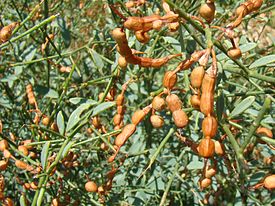
Single-leaved beans , linear, almost woody, rolled, unopened, improperly constricted or kidney-shaped, slightly curved or straight, bare, with four to five bud-like or almost square seeds .
Habitats
It is found in the south of the European part of Russia and Western Siberia , in Kazakhstan and Central Asia , in the Caucasus .
It grows in dry steppes , clayey and gravelly semi-deserts and deserts, along the banks of rivers and canals , on vacant lots and fallow lands .
Chemical Composition
The grass contains flavonoids , saponins , sugars , tannins , vitamins C , K and group B, carotene , ursolic acid , traces of alkaloids , essential oil , coloring agents, resins .
Economic value and application
In medicine, the above-ground part (grass) of camel's thorn is used, less often fruits and roots. The grass is dried under a canopy, previously crushed.
In folk medicine, as a diuretic and diaphoretic, an infusion or a decoction from the herb of the plant is used. Sometimes they are drunk to alleviate cough for colds. More often, infusions, decoctions or fresh juice are used for gastrointestinal diseases, mainly for chronic diarrhea and dysentery . Extractions from the aerial part of the camel's thorn have an antimicrobial effect, and they have a pronounced bactericidal effect on streptococci , staphylococci , and dysenteric bacilli . Broths are successfully used in the form of gargling with acute angina . Sometimes a decoction of camel thorn in folk medicine is used to treat hemorrhoids (baths, washing), for external treatment of eczema , pustules , festering wounds and ulcers (washing, compresses ).
In clinical conditions, decoction of patients with colitis , dysentery, used for gastric ulcer and gastritis , liver diseases such as choleretic, astringent, sometimes prescribed for colds and excessive cough.
All types of camel spines are good, highly nutritious forage plants. Their above-ground parts, especially when young, are rich in vitamin C, which, taking into account the nutritional properties of the leaves and especially their sugar content, allows them to be considered as a valuable vitamin product [3] .
In the hot season, the camel-thorn releases “manna” (a sugary flavoring agent), which is widely used in Iran and Afghanistan as a medicine and food product [3] . "Manna" is used as a diuretic and antipyretic agent, as well as with a dry cough.
Types
According to The Plant List , the genus includes 7 species [4] :
- Alhagi canescens ( Regel ) B. Keller & Shap. - Camel thorn gray , or yantak grayish
- Alhagi graecorum Boiss.
- Alhagi kirghisorum Schrenk - Kyrgyz Camel Thorn , or Kyrgyz Yantak
- Alhagi maurorum Medik.
- Alhagi nepalensis ( D.Don ) Shap.
- Alhagi pseudalhagi ( M.Bieb. ) Desv. ex B.Keller & Shap. - Camel thorn , or false camel thorn
- Alhagi sparsifolia Shap. - Camel thorny rhizolistny , or yanktak friable
Notes
- ↑ About the conditionality of specifying the class of dicotyledons as a higher taxon for the group of plants described in this article, see the section “APG Systems” of the article “Dicotyledons” .
- ↑ Camel thorn. Biological dictionary
- ↑ 1 2 Encyclopedic dictionary of medicinal, essential oil and poisonous plants / Comp. G. S. Ogolevets. - M .: Selkhozgiz, 1951. - p. 58. - 584 p.
- ↑ Alhagi (English) . The Plant List . Version 1.1. (2013). The date of appeal is September 26, 2016.
Literature
Links
- Camel thorn // Great Soviet Encyclopedia : [in 30 t.] / Gl. ed. A. M. Prokhorov . - 3rd ed. - M .: Soviet Encyclopedia, 1969-1978.