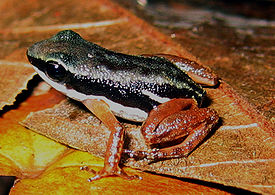
Silverstoneia flotator (lat.) - a species of tailless amphibians from the family of woodpeckers . The taxonomy of a species is subject to revision and refinement, since it may include several different species [1] . There may be sympathy between these frogs and slender tree frogs ( C. nubicola ), including with the participation of not yet discovered local species.
| Silverstoneia flotator |
 |
| Scientific classification |
|---|
| No rank : | Bilateral symmetrical |
| Squad: | Tailless Amphibians |
| View: | Silverstoneia flotator |
|
| International scientific name |
|---|
Silverstoneia flotator ( Dunn , 1931) |
| Synonyms |
|---|
- according to IUCN [1] :
- Phyllobates flotator Dunn, 1931
- Colostethus flotator (Dunn, 1931)
|
| Security status |
|---|
Least ConcernedIUCN 3.1 Least Concern : 55082 |
|
Content
Males from 12.8 to 17.6 mm long, females from 13.9 to 18.3 mm [2] . These frogs have a white abdomen, gray throat (in males), the rest is dark in color, highly variable within the species or, possibly, species. The structure of the body is fragile, the structure of the limbs is characteristic.
Frogs are active in all seasons, but in dry concentrate along the banks of rivers. They are capable of powerful jumps, which is reflected in the English name - rainforest rocket frog , that is, a rocket frog of rain forests . Mating takes place in forest litter. Caviar is attached to the leaves. Tadpoles with a length of 9 mm develop in forest rivers, where they are carried on the backs of male frogs. Their oral disc is specially adapted for nutrition from the surface of the water. With it, a tadpole can absorb water and stick to stones. Adults are found in forests and on stones in rivers. Males voice, croaking during the day, especially after rains, the sounds made should warn competitors that the territory is occupied by them. If the stranger ignores the warning, the males fight, as a result, the stronger one sits on the loser, pressing him to the ground. Frogs feed on insects and their larvae .
These frogs live in Panama and Costa Rica , preferring moist lowlands. Reports of their discovery in Colombia have not been confirmed [1] . The range of Colostethus flotator is highly fragmented; its southern border has not been reliably established. The species belongs to the widespread and least threatened, although it is believed that it can suffer from deforestation, urbanization and destruction of the habitat .
- ↑ 1 2 3 Silverstoneia flotator . The IUCN Red List of Threatened Species .
- ↑ Grant & Myers, 2013: Review of the frog genus Silverstoneia, with descriptions of five new species from the Colombian Chocó (Dendrobatidae, Colostethinae). American Museum novitates, n ° 3784, p. 1-58 ( texte intégral )