Kopievsky (Kopyevich) [1] Ilya (Eliash) Fedorovich ( Belorussian. Kapievich Ilya Fedaravich ) (c. 1651 - September 23, 1714 ) - enlightener , publisher , translator , poet , writer .
| Ilya Fedorovich Kopievsky | |
|---|---|
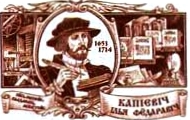 Drawing from the envelope of Belposhta 2001. | |
| Date of Birth | |
| Place of Birth | |
| Date of death | |
| A place of death | |
| Occupation | publisher , translator , writer , poet |
The name of Ilya Kopievich is one of the streets of Minsk .
Content
- 1 Origin and biography
- 2 Printing house of Kopievsky
- 3 Editions of Kopievsky
- 3.1 Publications of the Tessing Printing House
- 3.2 Editions of Kopievsky’s own printing house
- 3.3 Unpublished works
- 4 Role in creating a civil font
- 5 notes
- 6 Literature
- 7 References
Origin and biography
Ilya Kopievsky is a native of the Grand Duchy of Lithuania , according to various versions, was born near the city of Lyakhovichi (modern Brest region, Belarus) or near Mstislavl (possibly in the village of Lyakhovichi, Shumyachsky district, Smolensk region of Russia). Father is a petty gentry of the Protestant religion. During the Russo-Polish war, the child was captured:
Yeghda Khovansky, the great hetman, walk near Lyakhovichi with a military force, then the boyar’s son from Bezhetskiy piatiny against the punishment of the great sovereign me small, in the ninth year, stole and brought with him.
- Cit. according to G. Profit. For worldwide benefit
At first he lived in Novgorod , then, having escaped from the boyar, lived under the auspices of Alexei Mikhailovich and studied at a school in Moscow , was released to his homeland with the Mstislav voivode Tsekhanovetsky who arrived there. However, at the time of his return, his family’s estate on charges of heresy and treason was confiscated by the Polish king Jan Casimir in favor of the Jesuits . The reason for suspicions was, obviously, that during the war the family was under the auspices of the Russian tsar, and Prince Khovansky ordered the Fedor Kopievsky's house to be protected from ruin by putting a guard and a trumpeter on it.
A native of a Protestant family, he received his education at the Slutsk Calvinist gymnasium, founded in 1617 by Prince Janusz Radziwill , who professed Calvinism. In 1674 he was appointed a lecturer (teacher of the lower grades) of this gymnasium.
How and when he got to Amsterdam is also unknown, but by the time the Great Embassy of Peter arrived there (that is, by 1697 ) he was already living in Amsterdam and was a candidate for pastor . Traditionally, his studies in Holland are also reported; however, where, when and what he studied is unknown. Perhaps his studies were somehow connected with publishing.
In 1699 - 1700, Kopievsky collaborated with the Dutch merchant Jan Tessing in the publication of Slavic books, but already in 1700 Kopievsky opened his own printing house in Amsterdam.
In parallel with publishing, he gave lessons in foreign languages, grammar and navigation to young Russians arriving on instruction from Peter in Amsterdam to study. Among his students were O. I. Shcherbatov, S. A. Saltykov, the Georgian Tsarevich Archil and others.
Kopievsky actively worked on books, but the printing house did not go well: books in Russian did not diverge in the Netherlands, and it was impossible to sell them in Russia, since only Jan Tessing had the privilege for such trade [2] . In the years 1700-1701 Kopievsky received the privilege of the Dutch general states and the support of Jan de Jong. At this time, he published his books in the printing house of Abraham Bremen. However, the collaboration was unsuccessful and culminated in a rupture and trial.
In 1703, Kopievsky left Amsterdam, in 1703-1706 he lived in Danzig and Helm . He did not abandon attempts to establish his own printing house in Copenhagen and Halle .
In 1706, in the suburb of Danzig Stolzenberg in the printing house of H.-F. Goltsa Kopievsky published "A Guide to Grammar into the Slavonic Russian" ( lat. Manuductio in grammaticam in sclavonico Rosseanam seu Moscoviticam ).
Kopievsky came to Russia , where he received 50 efimkov from the imperial chancellery to purchase books abroad. However, the idea of becoming a book-selling agent of Peter failed: in Danzig he managed to buy only one book (Brown's “Artillery”), and on the way back to Russia he, according to him, was robbed by Cossacks .
Kopievsky and his daughter went to Warsaw , where he was seconded to Jacob Bruce before determining:
And I’m living with her daughter, my ninth month, with a lot of need, and it’s not possible for me to be in a campaign when I’m old, unless your lordly tsarist Majesty decides to determine where I am to be where ... I live by now for nothing ... let your dominion in determining my cause to be for old age in a place other than the local campaign, and that your highest and most generous mercy to perfection be a deed and your Majesty a salary determined.
... Bruce wrote to Peter that Kopievsky was living with him without any business, since he was not skilled in German, and it would be better for him to translate Polish chronicles or geometrical books, “for the sake of whether it would be better to send him to Gavril Ivanovich ( Golovkin , the head of the embassy Chancellery), but I don’t need it. ”
In Moscow , where he was sent to G.I. Golovkin, Kopievsky acted as translator of the Ambassadorial order . After 1708 there is no information about him; according to some versions, he died on September 23, 1714 .
Kopievsky spoke Polish , Russian , Belarusian , Dutch , German , Greek and Latin .
Kopievsky Printing House
In 1701 , Kopievsky became the owner of his own printing house, which consisted of several sets of punsons and matrices . In June-November 1702 , Kopievsky offered to buy his printing house to the Royal Prussian Society of Sciences in Berlin , but the deal did not take place; in 1703, Kopievsky moved to Danzig ( Gdansk ). The publication of “Guide to Grammar” in 1706 was produced by Kopievsky’s own types at the printing press of H. F. Goltz.
After some time, the Kopievsky printing house became part of the printing house of Pavel Pater ( Latin Paulus Pater ). Even before Kopievsky’s departure from Danzig, they tried to jointly print calendars for Russia. Although Pater’s printing house was organized in 1704, its operation began only in 1711. Pater printed books in German and Polish, he did not have Russian publications.
There is a hypothesis that in 1708 the printing house of Kopievsky, left in Danzig, was captured by the Swedes during the Northern War and was subsequently used to print leaflets and proclamations addressed to the Slavic population, in particular, “The manifesto of the military commissioner of October 8, 1708 . "And" Universal of Charles XII ". Kopievsky himself in a petition of 1710 reports that he was robbed by the Swedish army on the road from Gdansk.
Against the version with the capture of the printing house by the Swedes, the fact that the Swedes at the same time were actively, but unsuccessfully trying to acquire a Russian printing house for the publication of Sparvenfeld's dictionary testifies. In addition, the fate of the printing house is known.
In 1721 , part of the Pater printing house (including punches and matrices of the Kopievsky printing house) was acquired by the royal secretary, Quintilian Vasily Kvasovsky from Korvenov; in 1727 in Königsberg he printed Kopievsky’s fonts “Greek, Roman and Jewish calendar” [3] .
In the mid-1730s, the Kopievsky printing house was discovered at the University of Halle ( Germany ), where in the circle of Gallic pietists under the leadership of August Franke and his students there was an active work on the translation and publication in Slavic of important theological works of pietism. At this time, there were published, in particular, translations of Simon (Todorsky) : “Four books on true Christianity” by John Arntd (Halle, 1735), “The Beginning of the Christian Doctrine” by A. G. Franke (Halle, 1735) and others.
However, D. Chizhevsky points out the differences between the printed font of the Halle printing house and the fonts of the Kopievsky publications:
As far as we can judge the font of Kopievich’s publications (according to several originals and reproductions of title pages), they are in no way similar to the Gallic font. Therefore, as we already noted, the Slavic font for the Gallic printing house was prepared already at the beginning of the 18th century, when the Kopievsky printing house still existed, and was not purchased shortly before 1735. It can be assumed that the fonts were cut specifically for Halle and that they served as a model, most likely, various Cyrillic South Slavic editions of the 16th century, possibly editions of the Venetian or Tubing editions of Primus Trubar .
Original text (in Ukrainian)Poskilki can be judged about the typeface of the copy of Kvіnvich (for the number of originals and for reproductions of the title pages), it’s not possible to guess the Gallic font. For the sake of miracles, the word ян Yansky font for the Gallic drukarno bulo was also prepared on the cob of the 18th viku, if Kopієvic’s drunk was still there, but not bought a shorter hour before 1735. You need to read and write fonts for special use They used to be seen at once better than the Russian Cyrillic and English words of the 16th century, and the May of the 12th century, but the Tyubin of the Primus Trubar.D. Chizhevsky. Ukrainian friends in Gallє // Ukrainian Book of Books Library. Krakiv-Lviv, 1943. P. 19.
The further fate of the Kopievsky printing house is unknown.
Kopievsky Editions
Initially, Kopievsky composed and edited books in Russian , published in the printing house of Jan Tessing, who did not know this language. Peter also commissioned Kopievsky to translate various foreign books.
There are 3 lists of books prepared and published by Kopievsky. All of them were compiled by him and are in the following documents:
- Petition addressed to Peter in 1699 - 23 books are listed;
- Appendix to the Latin Grammar 1700
- Appendix to the “Guide to Grammar” in 1706 - 25 books are listed, of which 12 items are marked as sent to Russia.
Some books on these lists are marked as being in work or prepared for publication. 3 books from the list either were not preserved or were not printed. The circulation of publications is 2000-3000 copies each.
Tessing Printing Editions
In the Tessing printing house with the participation of Kopievsky, the following were published:
- A brief introduction to all history, according to the historical order from the creation of the world, is clear and completely retired. - Amsterdam, 1699 .-- 67 p.
- The preparation and interpretation of the clear and zealous hefty red-like uprising of the circles of heaven. - Amsterdam, 1699. Brief tasks in astronomy.
- Brief and useful guidance in arithmetic. - Amsterdam, 1699. - 16 p.
- A brief collection of Leo the Peacemaker, the august Greek Caesar, showing military affairs training. - Amsterdam, 1700. - Per. I.F. Kopievsky.
- The parables of Essopova , in Latin and Russian ... with the appendix "Homer battle or battle of toads or frogs and mice . " - Amsterdam, 1700. - With the application of 48 prints .
- I.F. Kopievsky. The glory of the triumphs and banners of the victories of the brightest and most august sovereign and invincible great sovereign Tsar and Grand Duke Pyotr Alekseevich, all great and small and whitish Russian autocrats, is briefly written off by poets of poetry. - Amsterdam, 1700. - Poetic panegyric on the occasion of the conquest of Azov .
The only book published in the Tessing printing house after the departure of Kopievsky, as well as after the death of Tessing himself (1701), is “ Saints , or the Calendar ” (Amsterdam, 1702).
The font of the Tesing typography was smaller than the usual Moscow font; the shape of some letters was borrowed from the Latin alphabet , others from the classic printed half-mouth . The format of the books is in the eighth or fourth part of the sheet.
Publications of Kopievsky’s own printing company
In his own printing house Kopievsky in Amsterdam were published:
- I.F. Kopievsky. Latin grammar ( Latin Latina grammatica in usum scholarum celeberrimae gentis sclavonico-rosseanae adornata ). Amsterdam, 1700. - 499 pages, with parallel Latin and Slavic texts.
- I.F. Kopievsky. Lexicon in Latin, German and Russian ( lat. Nomenclator in lingua latina, germanica et russica ). - Amsterdam, 1700.
- A compilation from the Tacticon by Leo the Wise, with the addition of a compilation from the writings of the Polish historian S. Starovolsky “The device of the royal army”. Amsterdam, 1700.
- A book teaching marine navigation (Dutch textbook by Abraham de Graf). - Amsterdam, 1701. - Per. I.F. Kopievsky.
- Synopsis Innocent Gisel . Amsterdam, 1700. The translation is attributed to Kopievsky.
- The shortest guide to rhetoric and at the same time oratory. Amsterdam, 1700-1702.
- The book is political, or Politician-scientist and scientist-pious, transmitted by Polish verses. 1700-1702; edition is not preserved.
- I.F. Kopievsky. The heading of grammar in Slavic-Russian ( lat.Manuductio in grammaticam in sclavonico Rosseanam seu Moscoviticam ). - Danzig, 1706.
A new font was cast in the Kopievsky printing house, which differs from the Tessing printing house in the form of individual letters.
Kopievsky is often credited with publishing the famous collection “ Symbols and Emblem ” (Amsterdam, 1705), Kopievsky himself mentions this book in the list of books published by him. However, in fact, it was published in the printing house of Heinrich Wetstein. Perhaps Kopievsky created translations of mottos for symbols and emblems.
Unpublished works
Remained in the manuscripts:
- Translation into Russian of the Calvinist catechism . Manuscript of the Slavic Foundation of the University of Helsinki Library, SI.Ms.-0-11.
- Translation from Latin of “Books on the Warlike Case” of a Byzantine writer of the 10th century Leo the Wise. The translation was completed on July 15, 1698 and dedicated to Peter . The location of the manuscript is unknown.
- Translation of Carl Allard's pamphlet ( lat. Carlus Allard ) Beshoryving der Eerpoorten, in's grazvehage opgerecht ... ”(Amsterdam, 1691 ) about the English Revolution of 1688–1690 and the arrival of King William III of Orange in The Hague in the spring of 1691 . The end of the 1690s. Manuscript of the Slavic Foundation of the University of Helsinki Library, SI.Ms.-0-11.
Since the end of 1708, Kopievsky has been working on translations of “Introduction to European History” by S. Pufendorf , the book “On Virtue” by Horace , the book “Acts of Alexander the Great” by Quintius Curtius (BAN, compiled by the Petrovsky Gallery, No. 31), and the book “On the Military art "S. Starovolsky. He also composes a symphony to the Bible , translates the Catechism (RGADA, f. 138, No. 42).
Role in creating a civil font
There is a point of view according to which it is the font developed by Kopievsky that is the basis of the civil font adopted in 1710 by Peter:
... in 1707, Ilya Kopievich received an invitation to take part in the development of a new civil font, introduced by Peter I a year later and for a long time called in Russia "either Amsterdam letters, then civil, or Belarusian alphabet." The Cyrillic alphabet improved by Belarusians still lies at the heart of the alphabet of Russian, Belarusian, Bulgarian, Ukrainian, Macedonian and other languages.
- Yuri Rubashevsky [4]
However, this point of view does not find confirmation in the surviving sources on the history of the Peter's reform of the font. There are no documents on the invitation of Kopievsky and his participation in the work on the font (for example, work on the final sketches of the font is under the headquarters of Menshikov, in 1706 in Zholkva (near Lviv ), in 1707-1708 - in Mogilev [5] , and Kopievsky is at this time under Jacob Bruce in Warsaw, and then in Moscow). The very styles of the letters go back to Peter's sketches , processed by the engraver Kulenbach [6] .
At the same time, it is doubtless that Kopievsky’s Amsterdam experiments became an important part of the preparatory stage of the Petrine reform of the ABC.
Notes
- ↑ Both variants of the surname are used in documents and reference books, however, the Kopievsky form is given as a title in the dictionary entry in the Dictionary of Russian Writers of the 18th Century (St. Petersburg, 1999) and the Russian Biographical Dictionary by A. A. Polovtsov.
- ↑ In 1700, Tessing received a special letter from Peter on the printing of secular books in Russia and on their sale in Russia for a period of 15 years / Shitsgal A. Russian civil print. - M. , 1959. - S. 22.
- ↑ Bykova T.A., Gurevich M.M. Description of publications printed in Cyrillic 1698 - January 1725 M .; L. - S. 208.
- ↑ Some works explicitly state that the Kopievsky printing house was brought to Russia and became the ancestor of a new civil font ( see (inaccessible link) ), which contradicts the facts from the history of the printing house.
- ↑ Efimov V. The dramatic history of the Cyrillic alphabet. The great Petrovsky fracture.
- ↑ Shitsgal A. Russian civilian font. M., 1959. S. 27-31
Literature
- Pekarsky P.P. Science and literature under Peter the Great. 1862.T. I, vol. II.
- Durovič L., Sjöberg A. The oldest source of the paradigm of modern Russian literary language // Russian Linguistics 11 (1987). S.255-278. (Analysis of the fate of the Kopievsky printing house after his departure from Amsterdam)
- Chizhevsky D. Ukrainian Friends in Galle // Ukrainian Book Literature Library. Crack Lviv. 1943. (in Ukrainian).
- Shitsgal A. Russian civilian font. M., 1959.
- Nowak Z. Eliasz Kopiewski, polski autor, tłumacz, wydawca, drukarz świeckich książek dla Rosji w epoce wczesnego Oświecenia // Libri gedanensis. 1968 / 1969. No. 2-3.
- Winter E. Halle als Ausgangspunkt der deutschen Russlandskunde im 18. Jahrhundert. Berlin, 1953.
- Kuznetsova I. E. About the source of “The Nomenclator in Russian, Latin and German” by Ilya Kopievsky // Indo-European linguistics and classical philology. Readings on the memory of Professor Joseph Moiseevich Tronsky. St. Petersburg, 2009.S. 319-326.
Links
- Begunov Yu. K. Kopievsky Ilya Fedorovich / Dictionary of Russian writers of the 18th century. SPb., 1999.
- Russian Biographical Dictionary of A. A. Polovtsov. T. "Knapp - Küchelbecker". S. 245.
- Biography from the site Biography.ru
- G. Profit. For worldwide use (inaccessible link) (belor.)