The species was first scientifically described in 1896 as Raja aleutica [5] . The species epithet occurs at the geographical location of the capture of an individual designated by the holotype. The holotype is an 82 cm long immature male, caught off the coast of the Aleutian Islands at a depth of 148 m [6] .
These stingrays live in the northern part of the Pacific Ocean in the waters of Canada ( British Columbia ), Japan ( Honshu ), Russia (western and northern parts of the Sea of Okhotsk , Kamchatka , Kuril Islands , Magadan , Sakhalin ) and the USA ( Alaska , Aleutian Islands , California ) [ 3] . The Commander Islands are absent [7] . They are found on the continental shelf and in the upper part of the continental slope at a depth of 16 to 1602 m [4] , mainly between 300 and 500 [8] , according to other sources, 150–950 m [7] . Large individuals prefer to stay at a shallower depth, since there is an inverse correlation between the depth at which spotted slopes come in and their average weight [9] .
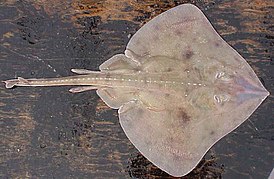
The broad and flat pectoral fins of these slopes form a rhombic disk with a wide triangular snout and rounded edges. On the ventral side of the disc are 5 gill slits, nostrils and mouth. There are lateral folds on the tail. These skates have 2 reduced dorsal fins and a reduced caudal fin [2] . The tail length is equal to or greater than the length of the disc. The length of the snout is 1/2 or longer from the tip of the snout to the fifth branchial fissure [10] . The distance between the eyes is about 4 times less than the length of the snout. The tail is fully covered with spikes. Large blade spikes are available. A continuous median row of spines runs along the disc and tail. The area in front of the mouth on the ventral surface of the disk is covered with small spines [7] .
The dorsal surface of the disc is even dark gray or dark brown in color, sometimes with implicit dark marks [7] . The ventral side of the disk is white, the edges are grayish [10] , sometimes dark spots with sharply defined edges are observed [7] .
Length and body weight have a high correlation [9] . The maximum recorded length is 161 cm and the weight is 23.1 kg [11] . In trawl catches, individuals are usually caught with an average body length of 75–91 cm and a weight of 4.6–5.4 kg [7] [12] . The average body weight is 4.43 kg [9] .
Embryos feed exclusively on yolk . The diameter of mature unfertilized eggs reaches 55 mm [7] . These stingrays lay eggs enclosed in a horn capsule with solid "horns" at the ends. The surface of the capsule is covered with small spines. The length of the capsule is about 12–13.6 cm (not including the terminal processes) [7] , and the width is 7.3–9.7 cm [3] [13] . The length of newborns is about 12-15 cm [14] . The Aleutian rays are likely to breed year-round, mainly in the summer-autumn period [12] . Life expectancy of males and females is estimated at 16 and 17 years, respectively (Bering Sea) and 18 and 19 years (Alaska) [3] [7] . Males and females reach puberty with a length of 108–116 cm and 112–133 cm at the age of 8–9 years and 9–10 years. The average length of sexually mature males and females is 113 cm and 125 cm, respectively [14] . The number of litters varies depending on the habitat: in the Bering Sea, females lay from 7 to 60 eggs, and in the Gulf of Alaska from 3 to 36. In the Bering Sea, spawning depth is approximately 250-500 m [3] . Among young animals, the number of females is slightly higher than males, and with the growth of fish, the sex ratio is leveled [9] .
These stingrays are benthoichtiophages; their diet mainly consists of crustaceans and, to a lesser extent, fish [15] [16] . Adult individuals prey on shear crabs, hermit crabs and shrimps , commander squids and octopuses , as well as large fish ( salmon , pollock , ruden liquids , northern one- rasp , sea slug ). They are able to feed on waste from fish processing vessels [8] . In pursuit of their prey, these slopes are able to rise into the water column and, if necessary, swim quite quickly [7] . Since the mouth of the rays is located on the ventral surface of the body, hunting for fish or squid, they first float on their prey, then press it to the bottom and swallow [12] . The mass of the daily diet of small individuals up to 50 cm long is 3.2–4.1% of body weight, while large ones are 1.5–0.9% [17] .
On the Aleutian rays, cestodes of Grillotia borealis parasitize [18] .
These ramps are not the target fishing target. At present, the domestic fishing industry practically does not use stingrays, while in Japan and in the countries of Southeast Asia they serve as objects of specialized fishing. The liver, whose mass is up to 8.8–9.6% of the body weight of Aleutian stingrays, is suitable for producing fat, which is less rich in vitamins compared to shark liver fat [7] . The abundance of deep-sea slopes in the Kamchatka waters is quite large. The bottom tiers are considered the most effective tool for their fishing [12] . The Aleutian stingray is the only species among the stingrays that live in the Kamchatka waters, which belongs to the “mass” category, since its frequency of occurrence in catches everywhere exceeds 50% [15] . According to the records of trawl surveys in the Kamchatka waters (1990–2000), the biomass of stingrays of the genus Bathyraja totals 118–120 thousand tons. With a capture rate of 20%, their potential catch is estimated at 20 thousand tons. Despite the fact that stingrays are constantly caught as by- catch in longline, trawl and snurrevodnoy fishing of cod , halibut and other bottom fish, their resources off the coast of Kamchatka today are not fully used [15] . The International Union for Conservation of Nature has assigned this species a conservation status of “Least Concerns” [3] .