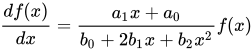
Depending on the distribution of the roots of the square trinomial {\ displaystyle b_ {0} + 2b_ {1} x + b_ {2} x ^ {2}}  There are 12 types of Pearson distributions. We denote {\ displaystyle D = b_ {0} b_ {2} -b_ {1} ^ {2}}
 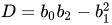 , {\ displaystyle \ lambda = {\ frac {b_ {1} ^ {2}} {b_ {0} b_ {2}}}}
  . [one]
Type I
Pearson Type I distributions are beta distributions. Conditions: {\ displaystyle D <0} , {\ displaystyle \ lambda <0} , {\ displaystyle b_ {0} + 2b_ {1} x + b_ {2} x ^ {2} = (\ alpha + x) (- \ beta + x) b_ {2}} , {\ displaystyle \ alpha, \ beta> 0} Probability Density: {\ displaystyle f (x) = {\ begin {cases} {\ frac {\ alpha ^ {2m} \ beta ^ {2n}} {(\ alpha + \ beta) ^ {m + n + 1} B (m + 1, n + 1)}} (\ alpha + x) ^ {m} (\ beta -x) ^ {n}, & x \ in [- \ alpha, \ beta] \\ 0, & x \ notin [- \ alpha, \ beta] \ end {cases}}} where {\ displaystyle B (m + 1, n + 1) = {\ frac {\ Gamma (m + 1) \ Gamma (n + 1)} {\ Gamma (m + n + 2)}}} , {\ displaystyle m> -1, n> -1} . [one]
Type II
Conditions as for type I with additional conditions {\ displaystyle \ alpha = \ beta, m = n} . [one]
Type III
Pearson type III distributions are gamma distributions. Conditions: {\ displaystyle D <0} , {\ displaystyle \ lambda = \ infty} , {\ displaystyle b_ {0} + 2b_ {1} x + b_ {2} x ^ {2} = 2 (\ alpha + x) b_ {1}} . Probability Density: {\ displaystyle f (x) = {\ begin {cases} {\ frac {k ^ {m + 1}} {\ Gamma (m + 1)}} (\ alpha + x) ^ {m} e ^ {- k (\ alpha + x)}, & x> - \ alpha, k> 0 \\ 0, & x \ leqslant - \ alpha \ end {cases}}} . [one]
Type IV
Conditions: {\ displaystyle D> 0} , {\ displaystyle 0 <\ lambda <1} , {\ displaystyle b_ {0} + 2b_ {1} x + b_ {2} x ^ {2} = (\ alpha ^ {2} + x ^ {2}) b_ {2}} . Probability Density: {\ displaystyle f (x) = c (\ alpha ^ {2} + x ^ {2}) ^ {- m} \ exp {- \ nu \ arctan {\ frac {x} {\ alpha}}}} , {\ displaystyle x \ in (- \ infty, \ infty)} , {\ displaystyle m \ geqslant {\ frac {1} {2}}} where {\ displaystyle c ^ {- 1} = \ int _ {- \ infty} ^ {\ infty} (\ alpha ^ {2} + x ^ {2}) ^ {- m} \ exp {- \ nu \ arctan {\ frac {x} {\ alpha}}} dx} . [3]
V type
Conditions: {\ displaystyle D = 0} , {\ displaystyle \ lambda = 1} , {\ displaystyle b_ {0} + 2b_ {1} x + b_ {2} x ^ {2} = (\ alpha + x) ^ {2} b_ {2}} . Probability Density: {\ displaystyle f (x) = {\ begin {cases} {\ frac {\ gamma ^ {m-1}} {\ Gamma {m-1}}} x ^ {- m} e ^ {- {\ frac {\ gamma} {x}}}, & \ gamma> 0, m> 1, x> 0 \\ 0, & x \ leqslant 0 \ end {cases}}} . [3]
VI type
Conditions: {\ displaystyle D <0} , {\ displaystyle \ lambda> 1} , {\ displaystyle b_ {0} + 2b_ {1} x + b_ {2} x ^ {2} = (\ alpha + x) (x- \ beta) b_ {2}} . Probability Density: {\ displaystyle f (x) = {\ begin {cases} {\ frac {(\ alpha + \ beta) ^ {- (m + n + 1)}} {B (-mn-1, n + 1)} } (x + \ alpha) ^ {m} (x- \ beta) ^ {n}, & x> \ beta, m-1> 0, n> -1 \\ 0, & x \ leqslant \ beta \ end {cases} }} . [3]
VII type
The Pearson type VII distribution is the student distribution. Conditions: {\ displaystyle D> 0} , {\ displaystyle \ lambda = 0} , {\ displaystyle b_ {0} + 2b_ {1} x + b_ {2} x ^ {2} = (\ alpha ^ {2} + x ^ {2}) b_ {2}} . Probability Density: {\ displaystyle f (x) = {\ frac {\ alpha} {B (m - {\ frac {1} {2}}, {\ frac {1} {2}})}} (\ alpha ^ {2 } + x ^ {2}) ^ {- m}} , {\ displaystyle x \ in (- \ infty, \ infty)} , {\ displaystyle m \ geqslant {\ frac {1} {2}}} . [3]
VIII type
Conditions: {\ displaystyle D <0} , {\ displaystyle \ lambda <0} , {\ displaystyle b_ {0} + 2b_ {1} x + b_ {2} x ^ {2} = x (x + \ alpha) b_ {2}} . Probability Density: {\ displaystyle f (x) = {\ begin {cases} {\ frac {m + 1} {\ alpha ^ {m + 1}}} (x + \ alpha) ^ {m}, & x \ in [- \ alpha , 0], - 1 <m <0 \\ 0, & x \ notin [- \ alpha, 0] \ end {cases}}} . [3]
IX type
Conditions: {\ displaystyle D <0} , {\ displaystyle \ lambda <0} , {\ displaystyle b_ {0} + 2b_ {1} x + b_ {2} x ^ {2} = x (x + \ alpha) b_ {2}} . Probability Density: {\ displaystyle f (x) = {\ begin {cases} {\ frac {m + 1} {\ alpha ^ {m + 1}}} (x + \ alpha) ^ {m}, & x \ in [- \ alpha , 0], m <-1 \\ 0, & x \ notin [- \ alpha, 0] \ end {cases}}} . [3]
X type
The Pearson type X distribution is an exponential distribution. Conditions: {\ displaystyle D = 0} , {\ displaystyle \ lambda = 0} , {\ displaystyle b_ {0} + 2b_ {1} x + b_ {2} x ^ {2} = b_ {0}} , {\ displaystyle a_ {1} = 0} . Probability Density: {\ displaystyle f (x) = {\ begin {cases} \ gamma e ^ {- \ gamma x}, & x> 0, \ gamma> 0 \\ 0, & x \ leqslant 0 \ end {cases}}} [2]
XI Type
The Pearson type XI distribution is the normal distribution. Conditions: {\ displaystyle D = 0} , {\ displaystyle \ lambda} vaguely {\ displaystyle b_ {0} + 2b_ {1} x + b_ {2} x ^ {2} = b_ {0}} . Probability Density: {\ displaystyle f (x) = {\ frac {1} {{\ sqrt {2 \ pi}} \ sigma}} \ exp {- {\ frac {x ^ {2}} {2 \ sigma ^ {2} }}}, x \ in (- \ infty, \ infty)} . [2]
XII type
Conditions as for type I with additional conditions {\ displaystyle \ alpha = \ beta, m = -n} . [one]



,
,
,
,
